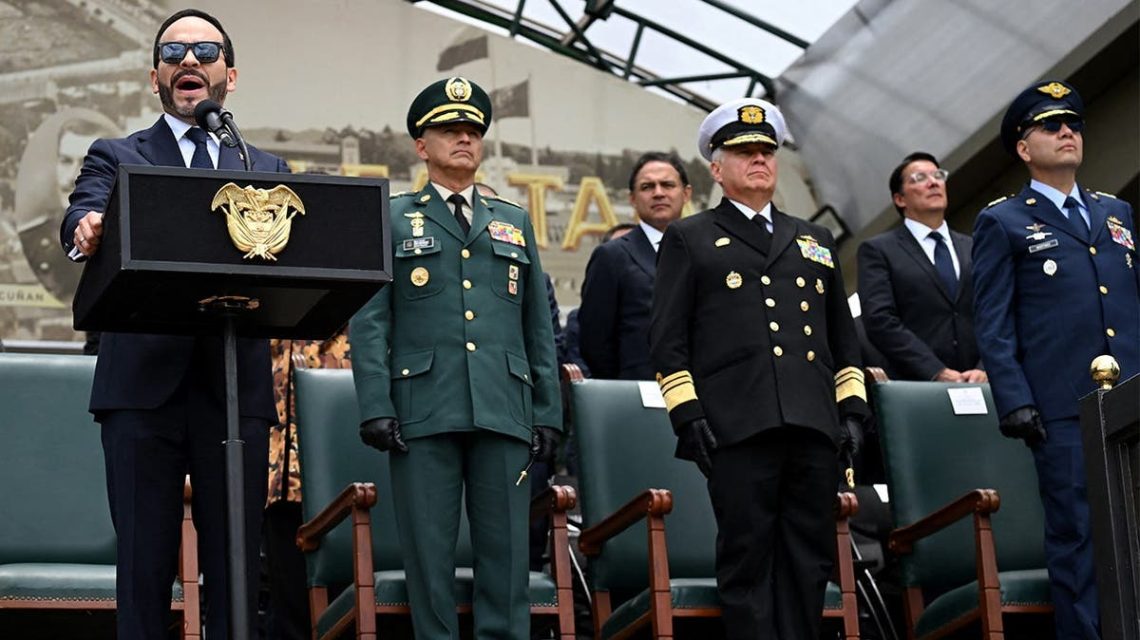
President Abelardo de la Espriella, known as ‘El Tigre,’ is taking strong measures against cartels in Colombia. He was elected on a platform focused on law and order, and his actions are showing positive effects both domestically and internationally.
Recently, de la Espriella participated in a significant raid in Barranquilla. In the early hours, 587 police officers and soldiers conducted simultaneous operations at 50 locations in the city and its surrounding areas. The operation, known as Blindaje 360, resulted in 72 arrests, including the gang leader nicknamed ‘Keko,’ who was openly defiant towards the president.
In a video released by de la Espriella’s office, Keko’s bravado turned to fear as he faced the president. This operation is part of a broader strategy reversing previous policies that advocated for peace talks with armed groups.
‘El Tigre,’ a hardline president, is determined to treat guerrillas, drug traffickers, and other criminal entities as terrorists. De la Espriella’s approach contrasts sharply with his predecessor Gustavo Petro’s ‘total peace’ policy, which sought negotiation with these groups.
De la Espriella’s administration, in collaboration with Washington, has seen over 32,000 arrests and the dismantling of 679 drug production sites. He has issued more than 100 extradition orders, including against individuals previously shielded by peace talks.
A notable aspect of de la Espriella’s strategy is his alliance with former U.S. President Donald Trump’s anti-cartel coalition. The collaboration reached a high point with the extradition of Geovany Andrés Rojas to the U.S., where he faces narco-terrorism charges.
Vice President José Manuel Restrepo emphasized that Colombian forces, not U.S. troops, will lead operations against armed groups, underscoring that the alliance is focused on security without external military intervention.
The bilateral cooperation builds upon historical U.S.-Colombian initiatives against organized crime and guerrilla warfare. Experts, while supportive, warn that flashy operations alone may not suffice to dismantle well-armed and funded groups thriving in areas with limited state presence.
Colombian scholar Oscar Palma notes that the success of the open war strategy remains debatable, as gangs are inclined to fiercely defend territories. He questions the effectiveness of total war or dialogue alone, advocating for a mixed approach, as demonstrated by previous dialogues combined with judicial actions.
The current strategy marks a new phase for Colombia and the region, according to Restrepo. He believes that the Shield of the Americas coalition presents significant opportunities to foster democracy and security.
 In-Flight Altercation on Qatar Airways Leads to Police and FBI Response
 Virginia Residents Sue Over Alleged Immigration Violations
 Updates on Key International and Domestic Events
 Pope Leo XIV Completes South American Tour with Farewell Mass in Peru
 President Trump’s Critical Asia Trip: Key Meetings and Implications
 U.S. Plans to Restrict AI Chip Exports Before Trump-Xi Meeting