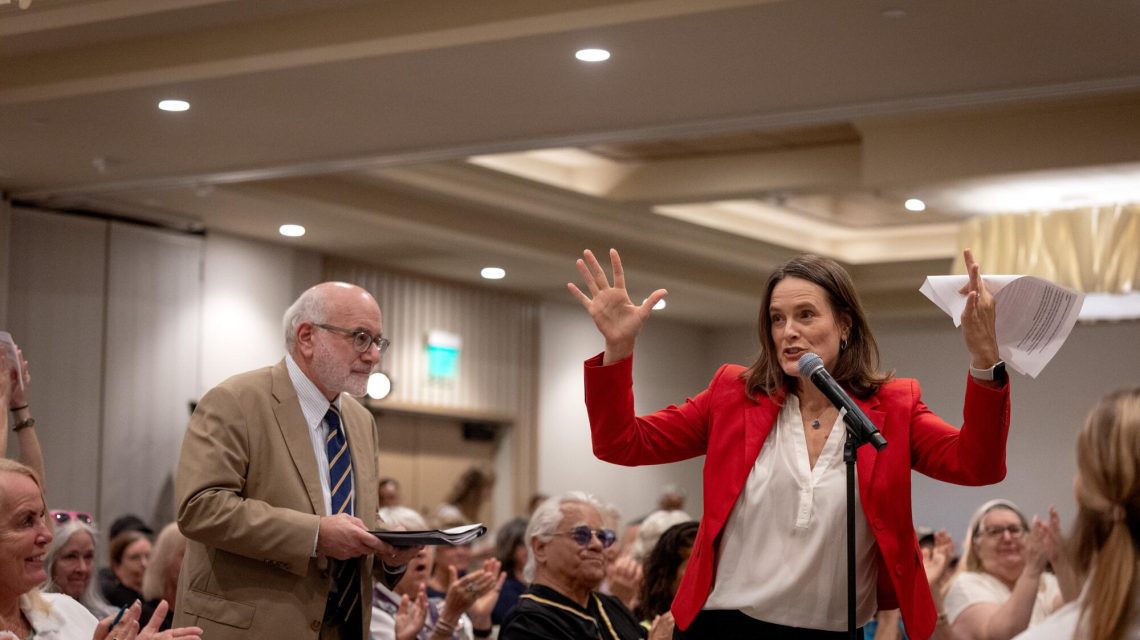
Hundreds of passionate Californians rallied in Santa Monica recently to oppose the Trump administration’s efforts to override local control of the state’s coastline. A diverse group, including environmental leaders, elected officials, businesses, community activists, Indigenous groups, and everyday citizens, participated in a public hearing. The hearing, organized by the National Oceanic and Atmospheric Administration’s (NOAA) Office of Coastal Management, focused on a significant investigation that might potentially strip California of its ability to reject federal projects.
The investigation, framed as a performance review of California’s coastal management practices, is viewed by some experts as a way to enable increased offshore oil drilling, more rocket launches, and potentially the construction of floating nuclear reactors. This move has sparked considerable concern about its implications, with worries that it might lead to similar actions in other coastal states.
“I’m scared, not because we haven’t built something worth protecting — we have. I’m scared because this meeting is performance theater. In some ways, the decision seems already made,” said Maureen Ellenberger, a Santa Barbara resident.
She expressed fears about the risk of another oil spill while maintaining her determination to voice her dissent. Many other speakers shared similar sentiments during the hearing.
Under the federal Coastal Zone Management Act (CZMA), coastal states like California have been able to review and object to projects in federal waters that conflict with state policy. Despite CZMA’s longstanding history as a cooperative framework, tensions have risen. This escalation followed U.S. Commerce Secretary Howard Lutnick’s accusations against California for obstructing spaceport development in bad faith.
Lutnick called for a new evaluation of California’s CZMA compliance, instructing NOAA to consider several factors, including offshore oil production, pipeline maintenance, desalination projects, and undersea cables. State officials, however, learned about this review through a social media post, fueling further suspicion.
California had recently undergone a routine review during the Biden administration, receiving high marks for its CZMA implementation. The sudden shift to a politically charged review process has caught many by surprise.
On Monday, the Lutnick-ordered review began with the only in-person hearing available during the public comment period. Attendees, including surfers, scientists, business owners, and others, voiced their concerns over several hours. Many held signs bearing messages such as “NO FEDERAL TAKEOVER” and “NO SELLOUTS FOR BIG OIL,” emphasizing their love for the California coast.
The hearing was punctuated with applause and emotional statements that underlined the importance of coastal access to Californians. “It was just example after example after example of how the state’s coastal management program is working,” said Jennifer Savage of Surfrider Foundation.
State leaders reiterated the CZMA’s role in fostering collaboration between federal and state governments. Kate Huckelbridge, executive director of the Coastal Commission, emphasized the need for a fair evaluation, expressing confidence in California’s track record.
“California has received very little information about why this new federal review is being undertaken. Still, we welcome a fair and transparent evaluation. Our record speaks for itself,” Huckelbridge stated.
Jack Ainsworth, a veteran of California’s Coastal Commission, criticized the review’s timing as “unprecedented” and “bizarre.” He noted California’s reputation as a leader in coastal management.
Experts suggest that if the review challenges California’s coastal management, the state should have opportunities to respond and discuss any proposed changes. The legal framework allows for multiple steps in this review process.
In a rally outside the hearing, environmentalists, Congress members, county supervisors, Indigenous leaders, and others gathered to amplify California’s collective voice. Toni Cordero, a former tribal chair of the Chumash Nation, stressed the cultural significance of the coast and its inhabitants, urging collaboration for their protection.
Wade Crowfoot, California’s natural resources secretary, assured the gathering of strong opposition to federal control over the state’s coast. “California’s coast is not for sale,” he asserted, reaffirming solidarity with diverse stakeholders.
 The Trump Team’s Challenge to the Military Leadership
  Maryland First State to Restrict Electronic Pricing in Grocery Stores
  Activists Push for Nationwide Ban on Child Marriage in the U.S.
  Democratic Hopes and Historical Warnings in 2026 Senate Race
  Republicans Face Challenges Amidst Cost of Living Concerns
  A Different Kind of Fall for Congress This Year