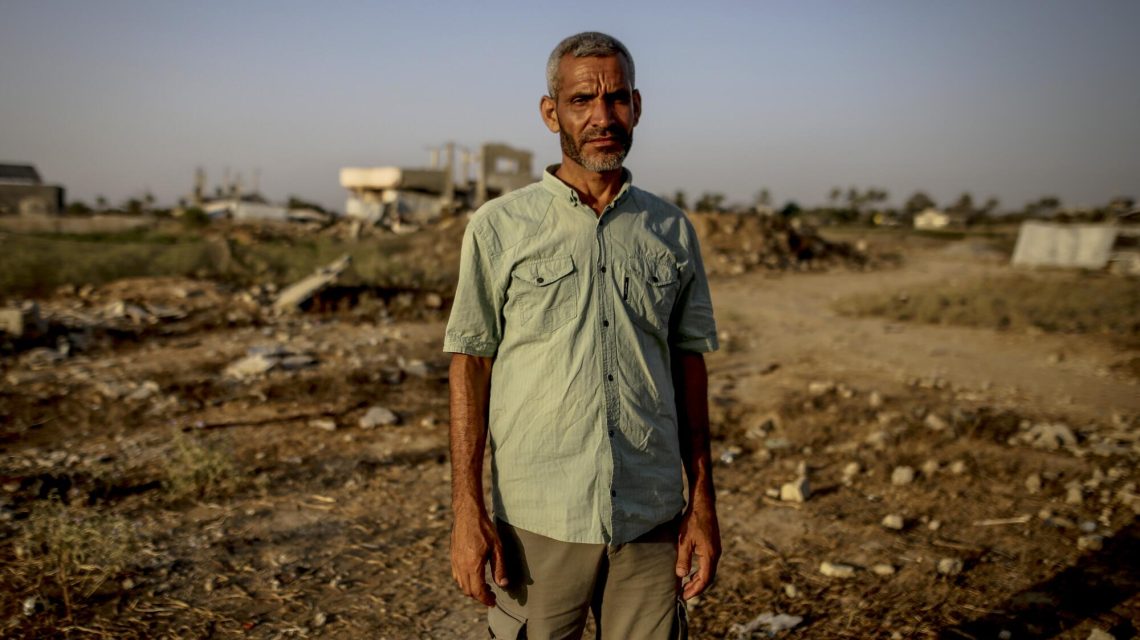
In Deir al Balah, Gaza Strip, Ashraf Al-Louh has been facing a harsh reality. For the past three months, the Yellow Line, marking the extent of Israel’s military zone in Gaza, has steadily encroached upon his home. Now it is a mere 100 yards away, compelling him to leave his shelter.
Many residents around him have already fled, joining the exodus from this beleaguered neighborhood. The Israeli military marks the expanding boundary with large yellow-painted blocks, gradually pushing the zone westward. As the line advances, it reshapes lives and communities in its path.
We’re exhausted. We’ve already been displaced seven times.
A donkey cart with elderly passengers, leaving behind their belongings in a mattress cover, moves past Al-Louh’s makeshift shelter. It is a stark reminder of the limited possessions that can be carried away, including only a few cans of beans and sacks of flour.
The Yellow Line emerged in October 2025 after a ceasefire between Israel and Hamas, brokered by the Trump administration. Although not recognized as a legal border internationally, the line divides Gaza into two zones: one under Israeli control and another under Palestinian administration. However, with the ceasefire’s progress stalled, Israel has gradually advanced the Yellow Line, further encroaching on Palestinian territories.
The consequences are dire, forcing thousands to abandon their homes and adding to Gaza’s crisis. A resident, Abu Miri, describes the Yellow Line’s impact:
The Yellow Line is a quiet thief. It stole my land, my work, and everything I spent my life building.
Initially, Israel occupied 53% of Gaza. Now, it claims 64%, not including a restricted Orange Zone where aid delivery requires coordination. These shifts push people like Al-Louh’s extended family closer to desperation, forcing them to live under precarious conditions.
Al-Louh emphasizes that the Yellow Line’s approach imposes a relentless schedule. “About a month ago, it was a kilometer away,” he says. Despite the shrinking safety, the line continues its forward march.
Venturing near the Yellow Line poses great danger. According to the U.N.’s Office for the Coordinator of Human Affairs, between the ceasefire and early April, 196 Palestinians, including women and children, have been killed by Israeli attacks in related areas. Israel claims these attacks are defensive measures against perceived threats.
Further west, farmers like Ahmed Al-Louh realize they have limited time to harvest their crops.
I’m working all day to get it all out of the ground before we can’t reach here anymore.
As sounds of gunfire echo, Ahmed recounts relocating his essential belongings with his wife to a safer location. Fearing being forced to flee instantly, he tries to make the most of limited time.
In recent developments, Hamas announced its intention to begin disarmament, provided Israel halts attacks and withdraws forces. Meanwhile, Israeli Prime Minister Benjamin Netanyahu stated Israel would not withdraw until complete disarmament by Hamas.
Satellite images reveal extensive earthworks and barriers along the Yellow Line, indicating a potential long-term presence rather than a temporary arrangement. Netanyahu hints at plans to further expand territory control.
We are now in 60% of the territory of the Gaza Strip. My directive is to move to — take it step by step.
The advance of the Yellow Line precedes systematically, from quadcopter warnings to eventual shooting and military movements. The pattern is all too familiar for families, forcing them to gather their belongings in haste before retreating further west.
For many, the Yellow Line means losing everything. Jamal Abu Miri, a retired land surveyor, watched as the line erased decades of labor and savings. Vegetable greenhouses, olive groves, date palms, and irrigation pools — all lost as bulldozers razed his property.
Al-Louh, who is unemployed, has prepared to move again. His tent, worn from previous relocations, might not survive another journey. Aid groups offer limited hope of acquiring another.
Awaiting the inevitable, Al-Louh reflects grimly on the yellow blocks that now delineate the borders of his world. Whatever happens, departure is certain.
 British Police Arrest Man Suspected of Terror Plot
  Activists Push for Nationwide Ban on Child Marriage in the U.S.
  Investigation into Alleged Incident at Cornell University
  Rising Drone Threats Highlight Vulnerabilities in Moldova’s Airspace Defense
  Bolivia Faces Security Test Amid Unrest
  Incident on FlyDubai Flight Raises Security Concerns