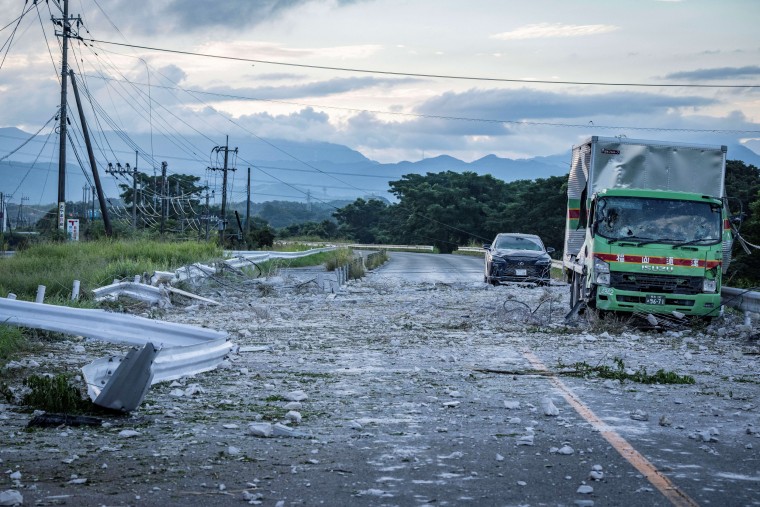
On July 29, 2026, a magnitude 7.1 earthquake struck southwestern Japan, resulting in the death of at least 13 people. Prime Minister Sanae Takaichi announced efforts to rescue survivors of building collapses at a shopping mall and a paper mill, emphasizing the urgency of the situation.
The earthquake occurred in Kumamoto prefecture on Kyushu, Japan’s southern main island, at a shallow depth of 6 miles. It triggered tsunami warnings, prompting evacuations from coastal areas. The epicenter was located about 12 miles south of Kumamoto City, home to roughly 700,000 residents. While the tsunami warning was lifted quickly, the earthquake caused extensive damage throughout the prefecture.
The quake damaged historic structures, including Kumamoto Castle, a site already under repair from a previous earthquake in 2016. Roads were ruptured, thousands of homes lost power, and officials warned residents of heat stroke risks due to high temperatures.
“Even now, there are people waiting to be rescued, and this is a race against time,” said Prime Minister Takaichi.
An explosion at the Aeon mall in Kashima left two women dead and prompted investigations into a possible gas leak. Four people remained missing with eight rescued from the rubble, according to mall officials.
Additionally, a collapsed chimney at a Nippon Paper Industries factory in Yatsushiro led to seven missing people. Thousands of soldiers joined rescue teams to aid the recovery efforts, while hospitals treated numerous injuries, including passengers from disrupted high-speed trains.
NHK reported a derailed freight train at Yatsushiro station, showing overturned carriages and collapsed pillars. Bullet trains and some airport operations were suspended, and 35,000 households were without power.
Japan’s meteorological agency warned of possible future earthquakes with similar intensity in the coming days. The nuclear reactors in the area appeared unharmed, with the Sendai nuclear power plant reported as undamaged.
The International Atomic Energy Agency continues monitoring the situation, noting Japan’s nuclear plants’ heightened scrutiny during earthquakes.
Japan, positioned on the “Ring of Fire,” is one of the world’s most earthquake-prone countries. Nearly 20% of global earthquakes measuring 6.0 or higher occur here, underscoring the nation’s vulnerability to seismic activity.
 British Police Arrest Man Suspected of Terror Plot
  Activists Push for Nationwide Ban on Child Marriage in the U.S.
  Investigation into Alleged Incident at Cornell University
  Rising Drone Threats Highlight Vulnerabilities in Moldova’s Airspace Defense
  Bolivia Faces Security Test Amid Unrest
  Incident on FlyDubai Flight Raises Security Concerns