Iran’s Revolutionary Guard Claims Attacks
Iran’s Revolutionary Guard announced a wave of strikes targeting U.S. military bases across the Middle East. These alleged attacks took place in Syria, Kuwait, Oman, Bahrain, and Jordan. However, there has been no confirmation from U.S. officials regarding any actual damage or impact from these claims. Iran’s forces have a history of exaggerating their reports.
The Guard claimed it executed a surprise assault on a U.S. special forces base in al-Tanf, Syria, destroying helicopters and causing casualties. Additionally, they reported launching surface-to-surface missiles at an American base in Kuwait, resulting in a massive fire.
Further assertions included destroying U.S. radar facilities on Oman’s Salamah Rocks in the Strait of Hormuz, targeting logistical support centers in Kuwait with drones, and striking a U.S. army base in Bahrain.
The IRGC also claimed damage in Jordan, including destruction of U.S. refueling aircraft and fighter jets and causing serious harm to more.
Despite these detailed claims, the U.S. military has not verified any of them. Kuwait’s Ministry of Electricity, Water, and Renewable Energy stated that Iranian strikes affected power and water desalination stations.
Meanwhile, Qatar reported a child injured due to shrapnel from an intercepted Iranian weapon.
Impact on the Strait of Hormuz Shipping
The breakdown of the U.S.-Iran ceasefire has led to significant hesitancy among ship crews to travel through the Strait of Hormuz. According to Dimitris Maniatis, CEO of Greek maritime risk management firm Marisks, this unease marks a return to the ‘worst case scenario’ for shipping in the region.
Maniatis explained during a briefing for Lloyd’s List intelligence group that previously trapped vessels in the Persian Gulf managed to exit during calmer conditions, but the recent events have reversed this situation.
There has been a marked decrease in transit through the strait and increased deadly attacks on commercial vessels since the ceasefire ended. As a result, crews are reluctant to navigate these waters regardless of promises made to them.
The renewed tension has caused oil prices to rise significantly. Brent crude, an international benchmark, increased by about 1% to approximately $85 per barrel. Similarly, U.S. benchmark oil rose to just under $80 per barrel.
U.S. Continues Military Strikes on Iran
U.S. Central Command confirmed another round of airstrikes in Iran early Friday morning. This represents the sixth consecutive night of U.S. strikes after the collapse of a ceasefire between the U.S. and Iran the previous week.
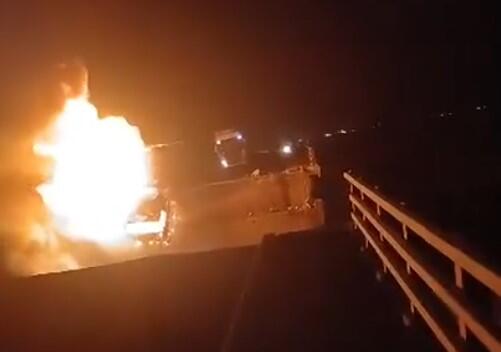
Amateur video from activist VahidOnline purportedly shows damage and fire on the Kahurestan Bridge following U.S. airstrikes in Iran’s southern Kahurestan province. While CBS News could not independently verify the footage, VahidOnline has previously shared reliable imagery from inside Iran.
According to CENTCOM, the strikes targeted dozens of Iranian sites, including coastal surveillance, air defense, and military logistics infrastructure. Fighter jets, aerial drones, and warships were used for these strikes.
CENTCOM reported that more than 50,000 U.S. military personnel are stationed across the Middle East.
Casualties and Damage in Iran
Iranian state media reported that U.S. strikes early Friday affected an airport, railway station, and bridges, causing three fatalities and injuring others. In Hormozgan province, a strike on two bridges killed three and wounded nine.
Three explosions were reported near Iranshahr airport in the southeast, hitting the site with projectiles. The Bandar Abbas Railway Junction Station was also targeted, resulting in two injuries.
Another U.S. strike wounded one person in the port city of Bushehr in western Iran.
Marines Intervene in Gulf of Oman
U.S. Marines boarded a commercial vessel in the Gulf of Oman as part of a naval blockade of Iranian ports reinstated by President Trump. CENTCOM reported that since the Tuesday blockade, three commercial vessels attempting to bypass it were redirected, and an oil tanker, M/T Belma, was disabled.
CENTCOM assured that the Strait of Hormuz and surrounding waters remain open except for those violating the blockade.
White House’s Position on Iran Talks
White House press secretary Karoline Leavitt avoided confirming whether President Trump believes peace talks with Iran are stalled or dead. She did affirm that the administration is still engaged in negotiations.
Leavitt highlighted that the continuous strikes this week are a direct consequence of Iran’s violation of the June memorandum of understanding. This agreement prohibited Iran from attacking commercial vessels in the Strait of Hormuz.
Leavitt emphasized that President Trump plans to ensure Iran faces consequences for its actions, viewing them as acts of terrorism.
 British Police Arrest Man Suspected of Terror Plot
  Activists Push for Nationwide Ban on Child Marriage in the U.S.
  Investigation into Alleged Incident at Cornell University
  Rising Drone Threats Highlight Vulnerabilities in Moldova’s Airspace Defense
  Bolivia Faces Security Test Amid Unrest
  Incident on FlyDubai Flight Raises Security Concerns