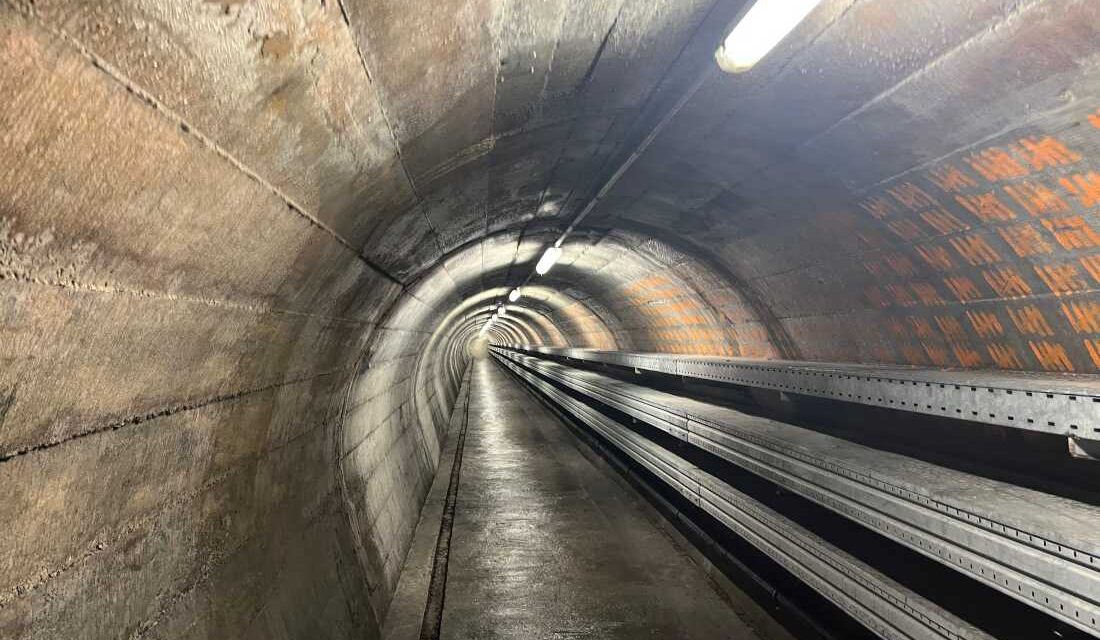
A tunnel from the entrance of the Sonnenberg nuclear bunker in Lucerne, Switzerland, descends into a vast underground complex. This bunker is recognized as the world’s largest underground nuclear shelter, designed to accommodate 20,000 people. Constructed during the 1970s amidst the Cold War, the bunker aimed to safeguard a significant portion of Lucerne’s population in the event of a nuclear conflict. Zora Schelbert, a guide for the Sonnenberg Bunker, explains the historical context and purpose of this imposing structure.
The entrance to the bunker, located quaintly in the center of a children’s playground, reveals a thick blast-proof door leading to a narrow, well-lit tunnel. Schelbert highlights that at the time of its construction, 20,000 people accounted for a third of Lucerne’s residents. This planning reflected concerns of the era, even for neutral Switzerland, which anticipated potential exposure to nuclear fallout from neighboring countries.
Switzerland provided the bunker with diesel-powered generators capable of sustaining operations for two weeks. During this period, basic utilities like water and power were assured. “After two weeks, resources would deplete,” notes Schelbert, aligning with the practical improvisation of Swiss civil defense strategies. As seen in ongoing conflicts such as those in Ukraine and Israel, the necessity for temporary shelter showcases the enduring relevance of such preparedness initiatives.
Despite the Cold War’s conclusion, Switzerland expanded its commitment to maintaining and building shelters. Over 370,000 nuclear shelters now promise protection to each of Switzerland’s nine million citizens. Daniel Jordi, vice director of Switzerland’s federal office of civil protection, recounts the 2011 parliamentary decision to retain these shelters. This decision followed Japan’s Fukushima disaster, reinforcing the idea that these shelters serve as an essential national reserve.
Swiss law requires residential buildings to integrate bunkers or contribute to nearby state-managed facilities. Residents pay an initial fee ranging from $1,700 to $3,500 for upkeep and construction. Interestingly, during peaceful times, many bunkers transform into alternative spaces such as wine cellars, saunas, or storage areas, like those found at the University of Bern.
Silvia Berger Ziauddin, a historian specializing in Switzerland’s bunkers, explains how these structures symbolize the country’s longstanding aspiration to be an “island of calm.” Originating during the World Wars, this metaphor has perpetuated across generations as a key element in Swiss security doctrine.
Swiss schools reinforce this notion through civil defense modules, where students actively engage with the concept of shelters. Ziauddin recounts classroom exercises where children mapped contrasting imagery — chaos above, safety below — nurturing perceptions of security within these underground sanctuaries.
Despite the shelters’ reassuring image, reality within a nuclear bunker could vastly differ. The Sonnenberg bunker’s facilities include a hospital ready for medical emergencies but limited in space for its intended population. The facility, once housing 20,000 people, saw its capacity reduced to accommodate only 2,000 by 2002, attributing to logistical challenges and socio-psychological concerns.
Over time, the Sonnenberg bunker has evolved, sometimes providing overflow housing for refugees and the homeless, a use met with criticism from concerned organizations. Although it has never been used for nuclear protection, the Swiss government invests millions annually to maintain this and other bunkers, embodying a steadfast commitment to national safety.
Contributions to this report were made by Esme Nicholson from Berlin.
 British Police Arrest Man Suspected of Terror Plot
  Activists Push for Nationwide Ban on Child Marriage in the U.S.
  Investigation into Alleged Incident at Cornell University
  Rising Drone Threats Highlight Vulnerabilities in Moldova’s Airspace Defense
  Bolivia Faces Security Test Amid Unrest
  Incident on FlyDubai Flight Raises Security Concerns