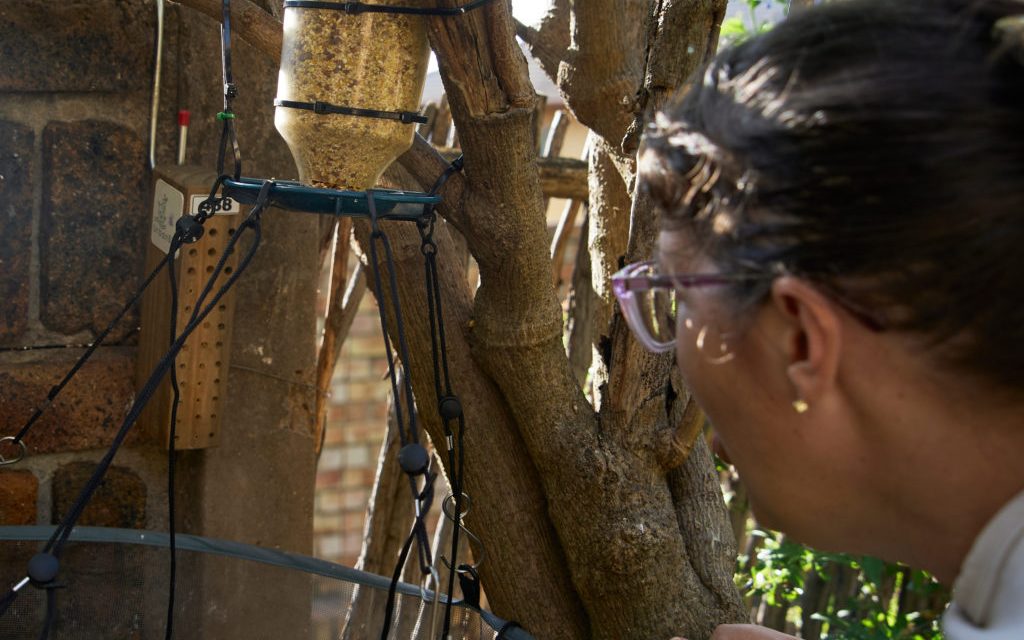
On a warm morning in Johannesburg, a solitary bee peeks outside one of the world’s smallest hotels. The bee quickly retreats back into a small hole drilled into untreated pine. This tiny guest is monitored by Celia Haupt, a Johannesburg banking analyst turned bee hotelier. Haupt is among the 510 volunteers across Johannesburg and Cape Town participating in a project monitoring solitary bees in urban settings. The initiative, known as UrbanBEE, explores how cities influence solitary bee diversity and aims to reconnect urban residents with nature through engagement with these pollinators.
Celia Haupt has observed her bee hotel for months and considers the bees like “little homebodies.” Despite their solitary nature, she finds the bees resemble “extroverted introverts.” She says, “They pop their heads out, and I feel like they’re chatting to me.” This project highlights the often-overlooked solitary bees, distinct from the more commonly known hive-dwelling honeybees.
Understanding Solitary Bees
Honeybees, which live in hives, are among the most studied insects globally. In contrast, solitary bees, which represent the majority of over 20,000 known bee species, are less understood. South Africa is home to about 1,300 bee species, many of which are solitary. These bees help pollinate both wild plants and crops. They create nests by burrowing or utilizing cavities in wood or stems, stocking them with pollen and nectar for their offspring.
The UrbanBEE Project
The UrbanBEE project originated during the pandemic, involving 347 Johannesburg residents under the guidance of University of the Witwatersrand researcher Chevonne Reynolds. The project expanded with European Union-backed funding, extending studies to Budapest, Turin, and Vienna. Volunteers began submitting weekly photographs in October 2025. Researchers aim to compare cities across different climates and conditions, understanding how these factors impact bee diversity and people’s perception of urban nature.
Observations and Experience
For many participants, the project opened their eyes to biodiversity. Johannesburg citizen scientist Guinivere Pedro realized, “Not every flying insect is a fly.” Sage Naidoo, a Ph.D. candidate coordinating the South African effort, noticed a bee using its rear to guard its room, identifying it as an Allodapula. Some solitary bees close their nests with various materials like mud or flower petals. When a leaf cutter bee enters, a bright green signal indicates its presence.
The Bee Hotel Community
Haupt, who initially had no guests, eventually attracted her first bee after repositioning her hotel to catch the morning sun, naming it “Yoncé.” Participants like Pedro engaged in friendly competition, tracking hotel occupancy. Pedro celebrated when bees began appearing in her hotel. Preliminary findings suggest participants modify their gardening practices to attract more pollinators, with bee hotels elsewhere showing varied occupancy rates.
A year in, Pedro’s hotel is nearly full. She has since planted more flowers and left parts of her garden undisturbed. “The bees revealed to me how much life there is in the garden,” she shares. “Once you notice the first small thing, the next small thing presents itself.”
 Lab Tests Show No Lead Contamination in Iowa Water After Detonation
 Snow Geese Migration: A Majestic Sight on Canadian Prairies
 Sharpie Marker Conceals Blade at Airport Screening
 EPA Monitors Lead Azide Detonation Effects in Iowa
 Two Earthquakes Hit Central California
 Earthquake Shakes Los Angeles County Beach Communities