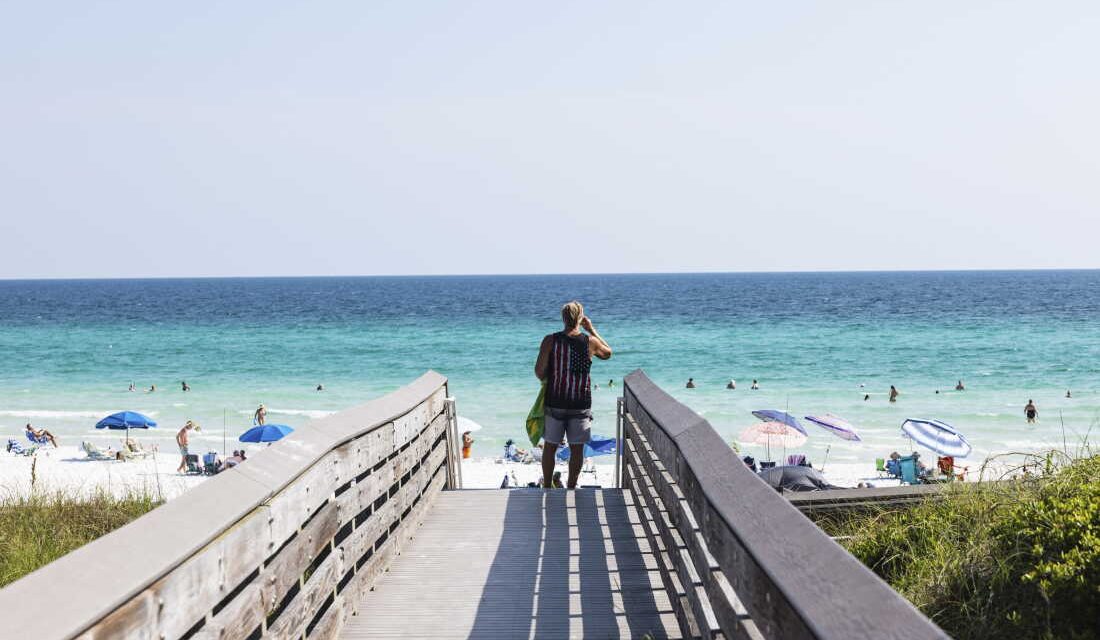
Santa Rosa Beach, Fla. — Off Scenic Highway 30A, the Ed Walline Regional Beach Access boardwalk is a site where private property rights clash with public beach access. This stretch of the Gulf Coast has been the focal point of this ongoing battle. Walton County, home to towns like Seaside and Alys Beach, boasts 26 miles of coastline known for its clear waters and fine white sand. Yet, where personal property lines end and public use begins remains contentious.
The conflict, ongoing for over a decade, has seen county initiatives to keep beaches open fail, fluctuating state laws, and numerous lawsuits from landowners. Beachgoers are left dealing with confusing access rules. As similar disputes arise in other coastal areas, Florida residents are considering a constitutional amendment to address the issue.
“Our beaches should be public,” says Dave Rauschkolb, founder of Florida Beaches for All. “They should be shared as they have for eons.”
Rauschkolb, owner of Bud & Alley’s restaurant, walks along a boardwalk that leads to a small public beach flanked by expensive Gulf-front homes. He points out signs indicating private property and security guards hired by owners to prevent public use.
He argues for the right to freely travel with chair and umbrella across any beach. Yet, homeowners like Eric Wilhelm from Marietta, Ga., defend their property rights.
“It’s the foundational rule of the way that we live in this freedom-loving country of ours,” Wilhelm states. “Once that breaks down, then we have anarchy and chaos.”
Wilhelm recalls moving to this area for its seclusion, but recent explosive growth has diminished this quality. He reports frequent trespassing incidents, indicating a shortage of public beach space.
The Legal Fight Over Sand
Wilhelm and other owners have been involved in a long legal battle with Walton County. The conflict intensified when the county declared public rights based on historical use. Influential homeowners, including former Gov. Mike Huckabee, opposed this, leading to a legislative change and a required lawsuit to prove public access rights.
Attorney Kent Safriet, representing about 80 owners, argues that English customary use law contradicts the U.S. Constitution.
“The Fifth Amendment [says] no private property can be used for public purposes without just compensation,” Safriet explains.
Although recent law changes have adjusted the situation, disputes continue. Sheriff Michael Adkinson Jr. highlights the ambiguity his deputies face in resolving access conflicts.
“To someone who is in favor of the beaches being open to everybody, they say the sheriff’s office are jackbooted thugs,” says Adkinson. “People that own the private property say we’re godless, liberal communists who allow everybody to go on their beach.”
He notes his office tries to de-escalate conflicts and has rarely arrested anyone for beach-related trespassing.
The Campaign for Public Access
Singer Brian Littrell is suing the sheriff for not enforcing trespass laws after beachgoers used his property. His attorney draws parallels to a homeowner reporting backyard trespassers, arguing that sheriff inaction is problematic.
Beach activist Sara Day has developed an app, Shoreline Defender, to help identify public beach zones. Inspired by a private security incident, she seeks to clarify access locations without encouraging trespass.
“It is not telling you to trespass,” Day emphasizes. “It is giving you a bandwidth of how much sand you might have at any given time.”
The rapidly growing population and tourism increase tensions. Real estate agent Linda Miller notes that inadequate public beach space makes selling non-Gulf properties difficult.
“I understand those people that pay $40 million for their Gulf-front property don’t want Bubba and them out there with a tent,” Miller comments. “Still, the no-trespassing signs and security guards have gotten out of hand.”
Some landowners propose creative solutions, like a beach-share program, though agreements have not yet been reached. Advocates push for a state constitutional amendment to protect public beach rights, calling on precedents from states like Texas and Hawaii.
“We need a constitutional amendment in Florida that will guarantee all of Florida’s beaches are public,” Rauschkolb insists. “If there ever was a state in our nation that should have public beaches everywhere, it should be Florida.”
 Senators Reach Bipartisan Agreement on Permitting Reform
  Experts Warn of Critical Period for the Colorado River
  Future Cities: Ambitious Projects Aiming for Innovation and Sustainability
  Navigating Los Angeles Real Estate on a Budget
  Supreme Court Case Suncor vs. Boulder: Implications for Accountability in Climate Change
  Hawaii Faces Impact of Record El Niño Through Recent Hurricanes