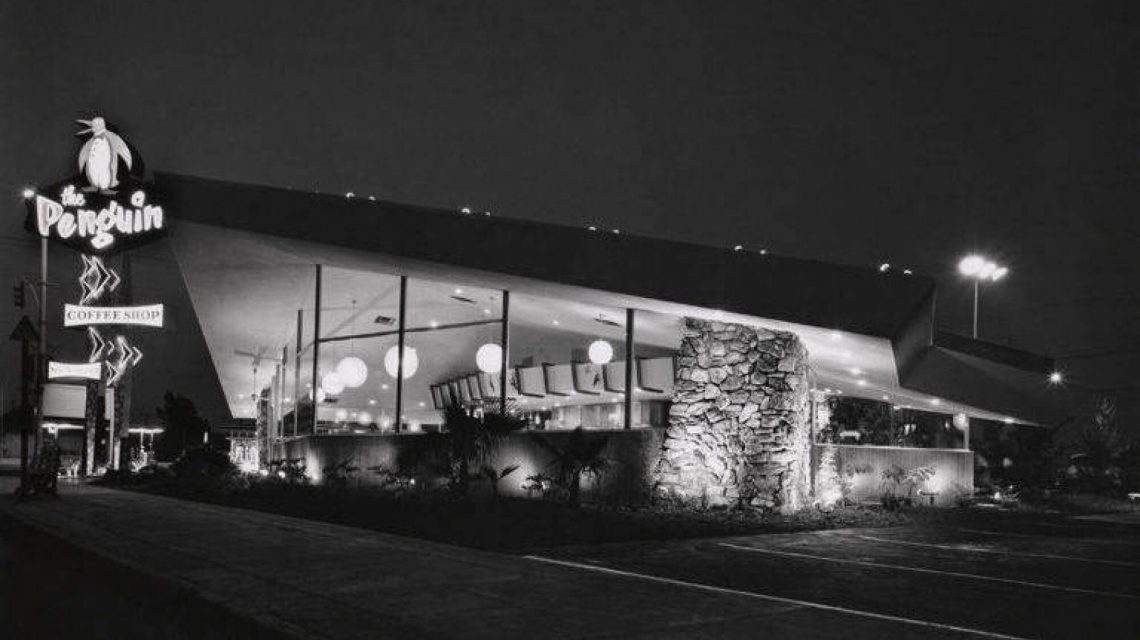
For many years, the building at Lincoln and Olympics boulevards in Santa Monica has marked the end of the iconic Route 66. Originally home to the Penguin Coffee Shop, it now houses Mel’s Drive-In. However, this building’s future is uncertain as the property owners plan to replace it with an eight-story apartment building.
Preservationists are making efforts to obtain a historic designation to protect the structure. On December 14, the Santa Monica Landmarks Commission will evaluate the site’s nomination for protected status, initiated by the Santa Monica Conservancy and the Los Angeles Conservancy. These organizations argue it represents a significant period in Santa Monica’s architectural history.
Architects Armet & Davis designed the building. It functioned as the Penguin Coffee Shop from 1959 to 1991. Nina Fresco of the Santa Monica Conservancy emphasized the importance of preserving Googie architecture, stating it’s crucial to balance housing needs with historic conservation.
ValueRock Realty purchased the property in 2020 for $6.2 million and started efforts to sell it in 2025, listing it for $26 million. In response to its potential sale, the conservancies applied for landmark designation to prevent demolition. They successfully raised $6,800 needed for the nomination process.
In September, ValueRock filed an early application for redevelopment plans, proposing 138 apartments, 123 parking spaces, and retail space. Initially, ValueRock recognized the site’s historic value but claimed no cultural resources exist in recent filings.
Should a landmark status be bestowed, the building could be protected from destruction. However, ValueRock can appeal such a decision. Currently, Mel’s Drive-In remains operational, with patrons continuing to visit.
Designed in the Googie style, known for its dramatic architecture, the building drew interest with its sweeping roofs and large windows. The Penguin Coffee Shop was favored for its American cuisine, gaining popularity despite not earning Michelin recognition.
By 1992, it became a dentist’s office, eventually left vacant until Mel’s refurbishment in 2016. The restoration aimed to honor the original 1950s ambiance, although many neon elements are now lost. Efforts complied with the Secretary of the Interior’s guidelines for historic restoration.
The building isn’t listed in key architectural guides. Yet, in 2025, Mel’s received a $10,000 grant to support Route 66 celebrations. Rhys Martin of the National Trust notes that the site, like Route 66, holds historical significance.
Fresco hopes a compromise allows both preservation and development. She cites successful precedents in Santa Monica where new construction integrated existing historic structures, like those at 829 Broadway and Rapp Saloon.
Route 66 began officially as U.S. Highway 66 on November 11, 1926, reaching Santa Monica in 1935. Though decommissioned in the 1980s, the route’s appeal endures, celebrated by recent centennial commemorations.
When the coffee shop opened in 1959, freeways were beginning to overshadow Route 66. The building’s strategic position targeted travelers from different eras. Alan Hess, an architecture critic, saw Los Angeles’ cultural evolution reflected in structures like the Penguin.
 U.S. Withholding Funds from Chemical Weapons Organization
  Facing New Global Threats: Lessons from the Past and Present Security Challenges
  Pope Leo XIV Undergoes Lung Surgery
  Drone Attack on Riyadh Airport Causes Casualties
  British Activist Raises Concerns Over Criminal Charges for Silent Prayer
  NATO’s Firm Stance Against Potential Russian Aggression