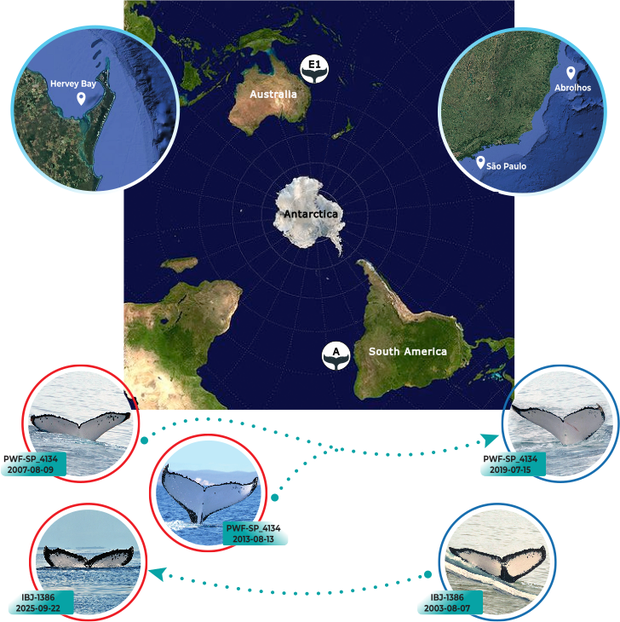
On May 20, 2026, researchers unveiled a significant discovery about humpback whales. Two whales traveled unprecedented distances between Australia’s eastern shores and Brazil’s breeding grounds.
Exceptional Journeys
A research team used extensive image collections of whale tails to trace these whales. The study, published in Royal Society Open Science, documented the greatest distances observed. One whale traveled about 8,823 miles, appearing in Queensland in 2007 and later near Sao Paulo, Brazil, in 2019. Another journey covered approximately 9,383 miles from Bahia, Brazil, to Hervey Bay, Australia, over 22 years.
These journeys surpassed previous records for humpback whales. According to Griffith University PhD researcher Stephanie Stack, such rare movements are crucial. They ensure genetic diversity across populations and facilitate cultural exchanges, such as song styles spreading across oceanic regions.
Methodology and Findings
The researchers analyzed nearly 20,000 photographs taken from 1984 to 2025, involving scientists and citizen researchers. An automated image-recognition algorithm helped identify these whales in both eastern Australia and Latin America.
Dr. Cristina Castro from the Pacific Whale Foundation emphasized the importance of citizen science. Each photograph contributed to understanding whale biology and recorded an extreme movement.
Scientific Insights
The study adds weight to the “Southern Ocean Exchange” theory. This hypothesis proposes that humpback whales sometimes choose new breeding areas after traveling to Antarctic feeding grounds. Climate changes, affecting sea ice and krill distribution, might make such extended journeys more likely.
Conservation Context
In the 1970s, due to commercial whaling, humpback whales were declared endangered in the U.S., as reported by NOAA. A moratorium on commercial whaling was implemented in 1985. Presently, four out of the 14 distinct humpback whale population segments remain endangered, while one is listed as threatened.
The findings hold significance for Brazil and Australia’s conservation efforts, highlighting the adaptability and resilience of humpback whales.
 Atlantic Ends September Without a Hurricane for First Time Since 1994
  Bobcat Sightings and Conservation Efforts in Illinois
  2026 El Niño: A Historical Comparison and Future Projections
  U.S. Records Warmest September in History
  Swiss Glaciers Show Effects of Ice Loss Amid Global Warming
  Climate-Resistant Rock Glaciers: Hidden Water Resources