School districts across the United States face declining student enrollment, reduced funding, and the end of pandemic relief funds. This situation has sparked discussions about school closures and cost-reducing measures. Leaders are pressured to consolidate while still supporting academic recovery. However, not all communities are affected equally by these closures.
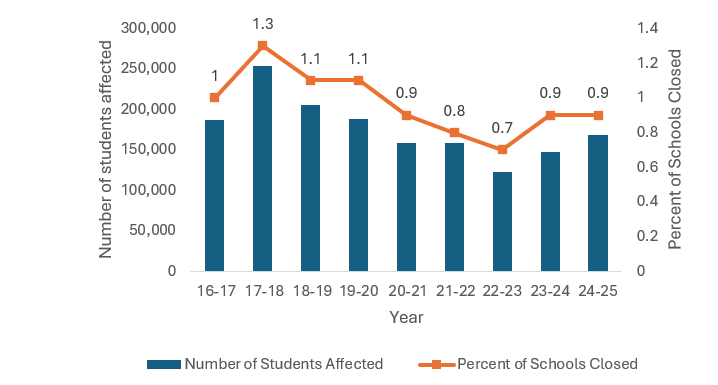
Research reveals that school closures disproportionately impact Black students and those from low-income backgrounds, intensifying their already significant educational challenges. Annually, about 1% of public schools close, affecting 100,000 to 250,000 students. This is equivalent to displacing an entire large school district each year. The pandemic initially slowed closures due to paused accountability policies and federal aid, but rates have risen back to pre-pandemic levels.
Trends in School Closures
School closures disproportionately target Black and low-income communities. Majority-Black and high-poverty schools are more likely to be closed. In 2024-2025, one-quarter of closures involved schools with mostly Black students, despite these schools constituting less than 10% of the total.
This trend isn’t merely a response to enrollment drops. Schools serving Black students remain more likely to close despite equal enrollment declines. High-poverty and schools with students of color showed significant academic gains post-pandemic, but stability is critical to maintaining progress. Closure can disrupt relationships, learning environments, and hard-won progress.
Effects of School Closures
Closures and the subsequent relocation of students generally result in short-term academic setbacks. When students are moved to similar or lower-performing schools, these disruptions are more pronounced. In places like Chicago and Philadelphia, displaced students regressed in reading and math unless relocated to significantly better-performing schools. Those needing to travel farther faced increased absences and suspension rates. Systemic barriers, such as long commutes and limited school availability, restrict the ability of displaced students to access better education opportunities.
Financial Implications and Long-term Effects
School closures do not always deliver anticipated cost savings. Data shows that financial benefits vary, and closures can lead to long-term disruptions. Texas research links closures with decreased test scores, higher discipline, lower graduation rates, and reduced college attendance and employment. These negative outcomes are especially evident among students from low-performing and economically disadvantaged schools.
Equitable Solutions and Policy Recommendations
Closing decisions remain inequitable, affecting Black and low-income students the most. Districts should employ strategies that preserve neighborhood schools in these communities. When closures are unavoidable, equitable execution with community engagement is essential. Ensuring displaced students receive no worse placements and adapting receiving schools with smaller classes, transportation, and support services can mitigate adverse impacts.
Systemic issues like gentrification, dwindling state education funds, and housing and economic patterns lower enrollment and exacerbate closures. District leaders require state and federal support to address these foundational problems. Protecting educational progress requires conscious policy choices that do not disproportionately affect communities already carrying the greatest educational burdens.
Authors: Megan Kuhfeld, Ph.D., and Ayesha K. Hashim, Ph.D., from the Northwest Evaluation Association
 David Madigan Appointed as USC’s Chief Academic Officer
  North American Values Institute Questions Pittsburgh Schools’ New Curriculum
  Debate Over Proposed English-Only Rule for Head Start Programs
  Impact of Removing Regents Requirement on Education
  Impact of College Rankings on Lesser-Known Institutions
  Evaluating Accountability in Missouri’s Education System