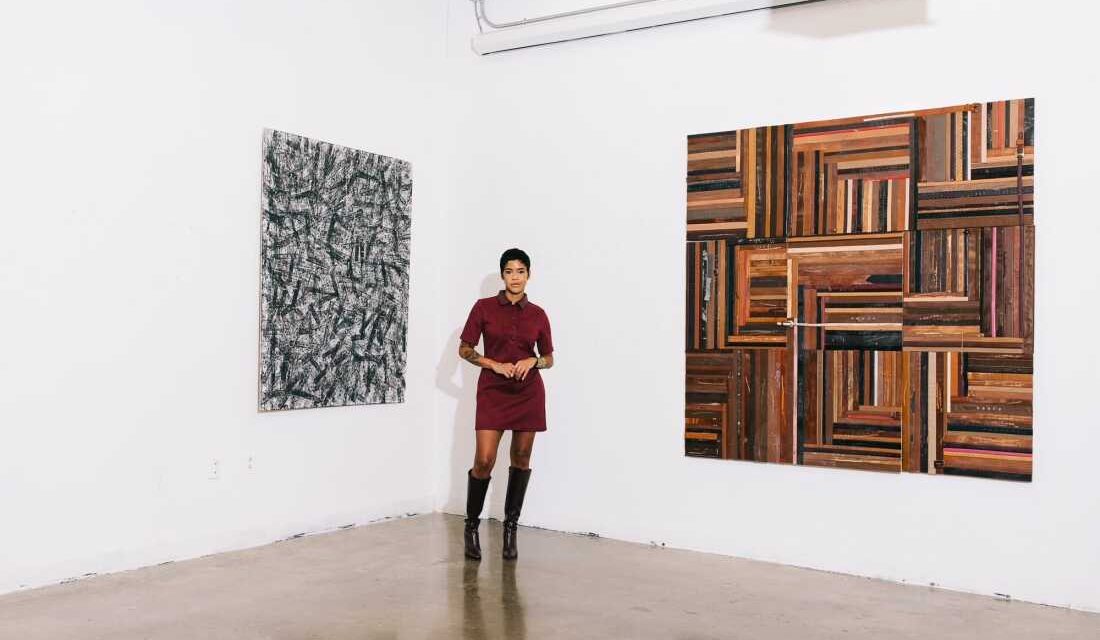
Multidisciplinary artist Lex Marie has gained attention on TikTok and Instagram for her provocative artwork addressing discipline within Black households. In her Washington, D.C. studio at the American University’s Katzen Arts Center, Marie transforms belts into more than mere objects.
In Marie’s studio, belts stretch across canvases in orderly rows and are used as tools to create art. By dipping them in paint and swinging them against the canvas, she leaves thick, expressive marks. Each piece tells a story of childhood and discipline, exploring the complex ways love can manifest. Her work addresses a challenging topic: corporal punishment in Black households.
Marie explains, “I’m critiquing discipline in Black households specifically. I’m trying to tackle the history behind spankings and whippings and address how millennials approach parenting differently.” As a 33-year-old mother, Marie’s art springs from her own experiences and thoughts about parenting her eight-year-old son.
Reflecting on the past, Marie shares, “Through motherhood, I find myself questioning my own childhood. The work speaks from my experience with spankings, alongside my feelings.” One pivotal piece in her series is “Watch Your Tone,” a six-by-six-foot canvas filled with dozens of belts. These belts symbolize various flesh tones, echoing the oft-heard phrase, “Watch your tone when speaking.” Marie believes they represent punishment’s ties to American history.
Scholars link corporal punishment in Black households to the legacy of slavery. Historian Yohuru Williams explains, “The excessiveness in discipline has deep roots, extending beyond slavery. Physical violence in enslavement influenced discipline methods that persisted. The brutalization continued after slavery.”
Another piece, “Because I Love You,” emphasizes the enforcement of punishment. Marie painted a wooden panel, repeatedly striking it with a paint-covered belt, leaving scars. “I spent hours beating the same spot over and over,” she recalls, experiencing physical soreness afterward.
The title reflects phrases like “This hurts me more than you” or “I’m doing this because I love you.” Although creating the piece was cathartic, it was also difficult. The online reactions were immediate, with many sharing experiences of their own painful or appreciative stories.
Marie insists her work does not aim to shame. It fosters a conversation often hidden away. Williams suggests Black families re-evaluate discipline methods, noting, “Many parents feel this is how they were raised and equate it with developing resilience.” He advocates for new, dignity-affirming communal practices.
As Marie’s solo exhibition at The Bishop gallery in Brooklyn approaches, her art serves as a tool for addressing childhood trauma. “The project will continue to grow,” she says. Marie anticipates the series to expand further, already comprising 20 pieces, with two sold to filmmaker Spike Lee. Her focus lies on recognition rather than agreement in her work.
 Readers React to Miss Manners Column
  Troy Swanson: Award-Winning Librarian Transforming Academic Libraries
  Lisdoonvarna Matchmaking Festival: A Unique Tradition
  Midwest Underground Railroad Network Gains National Recognition
  Art Collective Critiques Administration with Mall Installation
  American Hagwon: A Tale of Family and the Korean Diaspora