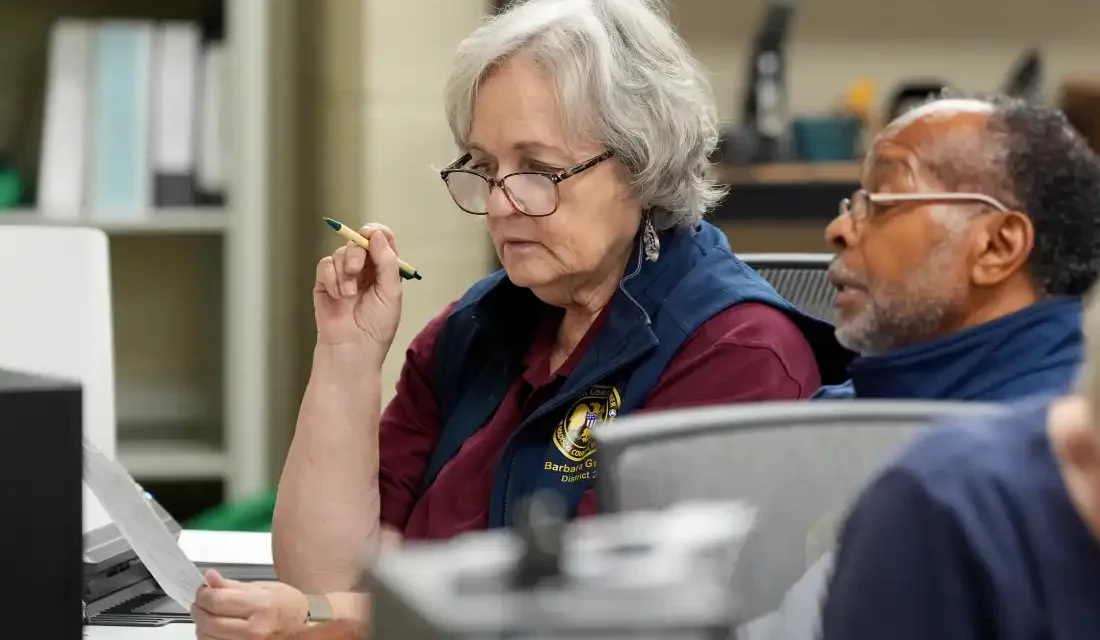
Two election commissioners in Madison County, Mississippi, closely examined an affidavit ballot envelope recently. The intense scrutiny stems from the state’s remarkably close U.S. Senate race, which has highlighted Mississippi’s election procedures.
The race between incumbent Republican Senator Cindy Hyde-Smith and Democratic challenger Scott Colom is too close to call, and every ballot is crucial. Yet, it’s unclear how many ballots remain uncounted in Mississippi’s slow and decentralized election process.
Michael Morse, a voting scholar and law professor at the University of Pennsylvania, criticized the state’s election administration. By midday Friday, fewer than 2,000 votes separated the candidates. However, the exact number of outstanding ballots remains uncertain.
The Colom campaign reported discovering over 15,000 provisional ballots by late Tuesday. These require verification before being counted. Meanwhile, the chair of the state Republican Party estimated 20,000 outstanding ballots. This estimate included possible absentee votes, which could be accepted if postmarked by Election Day and received by November 10.
Mississippi’s Secretary of State, Michael Watson, stated that individual counties control their elections, meaning his office lacks information on the exact number of provisional ballots yet to be counted. He mentioned that around 7,000 provisionals had been processed, with about 80% accepted.
“Until we have the certified results, the individual counties will be the best source of the latest and most up-to-date information,” Watson declared.
With 82 counties, Mississippi does not require prompt transmission of election results to the state. Morse expressed his surprise at the scant information available for such an important race.
Mississippi exhibits a notably high rate of provisional ballots, known locally as affidavit ballots. These are ballots cast by individuals whose eligibility is uncertain. Local officials decide case-by-case if these votes will count.
If Colom’s estimate proves accurate, affidavit ballots would represent about 1.5% of total ballots cast in the Senate race. According to federal data from the last midterm elections in 2022, only four states had a higher provisional ballot rate.
Mississippi likely has twice the provisional rate of North Carolina based on preliminary data. One reason is Mississippi’s voter registration process. In many states, voters remain active for a period even if they haven’t voted, but in Mississippi, inactive voters must use provisional ballots.
The state has experimented with using credit data to maintain voter lists, gaining attention for potentially introducing unreliability. Morse explained that this approach, combined with stringent procedures on inactive voters, complicates the process.
Watson defended the process, asserting that affidavit ballots improve voter roll integrity. Kathy Boockvar, former Secretary of State of Pennsylvania, noted that while many provisional voters are deemed eligible, the process can erode trust.
“It feels like you have to go talk to the teacher or something in the back room,” Boockvar commented, referring to voters’ experiences with the process.
Boockvar added that the lack of accessible information suggests Mississippi isn’t accustomed to the national attention typical of battleground states. She emphasized the need for transparent and accurate data to combat voter suspicion and distrust.
 Mayor Mamdani’s Policing Reform Plans
 Gen Z Voter Shifts and Their Impact on the 2026 Midterm Elections
 Disappearance of US Senate Candidate Raises Questions
 DOJ Rule Change Reduces Appeal Time for Immigrants Facing Deportation
 Hakeem Jeffries’ Bid for House Speaker Faces Progressive Hurdles
 Ohio Judge Dismisses Defamation Lawsuit by Rep. Max Miller