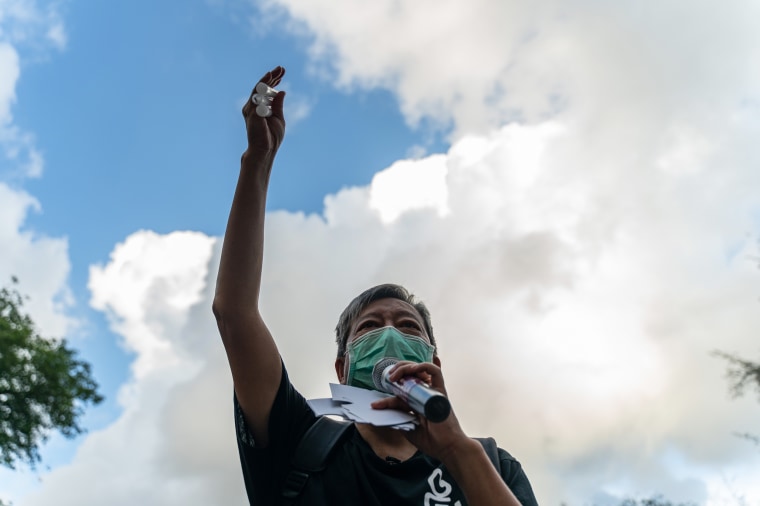
Two former organizers of Hong Kong’s vigil commemorating the 1989 Tiananmen Square crackdown were convicted under a China-imposed national security law, effectively dismantling the territory’s pro-democracy movement.
Lee Cheuk-yan and Chow Hang-tung, formerly leading the Hong Kong Alliance in Support of Patriotic Democratic Movements of China, faced charges in 2021 for inciting subversion. Pleading not guilty, they face up to 10 years in prison. The alliance itself was found guilty.
For three decades, the alliance’s vigil was the sole large-scale public remembrance event for the Tiananmen crackdown in the Chinese territory, attracting tens of thousands each year. The event was prohibited in 2020 due to Covid-19 and followed by the imposition of the security law to quell 2019’s anti-government protests.
Observers argue that this trial highlights diminishing freedom of expression in Hong Kong, a former British colony that returned to Chinese sovereignty in 1997. Lee, aged 69, and Chow, aged 41, have remained imprisoned since their 2021 charges. Judges have yet to provide the reasoning behind the convictions, promising an online publication of the full judgment.
Eric Lai, from Georgetown Center for Asian Law, notes the charge of inciting subversion is frequently utilized in mainland China against activists and intellectuals, including Nobel Peace laureate Liu Xiaobo.
“The verdict shows how Hong Kong’s court mirrors mainland’s party-led judiciary,” Lai remarked.
The court was heavily guarded for Lee and Chow’s trial. Prosecutors stressed that the case did not target political motives but criticized the alliance’s alleged call for overthrowing the Communist Party through unlawful means.
Lee contested in court, emphasizing the call was meant to advance democracy and enable citizens to choose their leaders, not end the Communist Party’s leadership.
Chow, defending herself, contended that “ending one-party rule” denotes removing power without limits, criticizing the inversion of moral standards in proceedings. She shared her experience of being shackled for court visits, questioning the significance of top-down verdicts.
The trial, planned for 75 days, finished faster than anticipated with closing statements wrapped up on its 24th day. Earlier, Albert Ho, involved in the case, pleaded guilty, potentially reducing his sentence.
Lee and Chow anticipate pleading for lighter sentences at a separate hearing possibly alongside Ho. Despite the rain, individuals queued outside the court to attend the hearing.
Tang Ngok-kwan, a prior alliance member, reported police obstruction, preventing him from lining up with “sensitive” items, such as “vindicate June 4” bookmarks commemorating the crackdown’s anniversary.
Margaret Chan, an ex-vigil-attendee, began lining up at 6 a.m. questioning the concept of inciting patriotism.
The 1989 crackdown witnessed the loss of hundreds, potentially thousands, as military tanks entered Beijing. This event established that China’s market reforms would not lead to political liberalization.
Following the easing of Covid-19 restrictions, the previous vigil site transformed into a carnival area organized by pro-Beijing groups during the Tiananmen anniversary.
Beijing justified the 2020 security law as essential for Hong Kong’s stability, leading to imprisonment of key activists like Jimmy Lai and dissolving numerous civil society entities, including the alliance.
 Realtor Arrested for Alleged Work as Unregistered Chinese Agent
 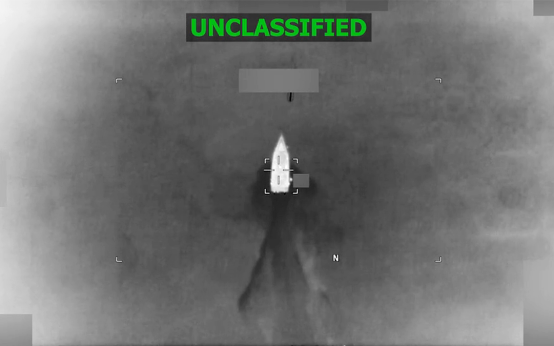 U.S. Military Strikes Vessel in Caribbean, Alleging Drug Trafficking
  Australia Investigates FlyDubai Incident Amid Security Concerns
  U.S. Military Operations in the Strait of Hormuz: Analyzing Sustainability and Impact
 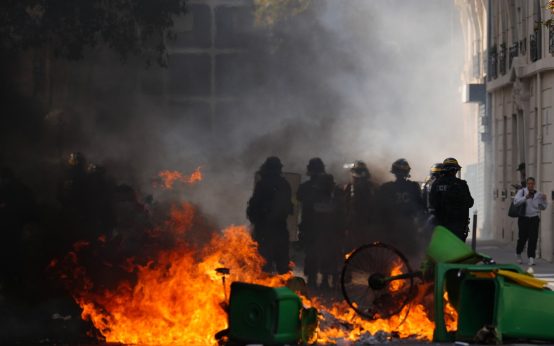 Escalating Student Protests in France: A Call for Educational Reform
 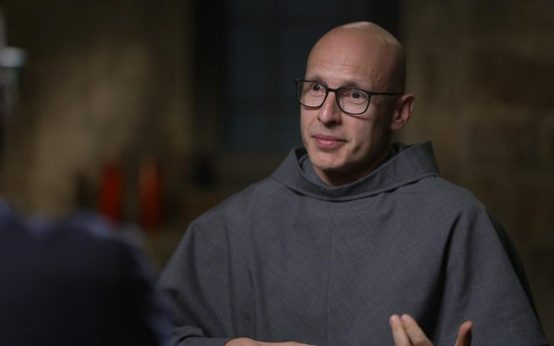 Advanced Technology Aids Restoration of Basilica of Saint Francis of Assisi