
Pentagon Signs Agreements for Interceptor Production Boost
The Pentagon has announced the establishment of two major framework agreements. These deals were secured with General Dynamics Ordnance and Tactical Systems along with Lockheed Martin. Their purpose is to accelerate the production of missile interceptors.
Under these agreements, the production of Terminal High Altitude Area Defense (THAAD) and Patriot Advanced Capability-3 Missile Segment Enhancement (PAC-3 MSE) components will increase significantly. The goal is to triple PAC-3 MSE interceptor capacity and quadruple THAAD interceptor capacity. These efforts extend to ramping up production of key sub-components such as seeker housings, motor cases, and shroud deployment systems.
“Today’s announcement represents an example of the evolution of how we partner with industry to expand the Arsenal of Freedom, outpace emerging threats, and ensure the Warfighter never faces a fair fight,” stated Michael P. Duffey, Under Secretary of Defense for Acquisition and Sustainment.
There is urgency in these agreements, given the depletion of U.S. missile interceptors. The U.S. military has utilized between 190 and 290 THAADs during the ongoing conflict with Iran. Estimates by the Center for Strategic and International Studies suggest a return to pre-war interceptor levels by mid to late 2029.
Impact on Defense and National Security Policies
Recent developments in defense policy have reflected political shifts. President Trump’s approval rating has decreased amid the Iran conflict, according to a University of Massachusetts Amherst poll. Conducted in late August, the survey shows 32% approval of Trump’s performance, noting a decline from previous polls.
In a statement, Trump suggested it is premature to consider speculation about Defense Secretary Pete Hegseth possibly running for president in 2028.
Additionally, the Pentagon expanded its AI platform by incorporating Starshield AI’s Grok for Government and OpenAI’s ChatGPT to enhance productivity and collaboration.
Recent Hostilities Escalate
Iran retaliated against U.S. actions, attacking American military bases in the UAE and Jordan. Iran’s Revolutionary Guard employed drones and missiles against these sites, as reported by Fars News Agency.
Upcoming Congressional Hearings and Events
The House Foreign Affairs Middle East and North Africa Subcommittee will conduct a hearing on “Countering Houthi terrorism: Protecting U.S. interests and security in the Red Sea.” Additionally, panel discussions on regional security implications are scheduled by centers and institutes focused on strategic studies.
 New Jersey Voter Fraud Prompts Renewed Push for SAVE Act
  Concerns Over Changes to Voter-Registration Form for Americans Abroad
  Trump’s 2024 Campaign Targets Young Men Through Cryptocurrency
  Trump’s White House Visitor Center Proposal Gains Bipartisan Support
  State Department Simplifies Passport Process with Online Applications
 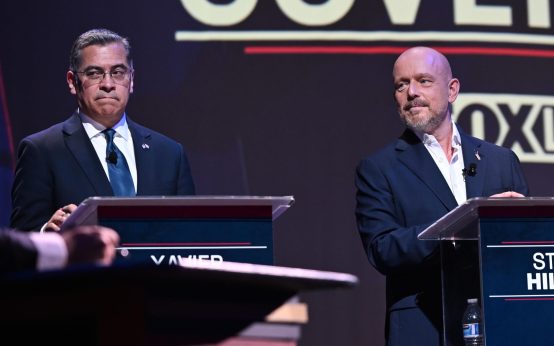 Becerra and Hilton Clash in California Gubernatorial Debate