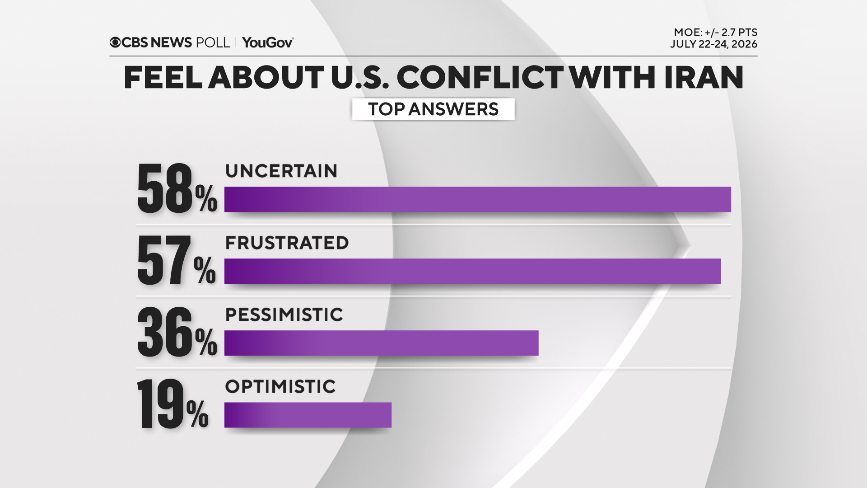
The situation in the Strait of Hormuz continues to perplex the American public. Many express uncertainty about the daily developments in the region. As the conflict intensifies, ‘uncertain’ and ‘frustrated’ capture the predominant public sentiment.
Most Americans now expect the conflict to stretch into months or even years. A large portion believes the situation has proven more challenging than anticipated by the Trump administration. The public maintains several clear priorities: ensuring the open passage through the Strait of Hormuz amid rising gas prices, halting Iran’s nuclear ambitions, and preventing regional threats from Iran.
Despite these goals, many remain skeptical about a quick resolution. An increasing number prefer to end the war, rather than push for further concessions from Iran. Even after a failed ceasefire deal, the sentiment to continue the conflict is significant, primarily among Republicans.
Approximately one-third supports pressing for more Iranian concessions. Younger Americans show a stronger inclination towards ending the conflict than those over 65. This uncertainty stems from a lack of transparency about daily events in the Strait of Hormuz. Many feel President Trump’s communications offer an overly positive spin, lacking clarity.
Perceptions of the war’s progress have declined, with opinions mixed on who holds the upper hand, if anyone.
Domestically, conditions remain relatively constant. While the World Cup provided a temporary morale boost, economic concerns persist. Inflation outpaces income growth, and many criticize the president’s priorities. Efforts on tariffs and infrastructure in D.C. face public scrutiny.
High gas prices continue to burden many Americans, particularly those disapproving of military actions abroad. Economic perceptions remain grim but stable. Tariff opposition is strong among individuals struggling with inflation’s impact.
The president’s approval regarding Iran mirrors its historical lows, slightly below his overall approval rating, which shows minimal change. Democrats aren’t viewed as having a superior strategy compared to Trump and the Republicans. Many feel conflicted, sensing no clear policy direction from either side.
This CBS News/YouGov poll surveyed 2,193 U.S. adults from July 22-24, 2026. The sample represents the U.S. adult population in terms of gender, age, race, and education, with a margin of error of ±2.7 points.
 The Trump Team’s Challenge to the Military Leadership
  Maryland First State to Restrict Electronic Pricing in Grocery Stores
  Activists Push for Nationwide Ban on Child Marriage in the U.S.
  Democratic Hopes and Historical Warnings in 2026 Senate Race
  Republicans Face Challenges Amidst Cost of Living Concerns
  A Different Kind of Fall for Congress This Year