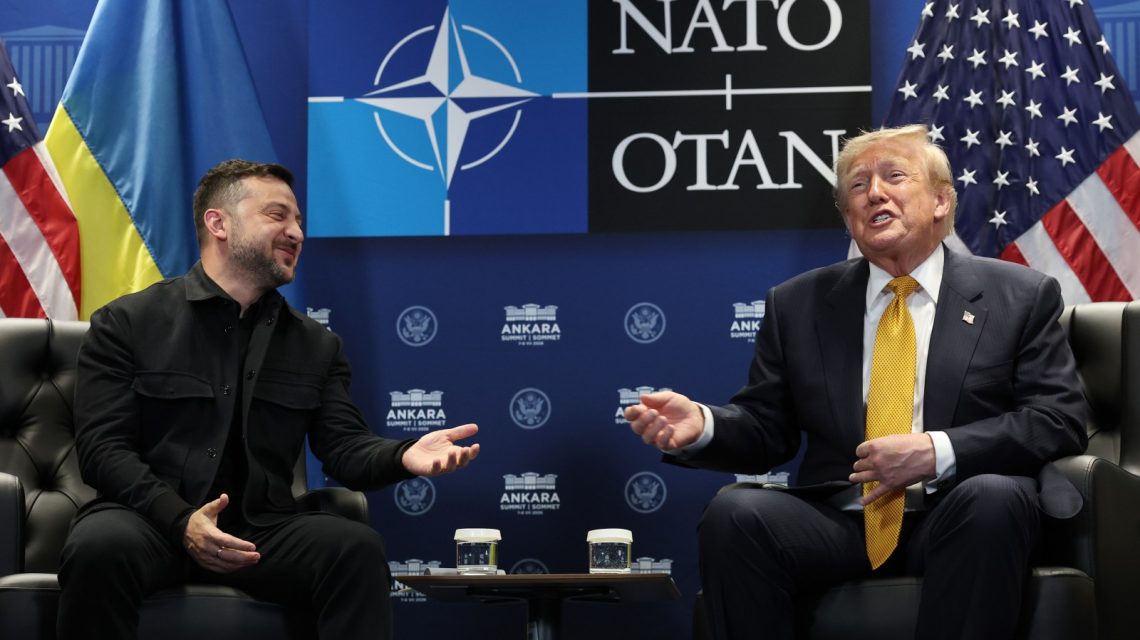
Representative Don Bacon, a Republican from Nebraska and retired Air Force brigadier general, publicly criticized President Donald Trump after his comments about the ongoing war in Ukraine. Bacon is known as a strong supporter of Ukraine in Congress. He accused the White House of creating a ‘moral ambiguity’ about the conflict by failing to hold Russia responsible for initiating the war.
‘Moral ambiguity continues to grip the WH,’ Bacon stated on X. ‘Putin started this war and is doing the invading. Blame Putin. This is embarrassing.’
This comment from Bacon followed Trump’s response to a public inquiry about his meeting with Ukrainian President Volodymyr Zelensky, where Trump expressed a desire for Zelensky to ‘end the war.’ Trump remarked, ‘It was good. Look, you know, he’s out doing his thing. I’d like him to end the war. So, it’s very simple. I get along with both. I get along with President Putin. I get along with President Zelensky. And like I told him, I want him to end the war, get the war ended.’
Trump also highlighted the human cost of the conflict by stating, ‘25,000 people died last month’ and emphasized the need to ‘end the war.’
A White House official explained in response to Newsweek, ‘The President has a humanitarian heart and wants this war settled so the senseless killing ends.’ He added that the administration aims to play a constructive role in settling the conflict through dialog with both Russia and Ukraine.
Bacon, however, argued that Trump’s wording could confuse responsibility for the conflict, which Russia started when it invaded Ukraine in February 2022.
Bacon’s Criticism of Trump’s Position
Bacon’s recent criticism isn’t an isolated incident. As he prepares to leave office, Bacon has consistently challenged Trump’s rhetoric on Russia, Ukraine, and NATO. In March, Bacon warned against appeasing Russian President Vladimir Putin and stressed that any peace agreement shouldn’t reward aggression.
Earlier this year, Bacon criticized Trump after Trump disparaged Zelensky, insisting that portraying Kyiv as the problem is morally and factually incorrect. Beyond Ukraine, Bacon has defended NATO and voiced his displeasure at Trump’s comments concerning Greenland and Denmark, as well as any actions that weaken U.S. alliances.
As a former military officer, Bacon expressed concerns about instability within the national security sector during Trump’s second term. He has advocated for strong alliances and experienced military leadership to effectively counter Russian aggression.
Current Situation in Ukraine
Bacon’s comments come as the war enters its fifth year, marked by continuous large-scale drone and missile exchanges. Diplomatic efforts struggle to progress. Zelensky recently visited Washington for talks with Trump and others about military cooperation, Russian sanctions, and possible peace negotiations.
This week included discussion on enhancing missile production and air defense support for Ukraine. Meanwhile, Ukraine launched strikes against Russian targets, demonstrating the global reach of the conflict.
Russia persists with its war aims, showing no signs of relinquishing annexed territories, despite economic pressure and sanctions.
The conflict has also increased tensions in the Middle East, with Ukraine accusing Iran of aiding Russia, while Tehran blames Kyiv for expanding the conflict.
Evolving Trump-Zelensky Relationship
Trump and Zelensky’s relationship has improved, following initial clashes over U.S. support. Recent meetings have been more positive, with both sides describing them as productive. Zelensky noted a change in tone with Trump, identifying an earlier meeting as a pivotal moment for mending ties.
Trump has also toned down some of his previous criticisms of Zelensky. These interactions signal a potential warming of relations between the U.S. and Ukraine under Trump’s leadership.
Laura Loomer’s Shift in Perspective
Laura Loomer, a strong Trump ally, recently changed her stance on U.S. support for Ukraine after a visit there. Her experiences on the ground altered her view, leading her to praise Ukrainian resilience and challenge Russian propaganda narratives.
Loomer’s change points to a possible shift among some conservatives who previously viewed Ukraine with skepticism. It highlights the growing acknowledgment of the conflict’s complexities and Ukraine’s plight.
Nonetheless, divisions remain about military aid and sanctions. Bacon consistently argues for clarity, insisting that understanding the war’s origins is essential. For him, the message is clear: Russia started the conflict by invading Ukraine. Trump’s call for Zelensky to ‘end the war’ should be seen as a plea for peace, but the responsibility must be placed accurately.
 The Trump Team’s Challenge to the Military Leadership
  Maryland First State to Restrict Electronic Pricing in Grocery Stores
  British Police Arrest Man Suspected of Terror Plot
  Activists Push for Nationwide Ban on Child Marriage in the U.S.
  Democratic Hopes and Historical Warnings in 2026 Senate Race
  Republicans Face Challenges Amidst Cost of Living Concerns