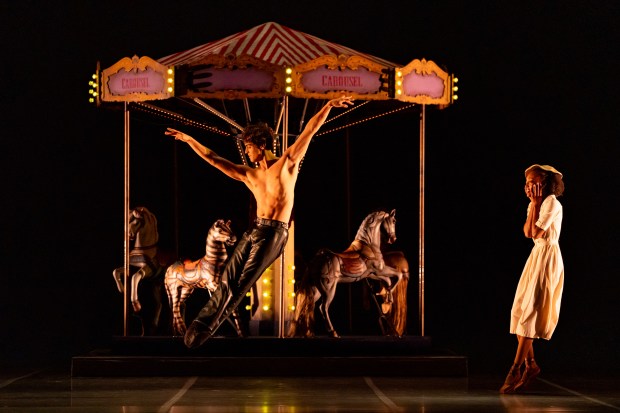
The Joffrey Ballet’s season opener presents a captivating performance with the ballet titled “Liliom.” The story revolves around Julie, portrayed by prima ballerina Victoria Jaiani, a character whose innocence and goodness lead her into a turbulent relationship with the central figure, Liliom. Liliom, played by José Pablo Castro Cuevas, is depicted as a carnival barker with a talent for persuasion that ultimately fails him, creating questions about whether bad deeds stem from character or circumstance.
Choreographer John Neumeier has crafted this ballet with a focus on Liliom, which questions if a man can truly reshape his destiny. Castro Cuevas delivers a compelling performance, exceeding expectations even after his recent portrayal of Eugene Onegin. Neumeier originally created “Liliom” 15 years ago for the Hamburg Ballet in Germany. His long-standing career includes his origins in Milwaukee and artistic contributions in Chicago.
Neumeier’s work is known for its unconventional style, blending classical ballet with modern dance and physical theater. He drew inspiration from earlier training with Sybil Shearer in Chicago. “Liliom” reflects Neumeier’s unique artistic approach, unfolding its narrative with varied musical accompaniment by Michel Legrand, interpreted by conductor Nicholas Koo and the Lyric Opera Orchestra.
The ballet opens with Evan Boersma, who embodies The Balloon Man, a character that guides the audience through Liliom’s journey between earthly and spiritual realms. The scene transitions from silence to the vibrant backdrop of Playland, a carnival, enhanced by the orchestra’s strings, horns, and trumpet. The interaction of these elements enriches the audience’s experience and gradually reveals the plot.
The performances of Reed Henry as Louis, Julie’s son, and the gradual uncovering of Playland’s past are part of the ballet’s imaginative storytelling. Neumeier along with set designer Ferdinand Wogerbauer and lighting designer Jim French visually distinguish the social classes within the carnival scenes.
Liliom’s persuasive abilities are central to his role, encompassing interactions with various women and showcasing his darker side, resulting in psychological and physical abuse towards Julie. His life choices lead him to theft and self-inflicted death, echoing themes found in Rodgers and Hammerstein’s “Carousel.” These narratives raise questions about alternative paths Liliom could have pursued.
The ballet’s climax features a powerful ensemble of 24 men portraying the frustration of unemployment during the economic upheaval of the 1920s to 1930s. Signs carried by these performers articulate the desire for work over charity, culminating in a dramatic dance sequence.
Despite Liliom’s destructive choices, his love for Julie is evident, exposing his vulnerability. Julie embodies the ability to see goodness in people amidst their flaws. This theme resonates throughout the ballet, concluding on a hopeful note as Julie extends unconditional love to her son, highlighting her unwavering integrity.
The Joffrey Ballet’s “Liliom,” directed by Neumeier, offers a rich blend of choreography and narrative, leaving viewers with much to contemplate.
Performance Details:
Running until September 27
Location: Joffrey Ballet at Lyric Opera of Chicago
Duration: 2 hours, 25 minutes with one intermission
Tickets can be purchased between $39 and $214 by calling 312-386-8905 or visiting www.joffrey.org.
 Operation Mincemeat: A Theatrical Review
  Hollywood Executive Praises Trump’s Efforts to Revitalize the Entertainment Industry
  Zoe Kazan’s Journey with ‘East of Eden’
  Pete Davidson Criticizes NYC Mayor Zohran Mamdani Over BQE Construction
  Chris Hansen Criticizes Hollywood’s Portrayal in ‘Primetime’
  Monet Mazur’s Home Targeted in Hollywood Hills Burglary Attempt