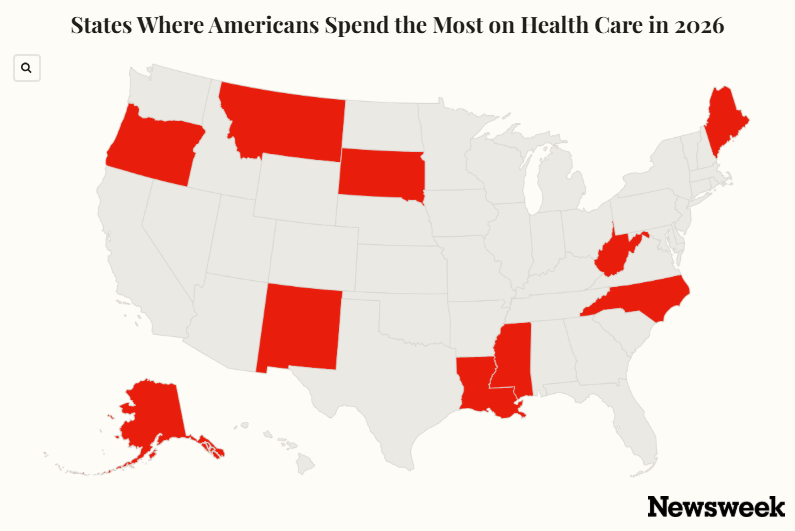
Americans are dedicating more of their income to health care as costs rise sharply over the past 20 years. Some states bear a heavier burden, according to a new WalletHub report. The report shows that residents in one state devote over 10% of their income to medical expenses, while it’s about half that amount in the least expensive states.
Nationally, average out-of-pocket health care spending has increased from $811 to $1,514 over two decades, surpassing inflation and adding strain to household finances.
Why Rising Costs Matter
The escalation in health care expenses is influencing financial choices for millions. Some individuals delay or avoid medical care due to these rising costs. Even in states with relatively lower prices, income often cannot offset the financial pressure, especially amid general inflation affecting housing and essential food costs.
Key Findings of the WalletHub Report
The WalletHub report ranked all 50 states by the share of median household income spent on essential medical services and medications.
Top 10 States Where Americans Spend the Most on Health Care:
- Alaska — 10.08%
- Oregon — 9.32%
- Maine — 9.30%
- Mississippi — 9.18%
- West Virginia — 9.14%
- New Mexico — 9.07%
- North Carolina — 8.78%
- Montana — 8.62%
- South Dakota — 8.60%
- Louisiana — 8.13%
At the other end of the spectrum, Utah, Virginia, California, New Jersey, and Nevada are among the states where health care consumes the smallest share of income.
New York ranks 15th, with residents spending about 7.98% of their income on health care.
Understanding the Differences
High spending isn’t always linked to lower incomes. Often, it reflects elevated medical costs. “Sharp increases in health care costs in recent years have made it difficult for some people to seek essential care,” said WalletHub writer and analyst Chip Lupo.
Alaska tops the list with residents spending 10.1% of their median income on health care, attributed to high doctor and medication prices. Oregon ranks second, where about 9.3% of income goes to health care, primarily due to high service costs.
In Maine, the third-highest state, high medical prices and lower household earnings boost the percent of income needed for health care.
Calculating the Rankings
The WalletHub report evaluated five components of medical spending across states:
- Doctor visits
- Dentist visits
- Optometrist visits
- Prescription costs for ibuprofen
- Prescription costs for insulin glargine
They compared these costs with each state’s median household income to assess the financial impact of care. Data was collected from the Council for Community and Economic Research and the U.S. Census Bureau.
Practical Steps to Reduce Health Care Expenses
Although location significantly influences health care costs, there are actions to lower expenses. Maintaining health insurance and using covered preventive care can reduce long-term spending. Finance experts recommend building an emergency fund and utilizing health savings accounts if possible.
Alex Beene, a financial literacy instructor at the University of Tennessee at Martin, emphasized that insurance alone doesn’t capture health care costs’ full scope. Many factors affect these expenses which must be considered in budgeting.
Future Considerations
Regional disparities in health care affordability may become a significant policy concern as costs rise. Without changes in pricing, insurance coverage, or income growth, Americans in high-cost states may continue to spend a larger share of their income on medical care.
Kevin Thompson, CEO of 9i Capital Group, noted that health care inflation encompasses more than insurance premiums. It is deeply embedded in the entire system, ultimately affecting consumers.
 Trump Administration Distributes ACA Refund Checks
  Higher Consumption of Ultra-Processed Foods Linked to Increased Health Risks
  Understanding Inflammation: Myths and Facts
  Calm Parenting: Strategies to Manage Stress
  Trump’s Executive Order to Combat Mosquitoes and Ticks in D.C.
  Overcoming Weight Loss Challenges: Brain Health and GLP-1 Medications