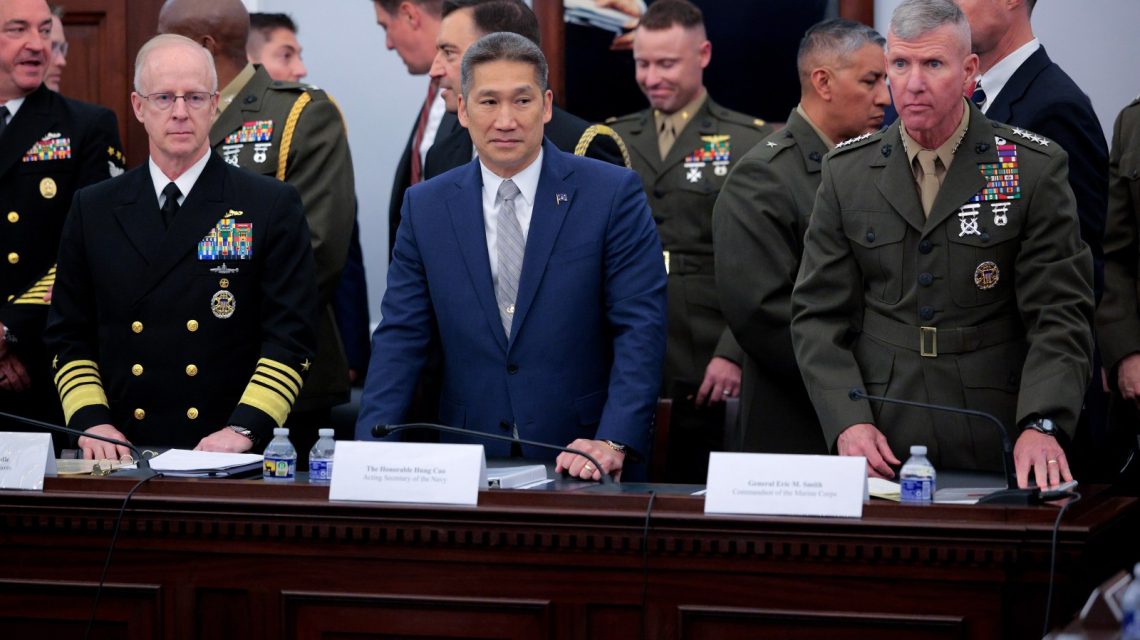
On Sunday, Acting Navy Secretary Hung Cao announced that Brandon Newsom, a senior Pentagon official, is no longer employed by the Department of the Navy. Newsom had been placed on administrative leave after undercover footage emerged showing him criticizing President Donald Trump.
Cao revealed the development on X, stating, “The individual is no longer employed by the Department of the Navy.” He did not clarify whether Newsom was fired, resigned, or departed under different circumstances.
Earlier in the week, right-wing activist James O’Keefe released hidden-camera footage, allegedly showing Newsom disparaging Trump and discussing plans to reverse administration policies. Newsweek has not confirmed the authenticity of the recording independently.
In the footage, Newsom expressed his intention to “stay and stick it out” at the Pentagon to potentially undo actions taken by the Trump administration. He criticized certain policies as conflicting with his values, mentioning religious services at the Pentagon and changes affecting federal employees.
Newsom was recorded labeling Trump as “a textbook narcissist” and referred to the conflict with Iran as “completely stupid” and driven by ego.
Following the release of the footage, Acting Secretary Hung Cao announced Newsom’s administrative leave, indicating a review was underway. “The Department of the Navy takes the conduct shown in this video extremely seriously,” Cao stated on X. “Statements intending to leverage a position to counteract policies set by elected leaders are inappropriate and incompatible with the standards expected of Department personnel.”
This story is developing and updates will follow as more information becomes available.
 Maryland First State to Restrict Electronic Pricing in Grocery Stores
  Activists Push for Nationwide Ban on Child Marriage in the U.S.
  Democratic Hopes and Historical Warnings in 2026 Senate Race
  Republicans Face Challenges Amidst Cost of Living Concerns
  A Different Kind of Fall for Congress This Year
  Cornel West and Sean Hannity Discuss Differences on Podcast