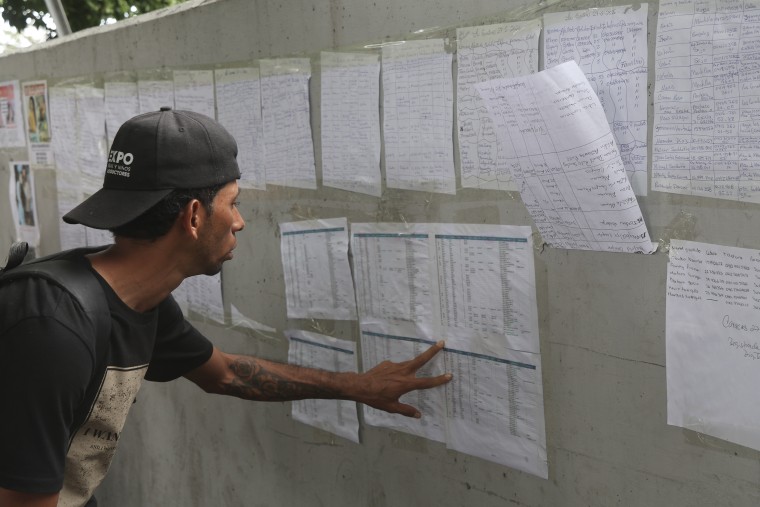
In La Guaira, Venezuela, local and international rescue teams are racing against time to pull survivors from debris, several days after two devastating earthquakes struck the region. By Sunday afternoon, the government reported that 1,450 people had died, amid criticisms from Venezuelans about the government’s inadequate response overshadowed by civilian efforts to rescue people trapped under collapsed structures. Thousands are missing, with families using multiple databases to find their loved ones.
Rescuers continue to find survivors despite diminishing chances of finding people alive. Aid agencies emphasize the critical nature of the first 48 to 72 hours post-disaster for finding survivors, though this period can extend with access to food and water.
On Sunday morning, rescue workers from the U.S. and France managed to save a man and his son from the ruins. They were carried to safety on a black tarp and given hydration through an IV, witnessed by a large crowd. As of Saturday, over 2,200 rescue workers from around the world had arrived, with more still joining the efforts, according to the U.N.
“It’s been incredibly hard work, but we’re going strong,” said Jason Mercano, a civilian involved in communication with family members buried under the debris via social media. “We’ve never given up hope,” he added.
Tension During Rescue Efforts
State television reported that more than 14,000 military and police personnel are patrolling La Guaira state, where access requires special permits. However, many in the region claimed minimal government presence. Nonetheless, rescue efforts appeared more organized by Sunday compared to previous days.
The disaster presents a significant challenge for Rodríguez, who assumed office in January following the U.S. removal of former President Nicolás Maduro. The country has been in economic turmoil for more than a decade, with many questioning the legitimacy of Rodríguez’s political movement. The government reported more than 770 buildings had totally or partially collapsed, double the number initially reported.
Amidst the chaos, people cried out names on building remnants, seeking any sign of life. Coastal communities were covered in dust, with many wearing masks to combat the smell of decomposition. Rescue teams identified bodies, while in other parts, bodies were loaded onto trucks from a makeshift hospital parking lot.
Frustration with the government led some to block an excavator from leaving a collapse site, after witnessing state workers taking selfies in front of flattened buildings without aiding in the rescue efforts. Over 6 million people could be affected by the quake, with 2 million in Caracas, according to the International Organization for Migration.
Experts attribute the massive destruction to the quick succession of shallow quakes, with smaller aftershocks continuing to shake Caracas and other affected areas.
Hope Amidst the Tragedy
International aid continues to flow in from countries including Mexico, the U.S., Brazil, El Salvador, and France, providing a sense of hope for many. Yonahí Regalado has been persistently calling out for her sister, nephew, and godson since the earthquakes, joining relief workers as they arrive. She said, “It doesn’t matter who it is, whether it’s family or someone else. If anyone is alive, let’s get them out.”
Amidst the debris in La Guaira, moments of humanity blend with grief and uncertainty. A video captured a Venezuelan rescuer comforting an elderly woman trapped under rubble, reassuring her, “The roof won’t cave in. If it falls, I’ll be here with you.”
Simón Bolívar International Airport in Caracas sustained significant damage. One runway remained operational while teams from the U.S. worked on repairs to help maintain a critical pathway for aid, according to Jeremy Lewin, a senior State Department official overseeing foreign assistance.
 British Police Arrest Man Suspected of Terror Plot
  Activists Push for Nationwide Ban on Child Marriage in the U.S.
  Investigation into Alleged Incident at Cornell University
  Rising Drone Threats Highlight Vulnerabilities in Moldova’s Airspace Defense
  Bolivia Faces Security Test Amid Unrest
  Incident on FlyDubai Flight Raises Security Concerns