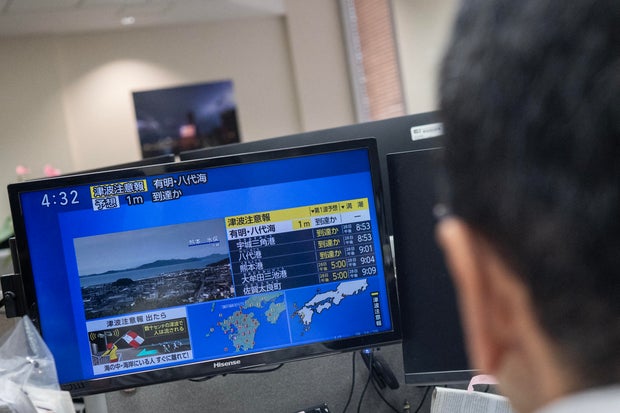
A strong earthquake struck southern Japan on Tuesday, registering a magnitude of 7.1, according to the Japan Meteorological Agency. The U.S. Geological Survey reported a magnitude of 6.8. The earthquake’s epicenter was near Kumamoto city, located about 600 miles south of Tokyo.
A tsunami alert was issued anticipating waves about one yard high. Japan’s Nuclear Regulation Authority reported no immediate damage, casualties, or problems at nuclear plants in the area. The quake rated a level seven on Japan’s Shindo scale, the highest possible level.
Footage of the earthquake’s impact in southern Japan was observed by reporters in Tokyo on July 28, 2026.
The Pacific Tsunami Warning Center in Honolulu indicated no tsunami threat to Hawaii or American Samoa. Prime Minister Sanae Takaichi urged residents to avoid coastlines due to potential tsunami risks. She announced the formation of a government task force to assess damage and prepare rescue operations if necessary. “We are putting people’s lives as the top priority,” Takaichi emphasized, advising residents in affected areas to remain cautious of potential strong aftershocks.
Japan’s Fire and Disaster Management Agency reported no immediate damage to major public utilities or infrastructure, but assessments were ongoing. Shinkansen bullet trains and local services in Kyushu were suspended temporarily for safety checks, a standard procedure after such quakes.
 British Police Arrest Man Suspected of Terror Plot
  Activists Push for Nationwide Ban on Child Marriage in the U.S.
  Investigation into Alleged Incident at Cornell University
  Rising Drone Threats Highlight Vulnerabilities in Moldova’s Airspace Defense
  Bolivia Faces Security Test Amid Unrest
  Incident on FlyDubai Flight Raises Security Concerns