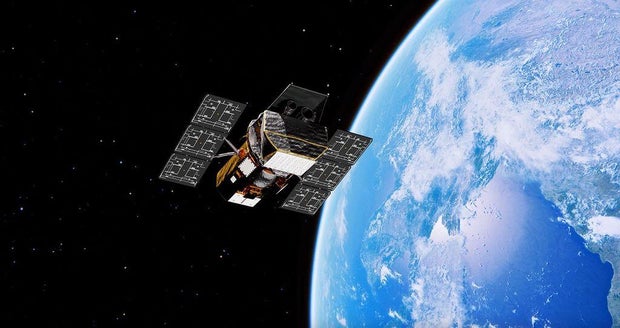
The Swift Observatory, a NASA telescope weighing 1.5 tons, returned to Earth after over two decades in space. It reentered Earth’s atmosphere at 7:39 a.m. ET over North Sumatra, Indonesia, as confirmed by NASA. Most of the observatory burned during reentry, but some components may have survived. These remnants could be scattered across different regions.
NASA and the U.S. Space Force tracked the observatory’s reentry path. The estimated reentry time was projected around 3:30 a.m. EST on November 4, with an 11-hour uncertainty window. Despite its return, NASA assured that the risk to human safety was minimal, with odds calculated at 1 in 2,100.
The Swift Observatory was launched into low-Earth orbit on November 20, 2004. Its primary goal was to detect significant galactic explosions like gamma-ray bursts and supernovas. Named for its agility in positioning toward these events, the telescope was intended for a two-year mission but operated for nearly 22 years until last month. Increased solar activity prompted its descent back to Earth.
In July, NASA contracted Katalyst Space to attempt rescuing the telescope. A robot named Link was deployed to reposition the observatory but faced challenges and could not get closer than seven miles. Consequently, in September, plans shifted to allow the telescope’s natural descent.
The observatory ceased scientific operations in late October when it became too low to maintain stability. Throughout its service, Swift observed over 2,000 gamma-ray bursts and 1,400 supernovas. It acted as a prompt notifier for observations, assisting major telescopes like Hubble and Webb.
NASA acknowledged the telescope’s contribution to understanding cosmic phenomena such as active galaxies with supermassive black holes, X-ray flares, and supernovas. Efforts are ongoing to cover the scientific void left by Swift.
John Nousek from Pennsylvania State University expressed the inevitability of Swift’s return, acknowledging the impact of its findings on future missions. He emphasized that deriving insights from Swift’s legacy can benefit subsequent space endeavors.