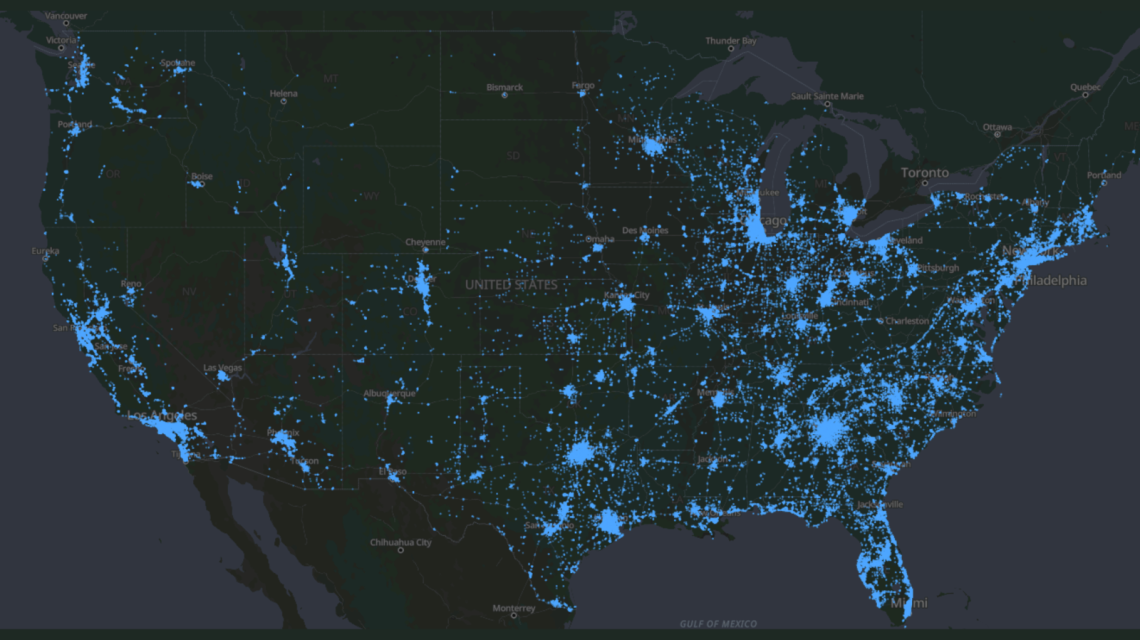
Flock Safety’s ALPR Network
Flock Safety manages a system of automated license plate reader (ALPR) cameras positioned at roads, intersections, and entrances to neighborhoods. These cameras collect not only license plate numbers but also details like the vehicle’s color, make, model, and other unique features. Law enforcement agencies that participate in this program can then search the collected data.
Supporters of Flock Safety claim the system is an essential tool for investigations. Across the nation, police departments have credited these cameras for identifying suspects, recovering stolen vehicles, and providing leads in criminal cases. These advantages have contributed to the company’s rapid expansion, with its cameras now operational in thousands of U.S. communities.
An anti-surveillance group, DeFlock, has recorded over 122,000 such cameras nationwide.
Controversy Surrounding Flock Cameras
The main source of contention is the ability to track vehicle locations continuously. Critics highlight that while a single camera offers only a brief glimpse, a network can compile a comprehensive record of a person’s movements.
Privacy advocates express concerns that these systems might unveil sensitive information such as where individuals reside, work, worship, seek medical care, or participate in political events. The concerns about surveillance and civil liberties have led several communities to reject new Flock camera installations or dismantle existing networks.
Likewise, pieces of legislation have been introduced by Republican lawmakers aiming to restrict or better regulate ALPR technology, citing concerns about its potential impact on privacy rights and constitutional protections, especially under the Fourth Amendment.
Questions regarding potential abuses of the system have arisen as well. Instances have occurred where officers have allegedly misused access to license plate databases, fueling arguments that current safeguards may fail to prevent such incidents. Supporters believe isolated cases of misuse should not diminish the technology’s capacity to help solve crimes, suggesting that enhanced oversight and access controls could mitigate abuse without eliminating this valuable investigative tool.
Fourth Amendment Implications
The legal discussion revolves around the Fourth Amendment, which guards against “unreasonable searches and seizures.” Traditionally, courts have ruled that there is no reasonable expectation of privacy for information exposed to the public, meaning that recording license plates on public roads does not constitute a Fourth Amendment search.
Proponents of Flock cameras lean heavily on this reasoning. Critics argue that the extensive surveillance capabilities of modern technology challenge this perspective. The core issue centers on whether authorities can aggregate millions of observations into a comprehensive database that reconstructs personal movements and daily routines.
This argument mirrors the Supreme Court’s decision in Carpenter v. United States (2018), where it was determined that while cellphone location records are held by carriers, they reveal critical details about personal lives that warrant privacy protections.
Are Flock Cameras Unconstitutional?
No court has definitively ruled Flock cameras unconstitutional. A notable legal challenge, Schmidt v. City of Norfolk, contests Norfolk, Virginia’s citywide Flock camera system. Plaintiffs claim that the collection and retention of location data from numerous drivers amount to a warrantless search, violating the Fourth Amendment.
In January 2026, a federal judge sided with the city, ruling that Norfolk’s usage of the cameras adhered to constitutional standards. The decision stated that the cameras did not surveil a person’s complete movements and only utilized publicly observable information.
The case is under appeal, potentially posing a pivotal test for how constitutional privacy frameworks apply to contemporary surveillance technologies.
Additional Concerns and Initiatives
The debate has led to the creation of projects aimed at revealing the extent of the Flock camera network. FlockHopper, for instance, illustrates the interconnected nature of ALPR systems and the ability to cross-reference vehicle information across jurisdictions.
Privacy advocates assert such initiatives demonstrate the operational dynamics of surveillance networks and how vehicle data might be accessed by remote agencies. Conversely, supporters advocate for information sharing to probe criminal activities spanning city and state boundaries.
Future Implications for Privacy and Surveillance
The contention surrounding Flock cameras transcends license plate data. For supporters, the technology signifies a breakthrough in crime-solving for police departments. Critics perceive a burgeoning surveillance infrastructure that documents Americans’ movements, many of whom are not suspected of unlawful actions.
Courts have historically maintained that individuals lack a privacy interest in public observations. What’s in dispute is whether mass collection, prolonged data storage, and searchable capabilities for cross-jurisdictional access represent a new reality.
This unanswered question is being reviewed by courts, lawmakers, and local governments nationwide, with potential ramifications for the Fourth Amendment’s application to future surveillance technologies.
 Trump’s 2024 Campaign Targets Young Men Through Cryptocurrency
  How Modern Windows Improve Home Insulation
  State Department Simplifies Passport Process with Online Applications
  Senate Democrats Block Data Center Bill Over Efficiency Concerns
  Future Cities: Ambitious Projects Aiming for Innovation and Sustainability
  High-Profile Hearing and AI Developments: Key Political Moves