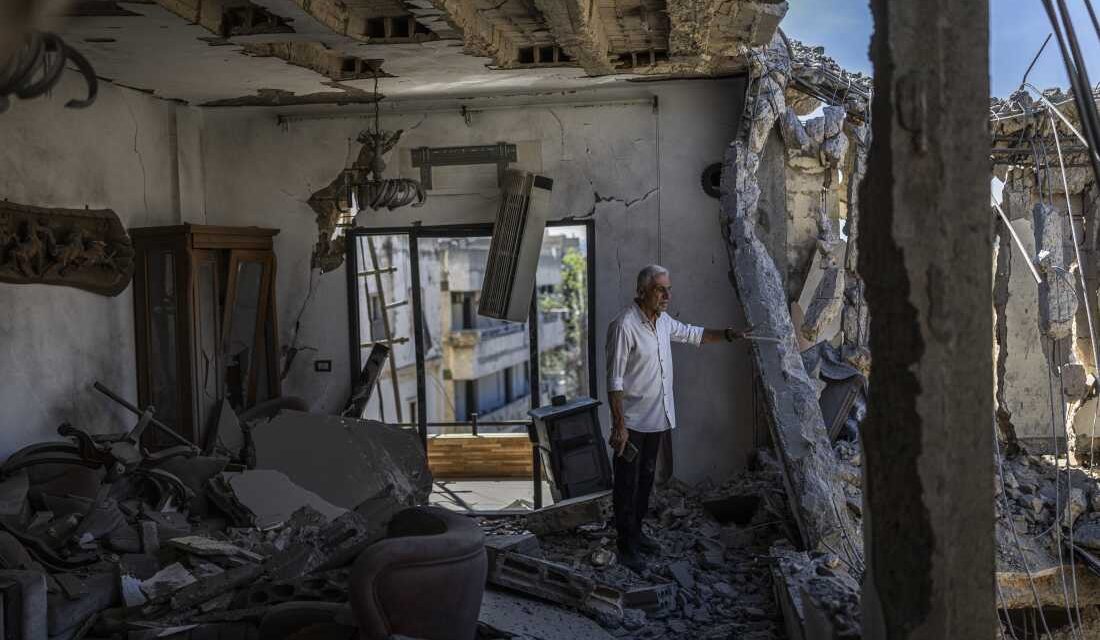
In Nabatiyeh, Lebanon, Najib Ayyad surveys his damaged apartment, now likely facing demolition. The apartment overlooks Beaufort Castle, a historic symbol of personal significance for him, currently under Israeli control. ‘You see the castle?’ Ayyad questions, referring to the fortress overtaken by Israeli forces in May, extending beyond a described ‘security zone’ in southern Lebanon. ‘They see us clearly from there,’ he points out, adding that the damage compels him to leave.
During a June visit, Israeli artillery smoke is visible near Nabatiyeh, a crucial hub in southern Lebanon. Despite the devastation and drone noises, the city shows signs of tentative rebuilding. Ayyad, a parliamentary worker, returns to fetch belongings from his ravaged apartment, previously a short commute to Sidon. With financial constraints, he stays with his daughter in Beirut. Reaching his apartment is challenging due to shattered glass and concrete blockages. Israeli air strikes have disabled the city’s electricity.
On Nabatiyeh’s streets, most homes show extensive damage. A once-elegant villa, though intact at the front, suffers heavy rear damage. Historically, Nabatiyeh served as a vital commercial center, first as a transit route between Jerusalem, Damascus, and Mecca, then as a significant Ottoman town. Israeli forces occupied it in 1982, withdrawing in 1985. Nabatiyeh’s covered market, once thriving with produce, clothes, and crafts, now lies in rubble.
Mayor Abbas Fakhreddin advises against returning due to security risks and a lack of basic necessities, highlighting extensive reconstruction needs. Fakhreddin and local residents interpret the damage as Israel’s attempt to halt commercial activities. Israeli Defense Minister Israeli Katz stated plans to demolish homes in a ‘buffer zone’ to prevent Hezbollah aggression.
Near the market, Hanan Hamadi’s small convenience store represents resilience. Returning with her mother from Beirut, Hamadi restocked their shop, replacing damaged goods and re-opening. A framed photo of her late father adorns the wall. Despite destruction, the store reflects hope, offering daily essentials and even birthday candles.
Hamadi recalls the Basma family, neighbors killed in a March airstrike. Two children remain under the collapsed house, emphasizing the war’s tragic human toll. Amnesty International deems the airstrike a potential war crime due to the lack of military targets. Israel asserts its efforts to minimize civilian harm, yet provided no updates on investigations.
For Hamadi and her mother, Nabatiyeh is now unrecognizable. Despite resilience, she admits exhaustion. The city’s paramedic teams continue their efforts amid danger. Mohammad Sleiman’s unit lost 16-year-old Joud Sleiman, killed in a strike while delivering food to civilians. Volunteers face ongoing psychological pressures but remain resolute in helping the wounded.
Nabatiyeh, once vibrant, now bears the scars of conflict. Despite previous wars, life persisted. Now, residents scarcely visit home. Sleiman reflects on a city that thrived, recalling a time when comings and goings were the norm. ‘We are sitting here, waiting for the airstrikes,’ he concludes.
 British Police Arrest Man Suspected of Terror Plot
  Activists Push for Nationwide Ban on Child Marriage in the U.S.
  Investigation into Alleged Incident at Cornell University
  Rising Drone Threats Highlight Vulnerabilities in Moldova’s Airspace Defense
  Bolivia Faces Security Test Amid Unrest
  Incident on FlyDubai Flight Raises Security Concerns