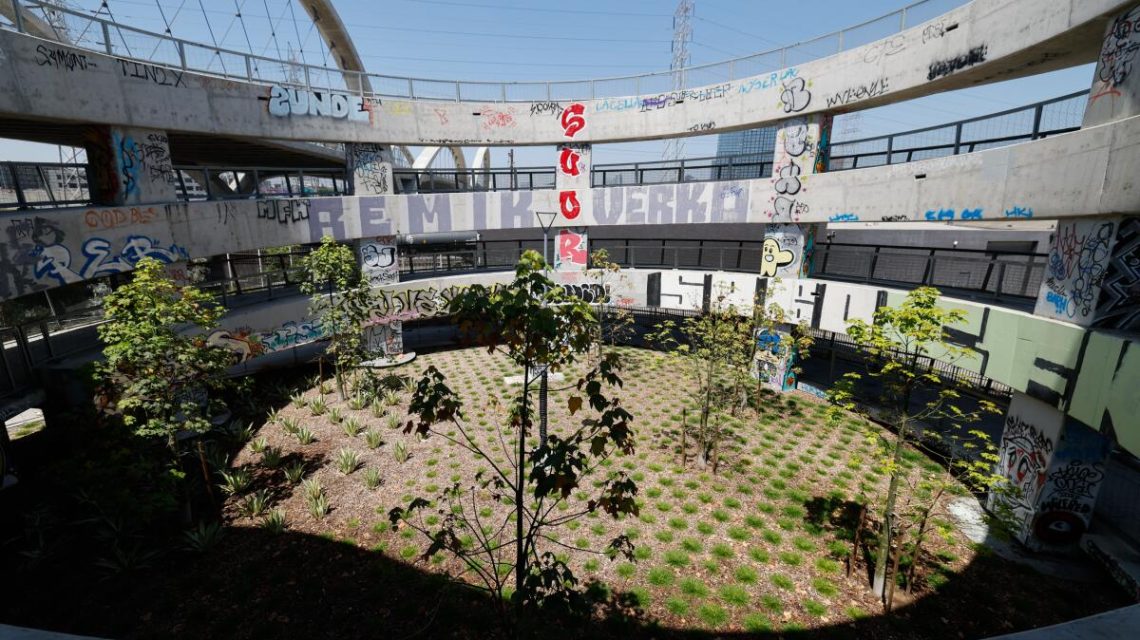
The Sixth Street Bridge in Los Angeles, an ambitious public project costing $588 million, is becoming a concern. Designed by Michael Maltzan Architecture and HNTB, it opened four years ago but now faces damage including graffiti and stripped copper wiring that leaves the area dark at night. Despite these issues, a new development is set to open beneath this bridge.
The $62-million Sixth Street PARC (Park, Arts, River, and Connectivity) aims to transform old industrial areas into vibrant recreational spaces. It will connect the Arts District with Boyle Heights, offering various amenities like fields, plazas, playgrounds, sports courts, and art venues. Michael Maltzan emphasized the park’s importance in uniting communities rather than dividing them.
“The park was always fundamental to the overall conception of the bridge,” said Michael Maltzan. “It’s this idea of changing the role of infrastructure from one of dividing communities to one that weaves them together.”
The park spans 12 acres, funded by state grants and city contributions, with planners including Hargreaves Jones and Tetra Tech. However, graffiti and trash are already appearing, indicating potential challenges for the park’s maintenance and security.
A Divided City
The park’s maintenance is divided between areas, with the Arts District Business Improvement District (BID) helping only within its boundaries. The Boyle Heights section lacks such support and relies on city government, which faces distrust. A proposal for a new BID aims to provide maintenance and security but has raised community concerns over control and influence.
The area around Boyle Heights has seen a growing presence of creative and studio businesses, which could benefit the locality. But there’s tension between potential gentrification and investments that might improve local quality of life.
Residents like Margarita Amador express both hope and concern about neighborhood changes. “They’re willing to invest in our community to improve our quality of life,” she stated.
Seeking Solutions
To preserve and manage the park efficiently, developer and activist Yuval Bar-Zemer proposes establishing a nonprofit to oversee it, similar to organizations in other cities. This body would partner with the community and government, ensuring operations are well-maintained.
“I don’t understand how someone can invest hundreds of millions of dollars in infrastructure, then it’s like, ‘We finished. Now let it go to hell,’” Bar-Zemer said.
However, any management model would need community approval, as emphasized by local council representatives. It’s essential the park reflects the needs of its residents.
The Path Forward
The park’s success hinges on collaboration between city officials, businesses, and the community. If neglected, it might worsen conditions. Conversely, if managed well, it could considerably enhance nearby areas.
Maltzan remains hopeful: “If this area is successful in navigating these pressures and potential, then the bridge and the park will do what we hope we wanted them to do: create a model for the way physical space can support a better version of future Los Angeles.”
 Atlantic Ends September Without a Hurricane for First Time Since 1994
  Bobcat Sightings and Conservation Efforts in Illinois
  2026 El Niño: A Historical Comparison and Future Projections
  U.S. Records Warmest September in History
  Increased Funding Needed for Psychiatric Hospitals
  Higher Consumption of Ultra-Processed Foods Linked to Increased Health Risks