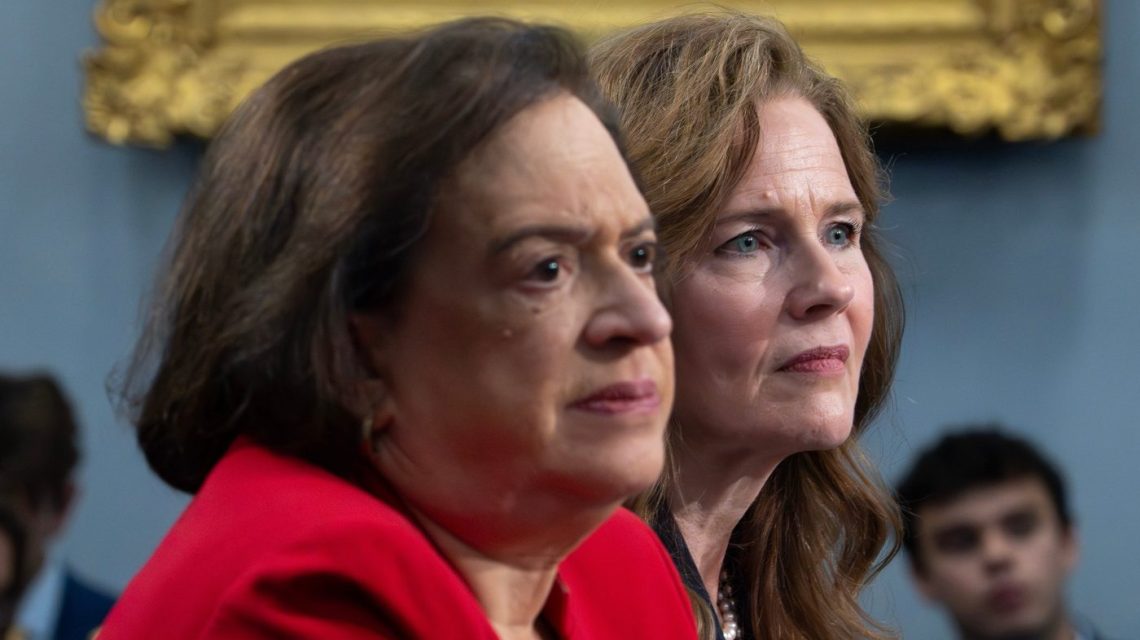
Supreme Court Justices Amy Coney Barrett and Elena Kagan appeared before a House Appropriations subcommittee. The hearing took place on July 14, 2026, at Capitol Hill in Washington.
Almost five decades ago, political scientist Robert Dahl remarked on the dual nature of the Supreme Court. He noted that viewing it solely as a legal entity misses its political relevance. Despite acknowledging its political aspects, Americans often struggle to reconcile this classification.
Recent polling indicates a shift in public opinion. Over half of Americans disapprove of the Supreme Court’s performance. Moreover, 46% believe that the Court’s decisions have aligned with Trump administration ideologies rather than legal principles. The perception of partisanship within the Court raises concerns about its role and credibility.
The present-day Court invites comparisons with historical precedents. The Taney Court’s Dred Scott decision, which contributed to the Civil War, comes to mind. Similarly, the 1930s Supreme Court’s opposition to FDR’s New Deal resulted in a constitutional impasse.
On June 29, the Supreme Court granted the president power to dismiss officials in independent federal agencies. Paul Krugman, a Princeton economist, viewed this as a threat to democracy. He criticized the concentration of power as detrimental and authoritarian.
Concerns about the Court’s political leanings are persistent. Senator Sheldon Whitehouse analyzed the 2017-2018 term, highlighting departures from conservative judicial principles for partisan gains. Such actions amplify doubts about the Court’s impartiality.
Supreme Court justices exhibit ideological divisions. Justice Ketanji Brown Jackson critiqued a voting rights case for political bias. Her dissent drew sharp rebukes from Justice Samuel Alito, who labeled her stance as provocative and unfounded.
Justice Antonin Scalia’s critique of the Obergefell v. Hodges ruling exemplifies ideological rifts. He perceived the decision as overreach, challenging legislative norms and suggesting a mismatch with governance principles.
The public often perceives the Supreme Court as predictably divided along ideological lines. Despite Chief Justice John Roberts’ assertion denying partisan labels, skepticism remains. Justice Neil Gorsuch and Justice Amy Coney Barrett have spoken against the view of justices as partisan actors.
The credibility of assertions about the Court’s nonpartisanship is in question. Public trust erodes when politics appear intertwined with judicial processes. Addressing these concerns is essential for restoring confidence in the Supreme Court.
Austin Sarat, a scholar at Amherst College, emphasizes the need for the Court to redefine its public portrayal. This redefinition would help Americans understand its unique political nature.
 The Trump Team’s Challenge to the Military Leadership
  Maryland First State to Restrict Electronic Pricing in Grocery Stores
  Activists Push for Nationwide Ban on Child Marriage in the U.S.
  Democratic Hopes and Historical Warnings in 2026 Senate Race
  Republicans Face Challenges Amidst Cost of Living Concerns
  A Different Kind of Fall for Congress This Year