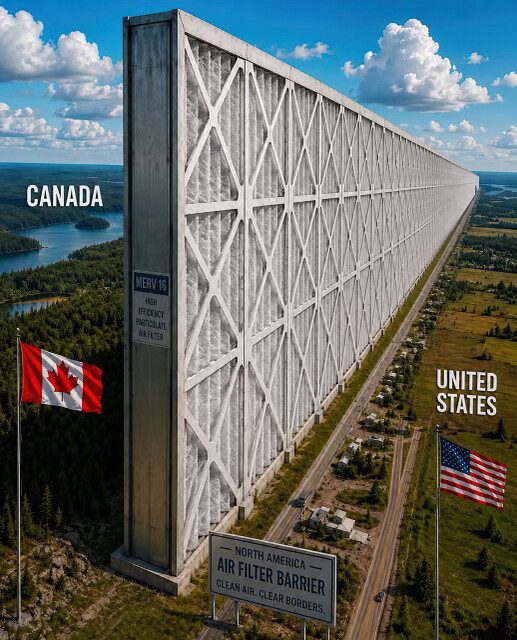
President Donald Trump intensified his criticism of Canada on Saturday by sharing an apparent AI-generated image on his Truth Social account. The image depicted a large air filter at the U.S.-Canada border, highlighting his blame on Ottawa for the wildfire smoke affecting U.S. air quality.
Context of Trump’s Post
The illustration shows a vast filtration barrier between the U.S. and Canada, with a sign stating, “North America Air Filter Barrier. Clean Air. Clean Borders.” It also labels the air filter as a “MERV 16 High Efficiency Particulate Air Filter.” The Canadian flag appears on the left side, and the American flag on the right.
Trump had previously suggested that the economic impact of the smoke should influence tariffs on Canadian goods. His statement comes despite the historical cooperation between the two countries during wildfire emergencies. Canadian officials have emphasized decades of cross-border firefighting partnerships where personnel and resources are routinely exchanged.
Canada’s Prime Minister Responds
Prime Minister Mark Carney addressed Trump’s remarks, stating that Canada is actively working to control the wildfires. He conveyed the vast scale of Canada’s forests, explaining that they are eight times the size of Texas. He also mentioned the extensive drought conditions affecting the region, equivalent to areas ranging from Texas to Minnesota.
Understanding Canadian Wildfires
Wildfires in Canada are a recurring natural phenomenon, particularly in the boreal forests. However, rising temperatures and drier conditions have exacerbated fire seasons. Experts note that lightning often sparks the largest fires, but human activities such as unattended campfires and equipment sparks contribute as well.
Currently, many fires are in remote Ontario and northern areas, complicating firefighting efforts due to limited access.
Impact of Smoke on the U.S.
Last week, wildfire smoke spread across the Great Lakes and Northeast, impacting cities like Chicago, Detroit, and New York City. The smoke triggered air quality alerts as particulate pollution reached high levels, causing orange skies and reduced visibility in some areas. Though much of the smoke has dissipated, it is expected to return in the upcoming week, according to meteorologist Ben Noll.
Looking Ahead
Canada’s wildfire season usually remains active from May through September, with activity decreasing in the fall due to cooler temperatures and increased precipitation. However, if dry conditions continue, air quality issues might persist in Canada and the northern U.S.
 Swiss Glaciers Show Effects of Ice Loss Amid Global Warming
  Climate-Resistant Rock Glaciers: Hidden Water Resources
  Dutch Review Board’s Euthanasia Ruling and International Debate
  Israeli PM Commends Heroic Actions in Flight Emergency
  Rabbi and Jewish Leaders Criticize Adam Brody for ‘Genocide’ Comment
  Senators Reach Bipartisan Agreement on Permitting Reform