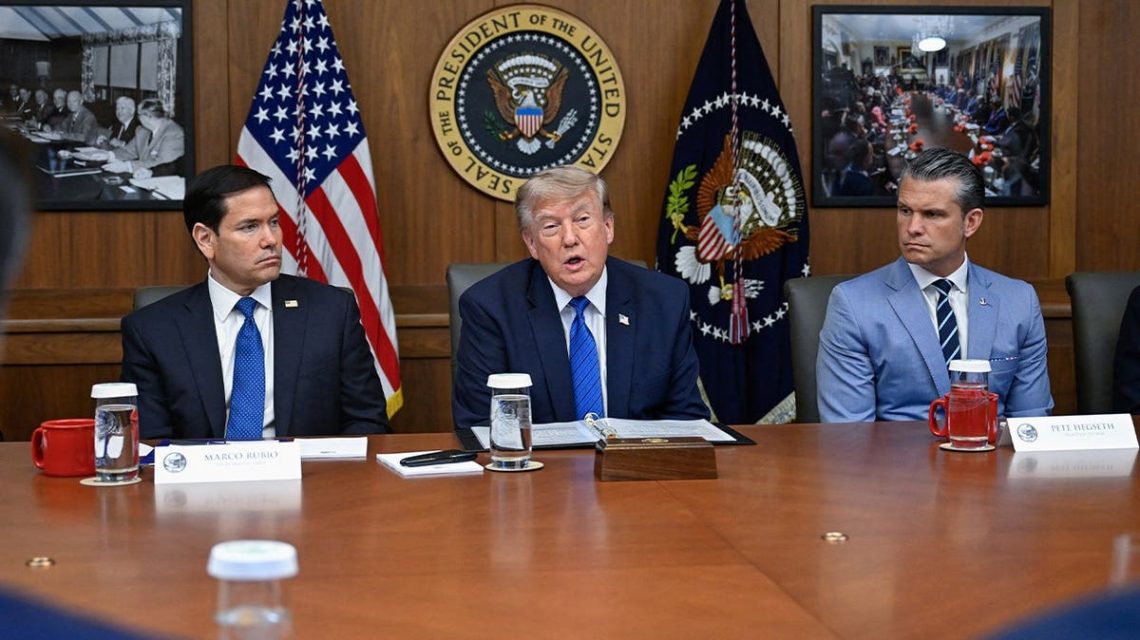
President Donald Trump stated that Americans should brace for ongoing conflict with Iran. He believes Tehran will eventually ‘peter out’ as U.S. strikes reduce its capacity to retaliate.
During a Cabinet meeting at Camp David, Trump acknowledged the possibility of continued attacks until Iran’s striking capability diminishes. ‘Yeah, sure, I think so. I’d be foolish to say no. You know, you always have to keep your guard up,’ he said. He predicted Iran would weaken over time.
They’ll get weaker. They’ll get a little stronger, maybe. But they’ll get weaker, and then they peter out.
The remarks suggest the five-month conflict may persist, despite Trump’s claims of reduced Iranian military strength and his earlier optimism about negotiations.
Trump commented on the U.S. position, ‘I think we just want to win. We’re doing very well. We’re trying to be nice—as nice as you can be in a situation like that—but they’re being decimated.’ He noted Iran’s diminished military capabilities, mentioning their lack of navy, air force, and significant anti-aircraft assets. However, Iran still possesses some military capability.
The fighting complicates previous statements from the administration about eliminating Iran’s military threat. The White House had declared the success of Operation Epic Fury in April, citing the destruction of Iran’s naval, ballistic missile, and drone capabilities. Despite this, Iran continues to launch attacks on U.S. bases and commercial shipping.
Trump expressed doubt about securing a deal with Iran, accusing them of deception. ‘They do lie, and they do misrepresent,’ he stated, emphasizing his frustration with their negotiation tactics.
The renewed conflict coincides with the approach of the November midterm elections, increasing pressure on Trump to clarify the war’s end. His comments followed U.S. Central Command’s announcement of targeted strikes on Iranian military facilities, including those of the Islamic Revolutionary Guard Corps.
The military actions respond to missile attacks targeting U.S. forces. These developments occur after the collapse of a June agreement between Washington and Iran aimed at restoring navigation through the Strait of Hormuz. Hostilities resumed in July when Iran attacked vessels in the critical waterway.
Countries like Oman, Qatar, Pakistan, and Egypt have attempted to revive the June agreement, focusing on control over the Strait of Hormuz, sanctions relief, and Iran’s nuclear agenda. However, an exchange of attacks has hampered these diplomatic efforts.
 British Police Arrest Man Suspected of Terror Plot
  Activists Push for Nationwide Ban on Child Marriage in the U.S.
  Investigation into Alleged Incident at Cornell University
  Rising Drone Threats Highlight Vulnerabilities in Moldova’s Airspace Defense
  Bolivia Faces Security Test Amid Unrest
  Incident on FlyDubai Flight Raises Security Concerns