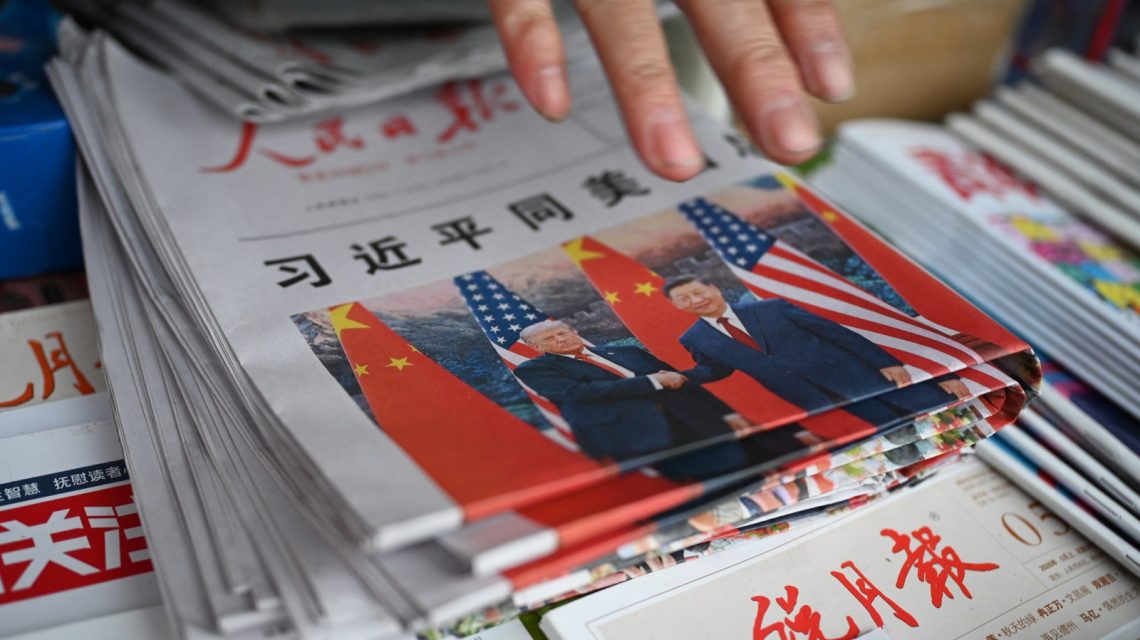
President Donald Trump announced plans to communicate with Taiwan’s President Lai Ching-te regarding a stalled arms package. This comes shortly after Trump’s visit to China. Engaging with Taiwan presents risks to the sensitive dynamics between the U.S. and China. The Chinese government asserts sovereignty over the self-ruled island. In response to inquiries about potential talks, Trump stated, “I speak to everybody.” This would be ahead of approving a $14 billion arms sale that is currently on hold in the State Department.
Trump emphasized that the “situation is very well in hand,” referencing a productive meeting with President Xi. He noted the importance of addressing the “Taiwan problem.” Trump has previously engaged with Taiwan’s leaders, such as taking a call from Taiwan’s President Tsai Ing-wen during his first presidential term. Since diplomatic relations ended in 1979, no sitting U.S. president has spoken directly with a Taiwanese leader.
Taiwanese Foreign Ministry spokesperson Hsiao Kuang-wei noted that President Lai stressed keeping communication open. If given a chance, Lai would highlight Taiwan’s societal views and underscore the importance of peace and stability across the Taiwan Strait. Taiwan positions itself as a peace and stability guardian in the region.
Why Taiwan Matters
Taiwan, a democracy, is key to U.S. economic interests and ranks among its top trading partners. It leads in producing advanced computer chips used worldwide. Taiwan’s strategic position complicates matters with China, which maintains the island as its territory. This ongoing tension concerns the U.S., the primary weapons supplier to Taiwan. The Chinese president warned of possible conflicts due to differing views on Taiwan.
U.S. Secretary of State Marco Rubio stated the American stance regarding Taiwan’s right to self-govern is unwavering. Though China consistently raises the issue, Rubio emphasized focus on other topics after making the U.S. position clear. The Taiwan matter has long fueled U.S.-China diplomatic tensions. Notable moments include former House Speaker Nancy Pelosi’s visit to Taiwan in 2022, which alarmed both Beijing and D.C. She was the highest-ranking U.S. official to visit in 25 years, pressing against authoritarian tendencies, while the Biden administration adhered to a “one China” policy.
Details on the Taiwan Weapons Package
The $14 billion arms deal remains under extensive discussion. Following December 2025’s announcement, it comes amid increasing Chinese military pressure on Taiwan. The package includes HIMARS rocket systems, anti-tank missiles, loitering drones, military software, and antiarmor missiles, according to CNN. Trump, fresh from China, disclosed recent talks on the arms deal with China’s leader, underscoring his commitment to avoiding war.
In light of China’s regional conduct, Taiwan considers bolstering its defenses essential. Taiwan’s appreciation for Trump’s involvement in the Indo-Pacific discussion was expressed by spokesperson Huang. Meanwhile, a Chinese U.S. embassy spokesperson emphasized Taiwan as the core issue between China and the U.S., stressing China’s perspective and urging U.S. actions that support peaceful relations.
Trump could delay authorizing the arms package pending further dialogues with Xi, planned for September, alongside the Asia-Pacific Economic Cooperation summit in December. Nonetheless, his Wednesday comments inferred eagerness to finalize the arms deal promptly. A White House official noted that Trump’s decision aligns with U.S. policy from the 1950s.
 The Trump Team’s Challenge to the Military Leadership
  Maryland First State to Restrict Electronic Pricing in Grocery Stores
  British Police Arrest Man Suspected of Terror Plot
  Activists Push for Nationwide Ban on Child Marriage in the U.S.
  Democratic Hopes and Historical Warnings in 2026 Senate Race
  Republicans Face Challenges Amidst Cost of Living Concerns