Location: Dubai, United Arab Emirates
On Monday, the United States and Iran reached an initial agreement aimed at extending their fragile ceasefire, which could lead to the reopening of the Strait of Hormuz. However, significant challenges remained, including Israel’s continued military actions in Lebanon.
Agreement Details:
The specifics of the agreement have not been disclosed but are expected to be finalized by Friday in Geneva, according to Pakistan, a key mediator. Until then, shipping through the Strait of Hormuz remains limited. This strait is vital for global oil and gas trade, and its closure has triggered an energy crisis worldwide.
Israel’s Position:
Israel’s Defense Minister stated that the country will not withdraw from the occupied territories of Lebanon, where it is currently engaged in combat against the Iranian-backed group Hezbollah. Israel and the U.S. initiated the conflict on February 28, but Israel is not part of the agreement. A spokesperson for the Prime Minister’s office, under Benjamin Netanyahu, affirmed Israel’s commitment to defending its security against any threats, potentially jeopardizing the agreement since Iran insists it must include an end to hostilities in Lebanon.
Additional Challenges:
The agreement also encounters other substantial hurdles. It involves a 60-day period to determine the fate of Iran’s highly enriched uranium reserves and its atomic program. The U.S. and Israel fear these could be used for nuclear weapon development, despite Tehran’s assertions of peaceful intentions—a matter previously resolved in the 2015 nuclear deal with world powers, later abandoned by President Donald Trump.
Global Response:
Despite uncertainties, the agreement was welcomed by leaders from Europe to China, aiming to end a conflict that claimed thousands of lives across the Middle East. The war has inflated fuel, food, and essential goods prices beyond the region. Nevertheless, concerns about the agreement’s fruition remain, highlighted by Luxembourg’s Foreign Minister Xavier Bettel, who remarked, “There is a long way until Friday.”
Strait of Hormuz Status:
The Strait of Hormuz will remain closed until the agreement is signed. Trump, under pressure to end the war before the midterm elections in November, announced the agreement’s success on social media, stating authorization for reopening the strait and lifting the U.S. blockade on Iranian ports. However, he confirmed the reopening would not occur before Friday.
Iran’s Confirmation:
Iran’s Deputy Foreign Minister, Kazem Gharibabadi, affirmed the agreement on state television but declared implementation would be postponed until signing.
Impact of the War:
Initially, Iranian attacks on ships nearly halted traffic through this critical waterway, prompting Trump to impose a blockade. This closure disrupted the transportation of one-fifth of the world’s oil and natural gas, causing fuel prices to surge with worldwide economic repercussions. Energy experts suggest it will take months for companies to restore operations to meet global demand.
Preparatory Meetings:
Preparations involve U.S. and Iranian officials meeting in Doha, Qatar, in the lead-up to the signing, according to a diplomat privy to the talks who requested anonymity for discussing closed-door meetings.
Israel and Hezbollah:
The success of the agreement relies partly on developments between Israel and Hezbollah in Lebanon. Recent Israeli bombing around southern Beirut nearly disrupted negotiations, with prior attacks causing exchanges between Iran and Israel. Defense Minister Israel Katz stated Israel intends indefinite occupation of controlled lands in Lebanon, Syria, and Gaza, threatening Iran with retaliatory force if attacked.
Israel’s Territorial Control:
Over the past two and a half years, Israel has seized 1,000 square kilometers (386 square miles) across Gaza, Lebanon, and Syria.
Israel’s Stance: A spokesperson for Netanyahu’s office, David Mencer, informed the Associated Press that Israel and the U.S. remain united in preventing Iran from obtaining nuclear weapons. He emphasized Israel’s intolerance of Hezbollah attacks on its territory and commitment to protecting its citizens.
Hezbollah’s Response: Hezbollah has yet to comment on the agreement.
 Dutch Review Board’s Euthanasia Ruling and International Debate
  Israeli PM Commends Heroic Actions in Flight Emergency
  Rabbi and Jewish Leaders Criticize Adam Brody for ‘Genocide’ Comment
  Flydubai’s Emergency Landing Highlights Cockpit Security
  Former Israeli PM Naftali Bennett Commends Passengers and Crew for In-Flight Heroism
 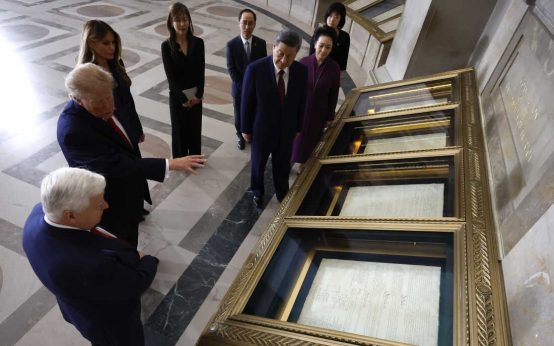 Diplomatic Complexities Unfold at U.S. National Archives Visit