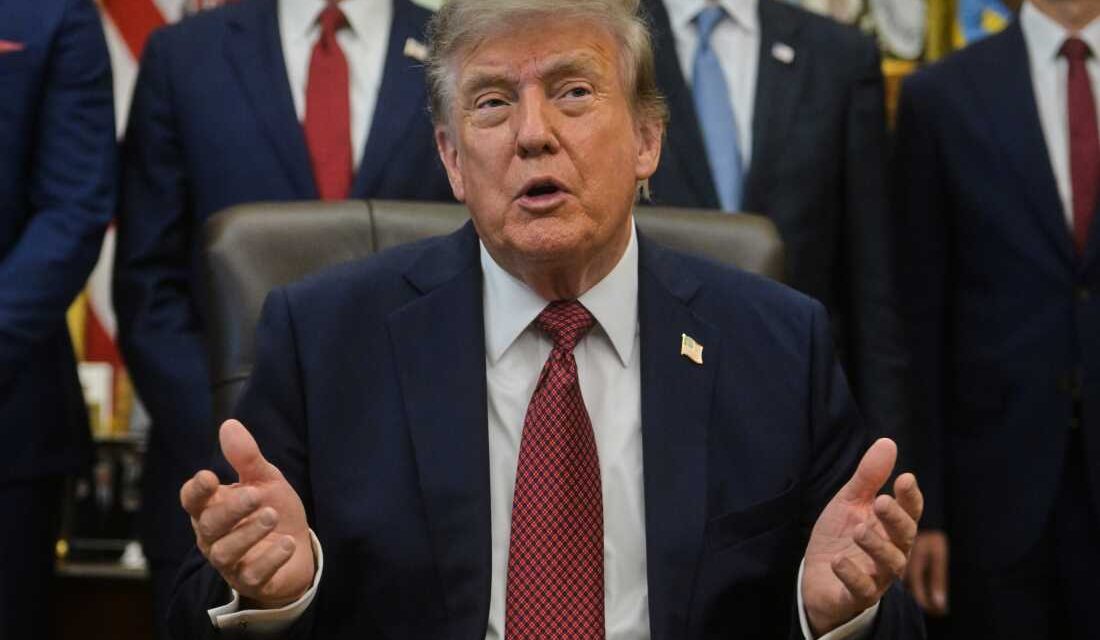
President Donald Trump addressed the current tensions in the Oval Office of the White House on July 24, 2026. The U.S. military has paused airstrikes against Iran following a period of intensified bombing. Diplomatic initiatives are underway to prevent further escalation and to avoid returning to full-scale warfare, though the outcome remains uncertain as the conflict approaches five months.
Despite threats of additional strikes, Trump highlighted ongoing negotiations, dismissing concerns about higher gas prices affecting Republicans in upcoming midterm elections. An additional element of unpredictability comes from Israeli Prime Minister Benjamin Netanyahu’s scheduled visit next week, potentially influencing the conflict’s dynamics. Israel has been absent from recent American attacks even after Iran closed the Strait of Hormuz, a critical oil transit pathway, since the onset of hostilities.
“The Iranians understand that perhaps it could get worse because Israel could come into the conflict,” said Michael Singh, managing director at the Washington Institute for Near East Policy. However, Israel’s lack of involvement might signal to Iran that efforts are being made to limit the conflict.
Singh, who served as senior Middle East director during the George W. Bush administration, advises caution in interpreting the current lull in fighting: “If it turns into a multiday pause, that’ll be significant, but it’s hard to determine if it’s operational or diplomatic.”
Mediators Strive for Resolution
A regional official engaged in mediation reported active diplomatic negotiations and noted that the pause in strikes and Iranian counterattacks is a positive sign favoring de-escalation. Both nations aim to return to an interim ceasefire, with discussions focusing on easing restrictions on ship transits through the Strait of Hormuz.
Iran has imposed constraints on this vital waterway by targeting tankers, raising oil prices during the conflict, which could endanger Republican positions in the November elections. Although an interim ceasefire was established in June, disputes over control persisted. Iran demands a coastal route for ships and proposes fees, while American-led forces have attacked Iran’s coastal defenses to secure alternate paths.
Diplomacy and Military Strategy
Singh notes U.S. strikes appear to press Iran back to negotiations, considering the fractured leadership within Iran. Some authorities fear that compromising with the U.S. might be perceived as a weakness. Both countries need the strait open for economic reasons, but differing terms of control must be reconciled for continued calm.
Tensions persist with Yemen’s Houthi rebels, backed by Iran, targeting Saudi Arabia after retaliatory strikes. This closure affects another strategic strait vital for oil exports. The U.S. also enforces a naval blockade on Iranian ports.
Trump Balances Threats and Diplomacy
President Trump emphasized two exit strategies: dismantling Iran gradually, or pursuing diplomatic negotiations, suggesting that Iran may soon become more earnest in talks. He met with national security aides regarding strategies to maintain or increase military actions.
No U.S. strikes occurred overnight following a 13-day sequence. Trump stressed that he isn’t rushing decisions for electoral reasons, asserting that strategic correctness takes precedence over political timing.
 The Surveillance Threat to U.S. Federal Agents
  Trump Administration Distributes ACA Refund Checks
  Trump Administration’s Approach to Illegal Alien Deportations
  New Jersey Voter Fraud Prompts Renewed Push for SAVE Act
  Concerns Over Changes to Voter-Registration Form for Americans Abroad
  Trump’s 2024 Campaign Targets Young Men Through Cryptocurrency