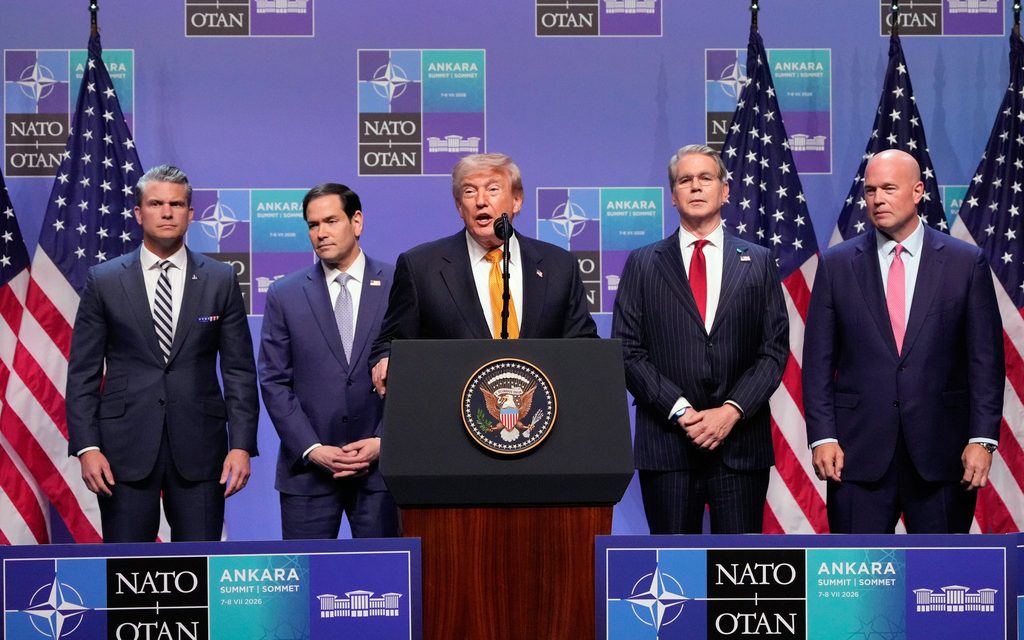
President Donald Trump spoke at a media conference during the NATO summit held in Ankara, Turkey. He was joined by key U.S. officials, including Defense Secretary Pete Hegseth and Secretary of State Marco Rubio. Current conflicts in Europe and the Middle East are expected to conclude, freeing military resources for global use. The U.S. needs to remain focused on that potential shift.
Russia’s Aggression
Russia, under Vladimir Putin, frequently uses military force to achieve political goals. Events such as the conflicts in Georgia, Crimea, and Ukraine highlight Russia’s military-driven strategy. The country’s focus on building a war-time economy and enduring significant casualties and sanctions reflects this resolve. Russia’s imperial ambitions pose a threat to Eastern European democracies. Countries like the Baltic states and Poland, along with NATO, face continuous challenges.
Strategic Moves by Europe
To counter these threats, European partners must address gaps caused by the Pentagon’s reduced presence in Eastern Europe. A strong response from Europe is crucial to withstand Russian pressures.
China’s Authoritarian Approach
The Chinese Communist Party governs with firm control, employing economic, cyber, and political tools to expand its influence. Despite tough rhetoric about Taiwan, China has not initiated major wars recently. Its last significant military foray was in 1979. Chinese military strategy focuses on deterrence and economic strength rather than direct conflict. The possibility of a sudden invasion of Taiwan remains unlikely given historical context.
Strengthening Indo-Pacific Ties
The U.S. should continue to build relationships in the Indo-Pacific. Stronger deterrence and freedom of navigation are essential. However, military priorities need to focus on areas experiencing active conflict.
Europe: The Pillar of Western Democracy
Europe has long been central to Western democratic values. America’s role in securing peace there post-WWII is significant, largely through NATO efforts. Today, Europe faces serious challenges. A robust U.S. commitment to Europe sends a strong message to adversaries while monitoring the Indo-Pacific area.
“Russia’s goal is to fragment NATO by observing weaknesses in Western unity.” – A statement on current threats
Reinforcing NATO
Investments in NATO’s eastern defenses are necessary for deterrence. Many defense investments focus on potential future conflicts with China, which may not occur. Meanwhile, munitions resources are depleting in Europe, revealing industrial base vulnerabilities. Rebuilding this capacity is vital.
The Importance of Global Deterrence
Strengthening NATO supports broader deterrence strategies. Investing in the U.S. Army and Air Force is crucial. The European theater demands land and air superiority, swift logistical support, and effective intelligence sharing. Enhancing these areas is essential for readiness.
NATO’s Influence Beyond Europe
A strong NATO can dissuade China from testing Western resolve. Defending Europe with determination benefits global peace efforts. Misallocation of U.S. military resources could be risky. Russia’s territorial ambitions are the current challenge, not China’s. By assisting European allies decisively, the U.S. can avoid escalating future conflicts and preserve American lives.
About the Source: Keith Self represents the 3rd District of Texas. He serves on the House Foreign Affairs and Veterans’ Affairs committees, leading the Europe Subcommittee. With 25 years in the U.S. Army, he provides valued insights into military and foreign affairs.
Copyright 2026 Nexstar Media Inc. All rights reserved. This material cannot be published, broadcast, rewritten, or redistributed.
 The Trump Team’s Challenge to the Military Leadership
  Maryland First State to Restrict Electronic Pricing in Grocery Stores
  British Police Arrest Man Suspected of Terror Plot
  Activists Push for Nationwide Ban on Child Marriage in the U.S.
  Democratic Hopes and Historical Warnings in 2026 Senate Race
  Republicans Face Challenges Amidst Cost of Living Concerns