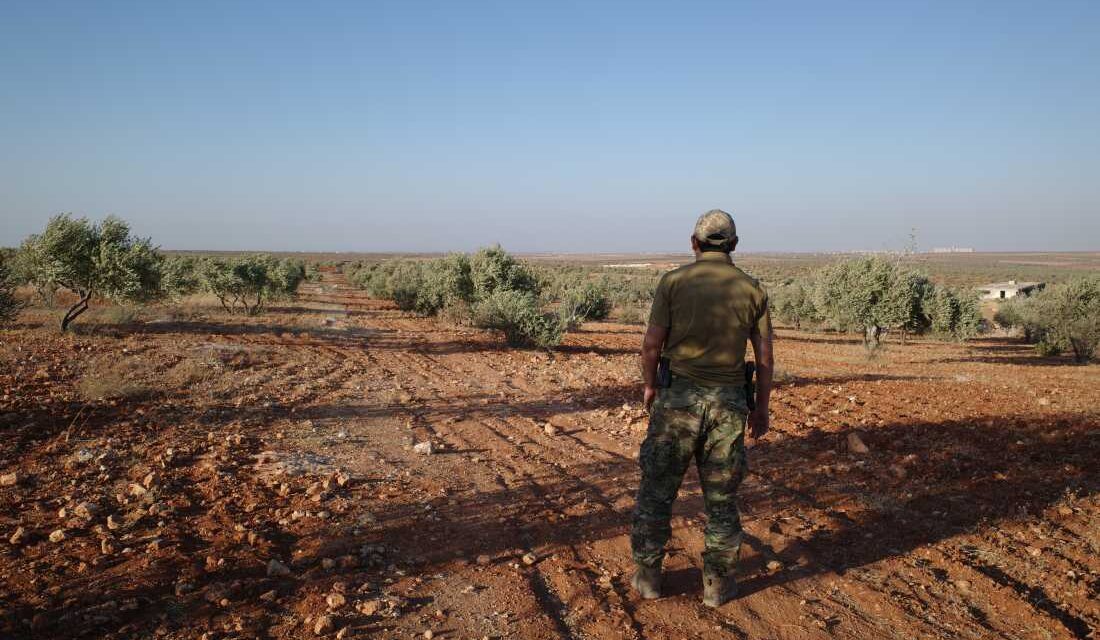
A senior Uyghur militant stands in northern Syria’s olive groves, reflecting on a successful assault against Syrian regime forces led by Uyghur fighters in November 2024. This daring plan involved elite forces ambushing Syrian government soldiers and cutting off crucial supply lines to Aleppo.
Uyghur fighters, part of a Muslim ethnic minority facing persecution in China, spent months preparing for the offensive by secretly clearing a long-disused water tunnel behind enemy lines near Aleppo.
During a meeting with Ahmed al-Sharaa, then leader of Hayat Tahrir al-Sham, a joint assault was planned to liberate Aleppo. These Uyghur forces were not originally from Syria, yet they played a pivotal role in the operation that unfolded one November night.
“We remained steadfast. Miraculously, all the brothers who charged into death itself came out alive,” remembers Hobayd, the senior commander.
By dawn, Uyghur fighters emerged from tunnels to surprise regime troops. As the second unit attacked from the front, government forces scattered in panic. This paved the way for other rebel units to advance on Aleppo.
Within days, Aleppo fell to the rebels. Soon after, Sharaa’s forces took control of Damascus as well. Bashar al-Assad fled soon after, ending his 24-year rule. This sweep was described as instrumental by Aaron Zelin of the Washington Institute, who noted the Uyghurs’ significant role in the Syrian conflict and their association with Hayat Tahrir al-Sham.
The Uyghur community has remained largely private. However, more than 40 fighters recently shared their experiences with NPR. They quickly gained a reputation as disciplined and effective, taking on challenges other rebels could not overcome.
The new Syrian government integrated the largest Uyghur militia into the Syrian National Army and appointed several Uyghur commanders as officers. Talks are ongoing about granting Syrian citizenship to some Uyghurs, despite viewing them with suspicion and Chinese diplomatic pressures to expel them.
This photo taken in May 2019 shows a “reeducation camp” for ethnic minorities in Xinjiang.
China regards all Uyghur militants, including those abroad, as terrorists. Since 2017, China has employed repressive measures like “reeducation camps” to suppress Uyghur culture and identity. In 2021, the U.S. called China’s actions a “genocide.”
Many Uyghurs described deep resentment toward China due to experiences of repression and the desire to protect their cultural rights. They hope to one day reclaim Xinjiang, known to them as East Turkestan.
“Our boys have a stubborn courage, fearless of death,” says Nurmemet, a 40-year-old fighter.
The fractured relationship between Uyghurs and Chinese authorities escalated following events like the 2009 Urumqi riots. Former Uyghur fighters cite these events as motivations to join battles abroad, finding no refuge or rights in China.
In Syria, the Uyghurs joined Hayat Tahrir al-Sham and other factions, repelling attacks and establishing influences in regions like Jisr al-Shughur. They maintained discipline and funded themselves through seized weaponry and diaspora support. However, allegiances were not uniform, with some splintering off to groups like ISIS.
Despite security challenges, Uyghurs in Syria continue to reside and play active roles in the region’s reshaped political landscape. The Uyghurs have constructed businesses and Uyghur-language educational institutions, aiming to preserve their culture while contributing to their host society.
Their future remains uncertain, facing domestic skepticism and foreign diplomatic pressure. Many Syrians, particularly those from minority sects, express unease about the continuing presence of Uyghur fighters.
“We cannot live alongside Uyghurs, given their beliefs and our differences,” says Denise Khoury, a Syrian Christian.
China has consistently called for action against Uyghur fighters. Still, as both observers and the fighters themselves note, there is no definitive link between their activities in Syria and actions in China.
“I never saw evidence linking Uyghurs in Syria with violence in China,” says Edmund Fitton-Brown, former U.N. coordinator.
Many perceive the Uyghurs as a religiously motivated nationalist movement rather than a threat to civilians. Yet, relations with China suggest ongoing tension. For now, Uyghurs resolve to fortify their community, studying historical movements that achieved independence and renewal.
Despite uncertainty over their rightful place, Uyghurs view Syria as both a new home and a stepping stone to returning one day to Xinjiang.
“We do not want our children to wander in foreign lands. Perhaps one day, our children will live in our homeland,” concludes Anas.
 G7 Nations Agree to Release 100 Million Barrels of Oil Amid Fuel Price Surge
  Co-Pilot Attempts Hijack on Flight to Tel Aviv
  U.S. Revises Global Health Aid with New Strategy
  U.S. Warns Against Travel to Colombia’s Norte de Santander Due to Security Threats
  Reflections on 30 Years at Fox News
  Mayor Mamdani Responds to Netanyahu’s United Nations Speech