Thanksgiving represents one of the peak travel periods, often marked by stress and busyness. However, for a growing number of young adults, holiday travel involves merely walking from their bedrooms down the hall of their childhood homes. Realtor.com released a report indicating a trend where regions previously attractive for affordable housing now see young adults returning to live with their parents.
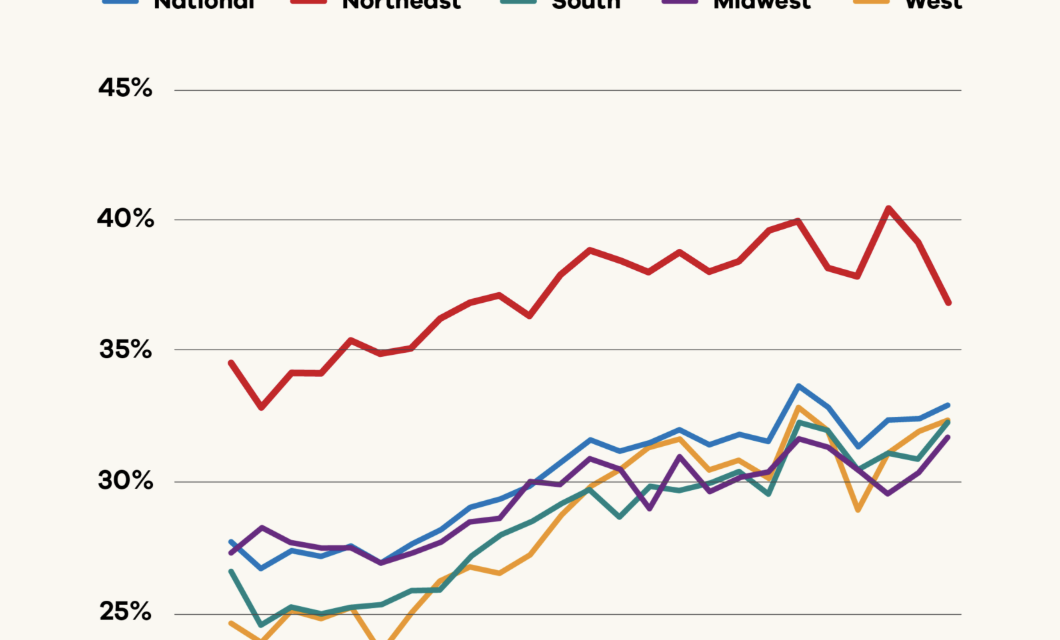
In 2025, the share of 18- to 34-year-olds living at home in the South and Midwest increased by 1.4 percentage points, reaching 32.3% and 31.7%, respectively. These regions showed the most significant rise. Contrastingly, the Northeast experienced a decline, with the percentage dropping 2.3 points to 36.9%, its lowest in a decade. Commenting on these trends, Hannah Jones, senior economist at Realtor.com, stated that this is no longer limited to coastal areas but has expanded nationwide.
Last year, a record 25.2 million young adults, about one in three, resided with their parents, as Realtor.com highlighted in June. Notably, the phenomenon of moving back home isn’t exclusive to young adults. Economist Geoffrey Sanzenbacher from Boston College’s Center for Retirement Research reported a rise in parents living with their 25- to 34-year-old children, increasing from 1.6% in 1996 to 4% in 2025.
The composition of living arrangements is shifting, with 22% of Americans in multigenerational households in 2024, up from 13% in 1970. A Pew Research Center survey revealed financial issues as the primary motivation for cohabitation, with 40% citing it as a major factor.
There is a corresponding trend in real estate. The National Association of Realtors noted that 14% of homebuyers in the year ending June opted for multigenerational homes. Reasons included caring for aging parents (30%), cost savings (23%), adult children never leaving (19%), and adult children moving back (18%).
For some families, the choice is intentional with long-term plans. In the Bay Area, Tim Yee from RE/MAX Gold observed interest in homes with accessory dwelling units. These allow families to live near one another while maintaining some separation.
In San Antonio, homes designed for multigenerational living attracted 65.2% more page views than standard ones in 2025. However, these listings had a median asking price of $573,105, significantly higher by 69%.
In the Midwest and South, often seen as cost-effective regions, these trends were prominent. Increased housing supply has not alleviated challenges. San Antonio listings are up more than 40% from pre-pandemic numbers, yet local young adults struggle to purchase due to pricing and rate barriers.
Hannah Jones of Realtor.com noted that high-earning newcomers and those upgrading their homes are better positioned to purchase available properties compared to local young adults who find it difficult to qualify under current conditions. “Mid-to-upper tier market growth does not ease entry-level housing struggles,” Jones pointed out.
 Manhattan Judge Upholds Rent Freeze in New York City
 Research Products International Invests in Libertyville 45 Corporate Center
 Jared Kushner’s Controversial Resort Development in Albania
 Rising Housing Costs Force More Young Americans to Stay with Parents
 Plans for New Apartment Development in Arlington Heights
 Transforming a Family Farm: The Story of White Oak Pastures