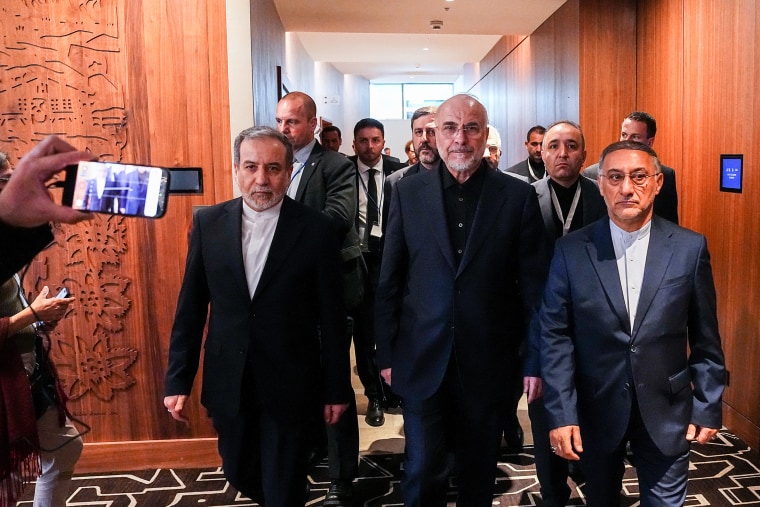
President Donald Trump announced that Iran agreed to extended nuclear inspections, contradicting Tehran’s denial of such a concession. This statement followed Vice President JD Vance’s positive summary of the recent diplomatic talks in Switzerland aimed at ending the conflict between the two nations.
Vance indicated that the discussions in Switzerland had set a strong foundation for a final agreement. He mentioned that Iran agreed to allow the International Atomic Energy Agency (IAEA) to inspect nuclear sites targeted by the United States last year. Additionally, Iran was reportedly open to using unfrozen financial assets to purchase American food products.
In a post on Truth Social, Trump affirmed these claims, suggesting negotiations would not proceed without that agreement. He highlighted Iran making significant concessions, which influenced his decision to keep the Hormuz Strait open without a naval blockade.
“If they did not agree to this, there would be no further negotiations.” – President Donald Trump
Conversely, Iran’s Foreign Ministry spokesperson Esmail Baghaei refuted plans for IAEA inspections on the bombed sites, indicating a lack of scheduled visits. The IAEA has interacted with Iran since Israel’s conflict in 2025 but hasn’t accessed the sites affected by U.S. bombings.
Despite diplomatic efforts, violence re-emerged in Lebanon. Israeli forces killed two individuals during unrest, threatening to destabilize ongoing talks as Iran insists on a truce in Lebanon as part of any broader agreement.
In Pakistan, Iran’s President Masoud Pezeshkian’s visit marked a milestone in diplomatic efforts. This is his inaugural visit since the conflict commencement. Officials in Pakistan received him under heightened security.
The negotiations also initiated a 60-day diplomatic process targeting a permanent resolution. A “de-confliction cell” was proposed to handle the Lebanon conflict involving Israel and Hezbollah. Discussions also covered maintaining open passage in the Strait of Hormuz, blocked by Iran during hostilities.
Pezeshkian, prior to Pakistani talks, emphasized adherence to obligations. He remarked on X about the necessity of commitment to agreed responsibilities for successful negotiations.
“Progress on this path will be measured by practical adherence to accepted responsibilities.” – President Masoud Pezeshkian
Iran disclosed that ongoing talks led to specific focus groups on sanctions relief, nuclear topics, reconstruction, and monitoring. Deputy Foreign Minister Kazem Gharibabadi highlighted mechanisms for the Hormuz Strait and Lebanon conflicts.
Uncertainty surrounds whether the creation of a deconfliction cell will suffice to halt Hezbollah and Israeli hostilities. Recently, Israeli troops’ actions in Lebanon resulted in fatalities, raising pressure on diplomatic efforts.
Iran refuted Vance’s claims about the use of unfrozen funds. Vance specified oversight by the U.S. and Qatar, ensuring assets from sanctions relief would buy American agriculture goods for Iranians. However, Iran asserted unilateral decision-making over those funds.
Israeli Prime Minister Benjamin Netanyahu cast doubt on the Lebanon ceasefire’s stability. He emphasized Israel’s discretion in defensive actions. Trump responded, expressing confidence in resolving issues swiftly, including those involving Netanyahu.
Despite the ceasefire, Lebanon and Israel planned further discussions in Washington concerning Israel’s withdrawal strategy, signaling ongoing diplomatic efforts.
 The Trump Team’s Challenge to the Military Leadership
  Maryland First State to Restrict Electronic Pricing in Grocery Stores
  British Police Arrest Man Suspected of Terror Plot
  Activists Push for Nationwide Ban on Child Marriage in the U.S.
  Democratic Hopes and Historical Warnings in 2026 Senate Race
  Republicans Face Challenges Amidst Cost of Living Concerns