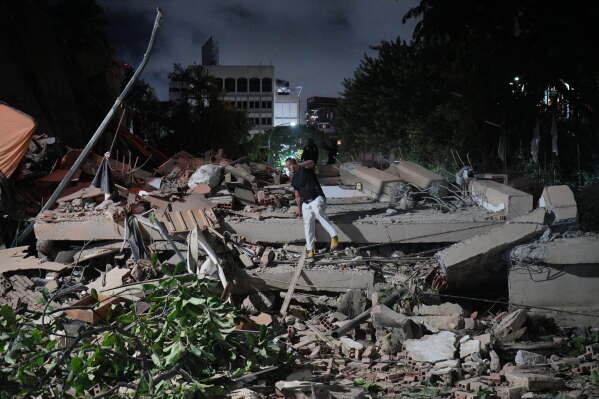
Caracas, Venezuela (AP) — Two powerful earthquakes shook Venezuela on Wednesday evening, leading to widespread panic among residents as buildings collapsed across the country. Acting President Delcy Rodríguez announced a state of emergency during a national address on Wednesday night, detailing the earthquakes’ impact without reporting the number of casualties or the specific extent of damage to buildings and homes.
The earthquakes, measuring 7.2 and 7.5 in magnitude, occurred shortly after 6 p.m. These were among the most powerful quakes to hit Venezuela in over a century. Residents evacuated buildings in various cities, with the effects felt as far away as the Brazilian Amazon, located about 1,700 kilometers (1,050 miles) from Caracas.
Damage led to the closure of Simón Bolívar International Airport near Caracas, as Rodríguez reported. Subway and gas services in the capital were also halted. Venezuelans were encouraged to report damage using a government app, and schools were temporarily suspended, with certain school facilities repurposed as shelters and donation centers.
“We urge our population to remain calm,” Rodríguez stated, asking healthcare providers to assist the injured. “We urge unity.”
Details of the Earthquakes
The U.S. Geological Survey initially reported the first earthquake at a 7.1 magnitude, later revising it to 7.2. The epicenter was located west of Morón on the Caribbean coast, approximately 168 kilometers (104 miles) west of Caracas, at a depth of 22 kilometers (13.6 miles). A second, even larger earthquake measuring 7.5 occurred moments later, with a depth of 10 kilometers (6.2 miles) and centered 16 kilometers (10 miles) southwest of Morón.
In Falcon state, Governor Víctor Clark revealed that 32 people were hospitalized, with 15 individuals trapped after the earthquake.
International Support
Numerous countries offered aid, including the United States, Argentina, Bolivia, Brazil, Chile, Ecuador, El Salvador, Mexico, Panama, and Uruguay. Jeremy P. Lewin from the U.S. State Department stated a disaster assistance team and task force were mobilized to send search-and-rescue teams, plus medical and humanitarian supplies, in cooperation with the interim Venezuelan government.
El Salvador’s President Nayib Bukele, who had previously opposed Venezuela’s government, expressed support and prayers via social media. Ecuador’s President Daniel Noboa committed to sending rapid humanitarian aid, citing humanity as a guiding force in leadership. Bolivian President Rodrigo Paz, having recently declared a state of emergency domestically due to protests, assured Bolivia’s readiness to provide assistance. Brazil also expressed solidarity, noting no Brazilian casualties.
Scenes from Caracas
People evacuated swaying structures in Caracas, visibly stunned as some buildings collapsed, leaving interior views exposed to the street. Dust clouds were visible in areas typically bustling with business activities. Residents gathered on the streets holding pets while debris littered the roads, disrupting power and cellphone signals.
“It started off gently and then gradually grew, leading everyone to leave their homes and gather outside,” described Hector Ricci, a local.
Roberto Gamas, another resident, recounted the building’s intense side-to-side swaying during the quakes. The temporary loss of cellphone service exacerbated worries, particularly among those affected by the country’s ongoing crisis.
Venezuela’s opposition leader María Corina Machado, in exile, sent messages of solidarity, promoting unity and strength.
Widespread Impact
Venezuela’s Interior Minister Diosdado Cabello noted that the quakes were felt in various states, urging drivers to yield to emergency vehicles. Numerous buildings collapsed in the Altamira area, suggesting injury occurrences. He appealed to residents to remain outdoors due to potential aftershocks.
“Please be cautious regarding children and the elderly. Contact each other to ensure safety,” he advised.
Regional Effects
In Brazil’s Amazon, buildings were evacuated in Manaus, Belem, and Macapá. While the quakes reached Colombia’s Caribbean and northeast regions, no damage or injuries were reported. The U.S. Pacific Tsunami Warning Center issued and promptly revoked tsunami alerts following the earthquakes.
Strong earthquakes are rare in Venezuela, despite its geographic location near multiple fault lines between the South American and Caribbean plates. This contrasts with other Latin American locations such as Mexico and Chile, known for frequent seismic activities along the Pacific Ring of Fire.
Associated Press contributions came from various reporters in Colombia, Brazil, Argentina, and Mexico.
 British Police Arrest Man Suspected of Terror Plot
  Activists Push for Nationwide Ban on Child Marriage in the U.S.
  Investigation into Alleged Incident at Cornell University
  Rising Drone Threats Highlight Vulnerabilities in Moldova’s Airspace Defense
  Bolivia Faces Security Test Amid Unrest
  Incident on FlyDubai Flight Raises Security Concerns