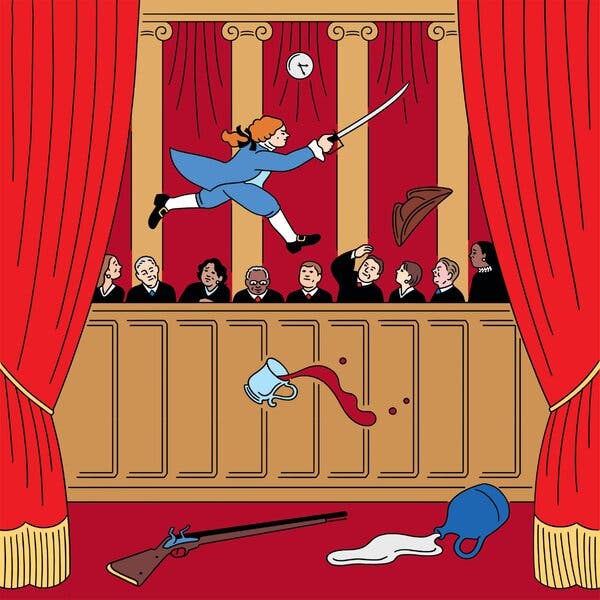
In a recent Supreme Court term filled with unexpected developments, one issue did not receive the attention it deserved. This term marked a period where the court’s emphasis on originalism veered into the realm of parody.
Originalism, a method of constitutional interpretation introduced during the Reagan era, aims to restrict judicial decisions to the confines of historical context. Justice Brett Kavanaugh once encapsulated this concept by stating, “History is far less subjective than policy.” His comment was intended to clarify why only “history and tradition,” not contemporary conditions, should justify restrictions on the Second Amendment right to “keep and bear arms.”
Objective History: A Myth?
The question of how objective history truly is can be illustrated through a practical example. Consider a young man living with his parents in Dallas. He has a steady job and, like many Texans, owns a gun at home. He also occasionally uses marijuana. Under federal law, specifically Section 922(g)(3), it is illegal for a user of a “controlled substance” to own a firearm. This infraction carries a potential prison sentence of up to 15 years.
When the government chooses to prosecute, they must rely on the “history and tradition” required by Supreme Court precedents to counter the young man’s invocation of the Second Amendment. The Bruen decision of 2022 clarified that “historical tradition” doesn’t pertain to the era during which a contested regulation was enacted, which in this instance, is 1986.
Challenges in Historical Tradition
The essence of the Bruen decision is that the government must reference an analogous regulation from the founding era of the country, or possibly from 1868 when the 14th Amendment, applying the Bill of Rights to the states, was adopted. Marijuana use in the United States was not prevalent in 1791 when the Second Amendment was incorporated into the Constitution, nor in 1868. This historical context puts the government in a challenging position.
In a creative attempt, government lawyers unearth “habitual drunkard” laws from the 18th and 19th centuries. These state laws typically removed visibly intoxicated individuals from public spaces, sending them to workhouses or jails where firearms were inaccessible. But is this the most relevant comparison the federal government can offer to legitimize a contemporary gun law?
 The Trump Team’s Challenge to the Military Leadership
  Maryland First State to Restrict Electronic Pricing in Grocery Stores
  Activists Push for Nationwide Ban on Child Marriage in the U.S.
  Democratic Hopes and Historical Warnings in 2026 Senate Race
  Republicans Face Challenges Amidst Cost of Living Concerns
  A Different Kind of Fall for Congress This Year