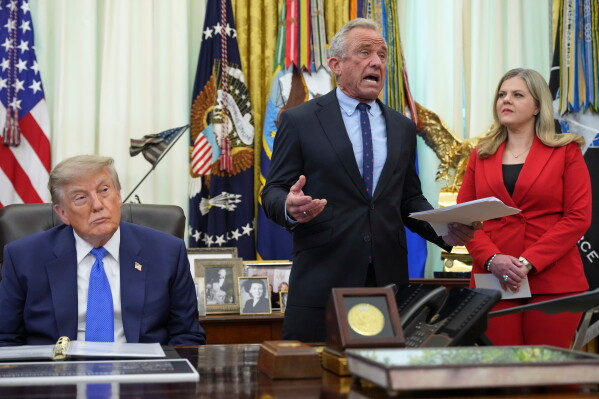
Washington (AP) — Dr. Heidi Overton, a senior White House aide, has been nominated by President Donald Trump to head the Food and Drug Administration (FDA). Overton, a medical doctor and deputy director of the White House Domestic Policy Council, has been actively involved in Trump’s health initiatives during his second term. She has gained trust within the administration and stands as a strong advocate for the president’s objectives.
If her nomination is confirmed by the Senate, Overton will face a challenging mix of priorities. These include Trump’s specific interests, the deregulation goals of traditional Republicans, and the anti-corporate stance of Health Secretary Robert F. Kennedy Jr. These competing aims have previously challenged the former FDA head, Dr. Marty Makary, who resigned in May, leaving several projects unfinished. Key issues such as ultraprocessed foods, antidepressants, and COVID-19 vaccinations remain unresolved.
President Trump expressed his support for Overton, describing her as a smart and respected leader who would focus on faster cures, innovation, reduced drug prices, and promoting Kennedy’s “Make America Healthy Again” initiative. Kennedy praised her judgment, professionalism, and commitment.
Overton’s educational background includes medical school at the University of New Mexico and a doctoral degree in clinical investigation from Johns Hopkins University. Prior to her current role, she was the chief policy officer at the America First Policy Institute, a conservative think tank.
Recently, Overton has been prominently involved in announcing substantial projects with the president. These include “most favored nation” deals with drug companies to reduce prices and controversial vaccine orders, which aim to separate the combined measles, mumps, and rubella (MMR) vaccine into three distinct immunizations, against medical advice. She supported Trump’s claims that vaccine timing may contribute to rising rates of autism spectrum disorder, despite extensive scientific studies disproving this.
Overton has also expressed opposition to abortion pills. Her confirmation could lead to rollbacks of FDA rules that have increased accessibility to these medications. U.S. abortion opponents view the widespread prescription of these pills online as undermining state abortion bans.
To be confirmed, Overton will require approval from a narrowly Republican-led Senate and will face scrutiny from the Senate Health, Education, Labor and Pensions Committee, chaired by Republican Sen. Bill Cassidy. Cassidy, a physician, has criticized Trump’s vaccine policies.
Democratic senators have publicly criticized Overton’s nomination. Sen. Patty Murray labeled her a “far-right, anti-abortion extremist” unfit to lead the FDA.
Makary’s departure left the FDA with unresolved challenges, including the issue of flavored e-cigarettes. These products are aimed at adult smokers but are blamed for teenage vaping trends. Although the FDA has been hesitant to endorse flavored vapes, it recently opened a path for unauthorized electronic cigarettes and nicotine products, bypassing expert opinions.
Biotech companies have also faced obstacles with the FDA under Makary’s tenure. Complaints arose from companies, investors, and patient groups about rejections or reversals of drugs for rare diseases. Makary attempted to streamline drug approvals but faced challenges in the implementation of new programs.
Several deputies within the FDA have resigned, citing the growing pressures and critiques from industry stakeholders. Changes in leadership aim to address these concerns and streamline regulatory processes.
If confirmed, Overton will need to align with Kennedy’s health movement priorities. Activists within the movement, like Kelly Ryerson, have expressed skepticism about Overton’s alignment with corporate interests, citing her participation in meetings promoting Bayer’s stance on pesticides.
Upcoming decisions for the next commissioner include peptide regulation, which has received mixed recommendations from Kennedy’s appointed advisors. Additionally, the FDA is working on a new definition for ultraprocessed foods, which are blamed for rising rates of chronic health conditions.
Kennedy’s leadership has seen increased regulatory hurdles for vaccines and resistance to publishing COVID-19 vaccine effectiveness studies. The FDA is also reviewing the risks associated with antidepressants during pregnancy, a focal point of Kennedy’s past advocacy.
Recently, the FDA has been dealing with foodborne illness outbreaks linked to contaminated produce. These incidents highlight the ongoing challenges faced by the agency in ensuring public health and safety.
This report was contributed by Swenson from New York and Associated Press journalist Laura Ungar from Louisville, Kentucky.
Note: The Associated Press Health and Science Department is supported by the Howard Hughes Medical Institute’s Department of Science Education and the Robert Wood Johnson Foundation. The AP maintains sole responsibility for all content.
 Sen. Cotton Opposes Permanent Daylight Saving Time
  Steve Hilton’s Latino Outreach and Gubernatorial Ambitions
  The Need for Reform in Presidential Nominations
  Controversy Surrounds Performances at Gillette Stadium
  Early Detection of Atherosclerosis and Heart Disease Prevention
  Celebrity Controversies Over Political Activism and Speech