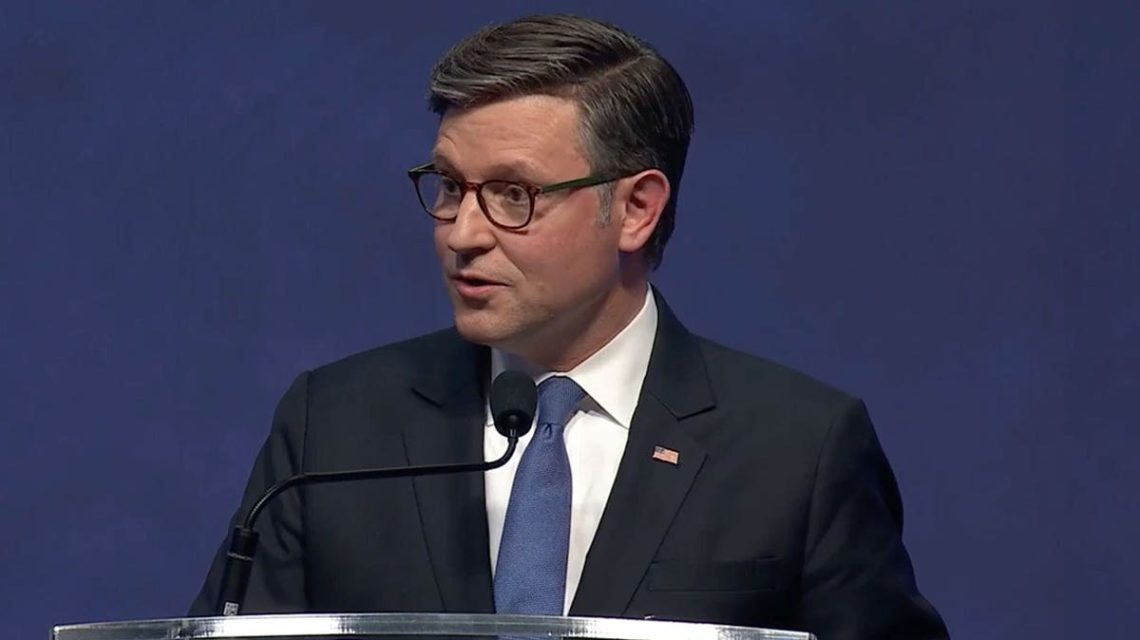
House Speaker Mike Johnson, R-La., refrained from supporting an emergency halt to artificial intelligence development on Sunday. While speaking during CNN’s “State of the Union,” he highlighted the risk that halting American innovation presents, especially given the potential for China to gain a technological advantage.
“We should avoid Congress imposing an emergency moratorium,” Johnson emphasized. “I propose that leaders and providers of AI platforms should collaborate with us to find a balanced approach. We cannot afford a moratorium because China might surpass us.”
Amy Kremer, Republican National Committee member and Humans First chairwoman, spoke with Fox News Digital. She suggested that while establishing safeguards is essential, the U.S. should maintain its technological edge over Beijing. “We need guardrails to protect Americans without stifling innovation,” she stated. “This includes ensuring the safety of children, workers, and national security while ensuring the U.S. remains ahead in the AI space.”
Kremer has been outspoken against the rapid proliferation of AI data centers. She recommends that Congress allow state and local authorities to retain control over essential infrastructure. The Humans First movement advocates for opposing blanket data-center moratoriums and supports local decision-making while opposing eminent domain for AI projects.
Kremer remarked, “Massive data centers should not strip state and local authorities of control. Communities affected by these projects should have a say in their location, and transparency about the companies involved is critical.”
The conversation around AI heightened when Anthropic CEO Dario Amodei recommended slowing development of advanced AI models. He was supported by xAI founder Elon Musk and OpenAI CEO Sam Altman. Amodei emphasized the need for a measured approach, stating, “We need to slow down AI model advancements. Progress will remain swift, so it’s crucial we use this time wisely.”
Former President Donald Trump dismissed calls for a slowdown during his remarks in Ireland. He stressed the importance of U.S. dominance in the AI sector, framing it within the context of competition with China.
The infrastructure demands for AI growth have become a public concern. A Fox News poll in July revealed 70% of registered voters opposed local AI data center construction.
To address these concerns, the Trump administration promoted the Ratepayer Protection Pledge. This initiative ensures AI firms cover their associated electricity costs instead of passing them onto consumers. Currently, it safeguards 80% of the electricity supplied to American homes and businesses.
Kremer reiterated the need for consumer protection beyond just electricity pricing. “Americans shouldn’t subsidize Big Tech with higher bills, tax incentives, eminent domain, or the loss of farmland,” she argued.
Mike Johnson proposed convening major AI executives and policymakers to discuss national security and safety issues. Suggesting the White House as a venue for these discussions, Johnson said, “We need everyone in one room at the White House to resolve this. I’ll advocate for these conversations.”
 The Trump Team’s Challenge to the Military Leadership
  Maryland First State to Restrict Electronic Pricing in Grocery Stores
  Activists Push for Nationwide Ban on Child Marriage in the U.S.
  Democratic Hopes and Historical Warnings in 2026 Senate Race
  Republicans Face Challenges Amidst Cost of Living Concerns
  A Different Kind of Fall for Congress This Year