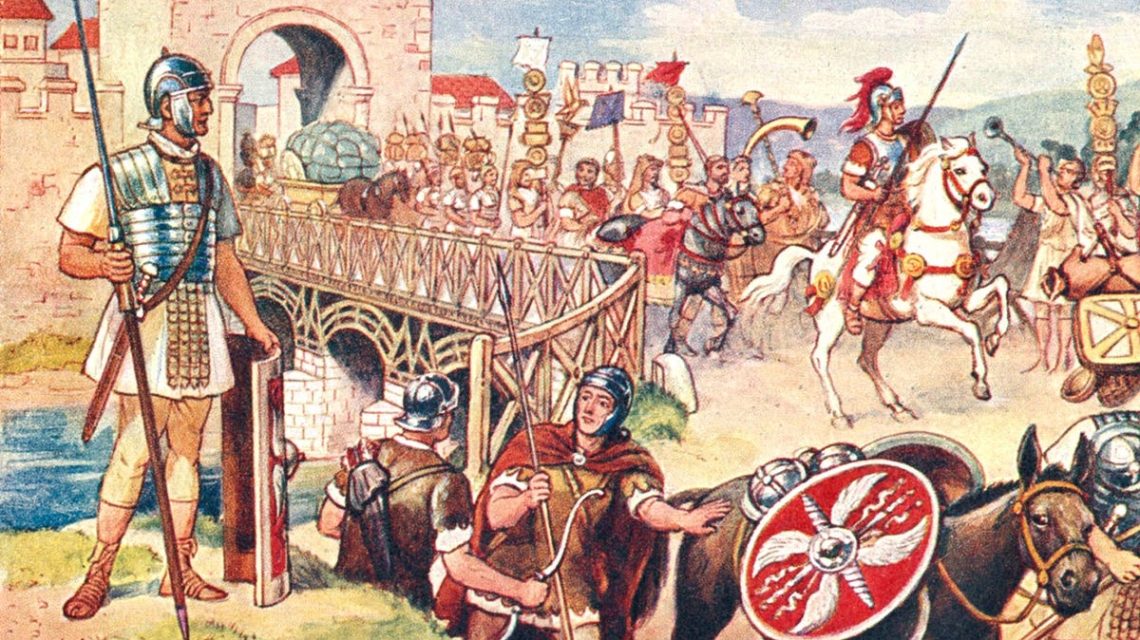
A new study published in Nature Communications is challenging the notion that “All roads lead to Rome.” The research analyzed approximately 190,000 miles of Roman roads across Europe, the Middle East, and North Africa. The team created an updated map to examine the Roman Empire’s road network.
Construction workers clearing old bombs unexpectedly find ‘important’ ancient sanctuary
during the study’s data collection phase.
Tom Brughmans, the study’s lead researcher and classical archaeologist at Aarhus University in Denmark, found provincial capitals were pivotal in overland travel, not just Rome. Constantinople, now Istanbul, Turkey, became a central hub after becoming the imperial capital in the fourth century A.D.
Constantinople’s geographic location between Europe and Asia facilitated travel across the empire, thus disputing the old phrase coined after the empire’s fall.
Ancient clue cracks open a 2,000-year-old mystery near famed Colosseum
during research efforts.
Brughmans emphasized the proverb’s medieval origins and cautioned against taking it literally. He noted the absence of routes directly connecting Roman Britain to Rome. He stated, “It is quite surprising how persistently this maxim has shaped popular understanding of Roman roads.” He prefers to view them as leading “to Rome and everywhere else.”
Taco Terpstra, history and classics professor at Northwestern University, argued that Rome’s significance as the empire’s center remains undiminished by these findings. He noted that Constantinople, initially a fishing village called Byzantium, gained prominence only when it became the capital.
Terpstra affirmed Rome’s role as the empire’s political, military, and ideological core, highlighting its population of a million compared to Alexandria’s half a million.
Rare pagan masterpiece emerges near where St Paul spread teachings of Christianity
while analyzing Roman engineering feats.
Historical analysis showed roads in the vast empire were built as straight as technology and terrain allowed. Although intended initially for military purposes, these roads later acquired economic significance.
According to Terpstra, “The roads in the first instance were military infrastructure.” They facilitated swift troop movement post-conquest and played a vital economic role.
Despite their enduring legacy, Roman roads were secondary to maritime transportation, which offered more economical goods transport across the empire.
 Possible 19th-Century Shipwreck Exposed by Nor’easter in Nantucket
  Midwest Underground Railroad Network Gains National Recognition
  Art Collective Critiques Administration with Mall Installation
  American Hagwon: A Tale of Family and the Korean Diaspora
  Volunteer Enthusiasm Shines at Frank Lloyd Wright Home and Studio
  Bible’s Role in Times of War