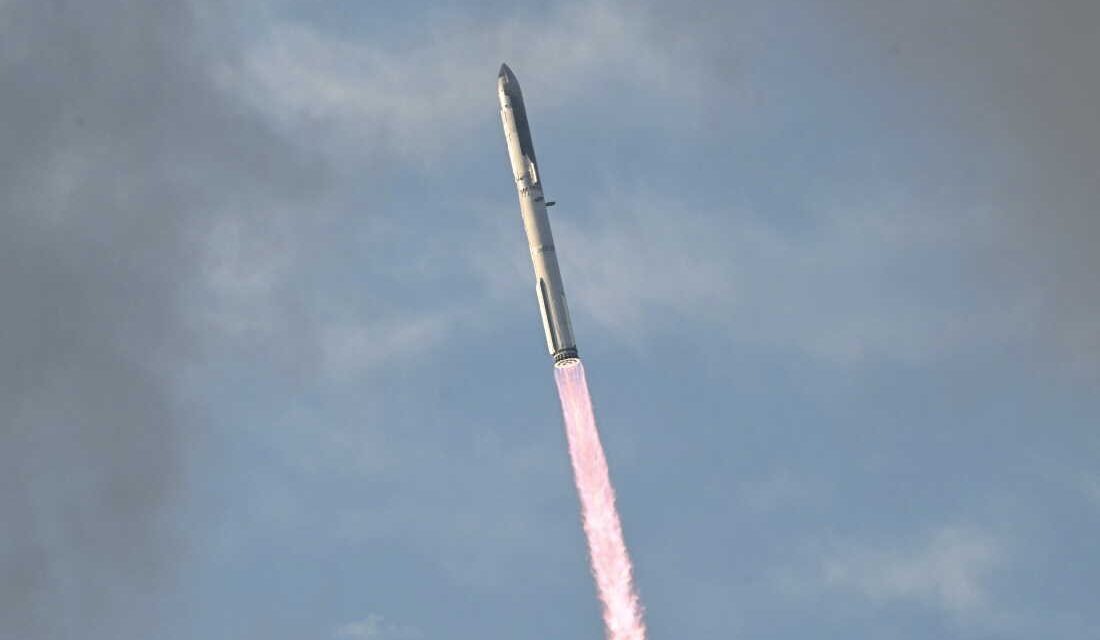
SpaceX’s Starship Flight 14 launched from the company’s Starbase facility at Boca Chica Beach, Texas, marking its first orbital mission. The 171-foot-tall spacecraft, equipped with a Super Heavy booster, ignited its 33 rocket engines at 7:48 a.m. CT on Monday.
Two-and-a-half minutes into the flight, Starship separated from the booster and continued its journey into space. Though one of the six engines on Starship failed during ascent, SpaceX determined it was safe to proceed with the orbit at around 22 minutes into the flight.
The Super Heavy booster, designed for reusability, typically returns to its launch site to be caught by the launch tower. However, during this flight, it simulated a landing offshore in the Gulf of Mexico while SpaceX tested upgrades to its software and hardware.
This unmanned mission features a 10-hour flight plan, including approximately six orbits around the Earth at an altitude of around 170 miles. Previous Starship flights were suborbital, with Flight 14 now achieving orbital speeds up to 17,500 mph.
During the flight, SpaceX intends to deploy 26 Starlink V3 satellites, further expanding its constellation that provides global broadband access. While SpaceX typically launches Starlink satellites using Falcon 9 rockets from Florida and California, plans are underway to use Starship for Florida launches.
Assuming Monday’s mission proceeds as planned, Starship is scheduled to splash down in the Pacific Ocean off the Chilean coast. Though SpaceX ultimately aims to recover and reuse the spacecraft, this flight tests key systems, such as Starship’s heat shield. Three Starlink satellites equipped with cameras will collect data on the spacecraft’s re-entry.
Starship’s success is crucial for SpaceX’s growth strategy, as noted in filings to the FEC before its IPO in June. A statement in the filings highlights the importance of Starship’s development in maintaining growth momentum.
Besides commercial applications, Starship is pivotal to NASA’s lunar ambitions. The agency has partnered with SpaceX to develop Starship as a human landing system for Artemis missions aimed at returning astronauts to the moon.
NASA plans to test the docking capability of its Orion space capsule with Starship, alongside a lander designed by Blue Origin during Artemis III, scheduled for late next year.
SpaceX announced intentions to construct an extensive facility in Louisiana as part of a $100 billion investment. This plan includes multiple launch pads, with Starship launches from Louisiana expected to commence in 2029.
 Pentagon Confirms US Possession of Space Weapons Amid Rising Tensions
  Countering Fear: A Pilot’s Approach to Calm Nervous Flyers
  Challenges in Establishing a Unique Identity for the United States Space Force
  NASA Launches Major Space Telescope for Cosmic Exploration
  NASA’s Roman Space Telescope Embarks on Mission to Unravel Cosmic Mysteries
  President Trump Establishes U.S. Space Academy to Train Future Space Professionals