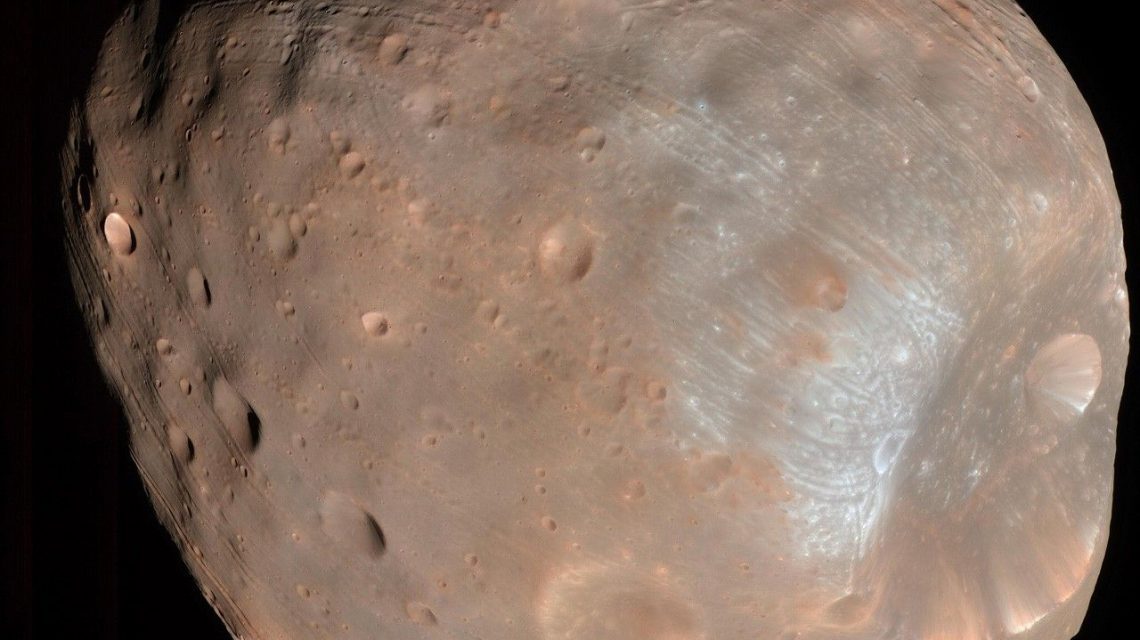
A Japanese spacecraft launched towards Mars on Tuesday as part of a groundbreaking mission to study its moons and return samples. Five international space agencies collaborate for this five-year journey. The plan involves landing a robotic prospector and a rover on Phobos, the larger of Mars’ two moons. The Japan Aerospace Exploration Agency leads this daring effort, with the spacecraft taking off from Tanegashima Island.
NASA has landed nine spacecraft on Mars, while China achieved a touchdown in 2021. However, no space agency has landed on Phobos or Deimos, nor collected samples from Mars or its moons. If successful, Phobos samples could reach Earth by 2031. NASA astrophysicist Tom Statler, involved in the project, describes it as filled with excitement.
Japan has prior experience with asteroid sample returns. This mission, called MMX (Martian Moons Exploration), is a $578 million endeavor featuring a 5-ton spacecraft set to arrive at Mars by late next summer. It will align with Phobos’ orbit before deploying a rover named Idefix.
Idefix, a small rover, will independently land on Phobos. With low gravity, it may bounce before settling. The rover is designed to right itself if it lands upside down, a crucial feature given potential terrain challenges. Julien Baroukh of the French Space Agency notes that once the solar panels deploy, the rover moves at only 1 millimeter per second, enhancing safety exploration on Phobos. The rover will scout for 100 days to identify safe landing zones for the mothership.
The mothership will briefly land on Phobos to collect samples in 2028 or 2029. It aims to gather at least one-third of an ounce of material before returning to space. The mission includes studying Deimos via flybys before returning to Earth by 2031, with an Australian desert landing planned for the samples.
Phobos and Deimos’ names mean ‘fear’ and ‘dread’ in Greek, respectively, named after Ares’ sons in mythology. Past missions faced challenges; Japan previously failed to orbit Mars, and Russia experienced setbacks with its Phobos attempts. The mission seeks to uncover origins, suggesting Phobos and Deimos may have formed from a collision or are captured asteroids. Discoveries could reveal insights into planetary formation and the conditions potentially leading to life.
The mission will also influence future Mars expeditions, including those involving astronauts, according to NASA’s Lindsay Hays. Markus Grebenstein of the German Space Agency underscores the mission’s uniqueness as the first Mars system sample return.
China plans a Mars sample mission in 2028, with NASA evaluating options for retrieving samples from its Perseverance rover. Both Japan and China aim to return samples by 2031.
Financial contributions include $350 million from Japan, $87 million from NASA, $68 million from the French Space Agency, $56 million from the German Space Agency, and $17 million from the European Space Agency.
 Global Helium Shortage Amid War in Iran
 Impact of 2010 Deepwater Horizon Spill on Gulf of Mexico Marine Life
 Ancient Ring Discovery in Submerged Harbor of Cleopatra
 Meta’s Settlement and AI’s Impact on Children’s Development
 Help Name the Feisty Red Panda Cub at the National Zoo
 Expedition Seeks Evidence of Amelia Earhart’s Missing Aircraft