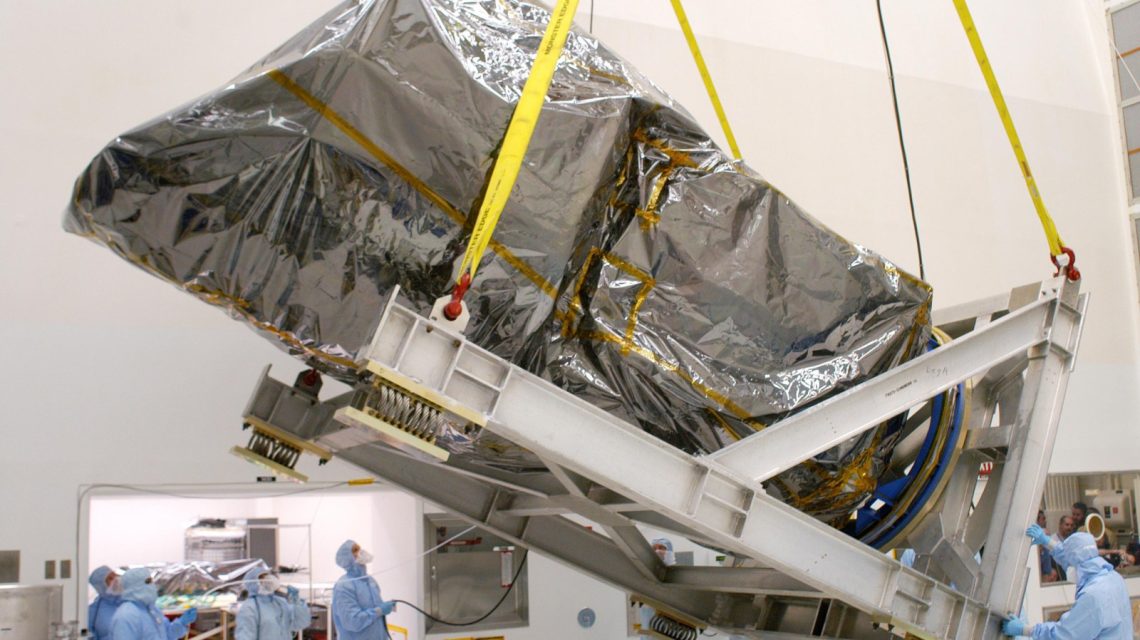
The Swift Observatory, a NASA space telescope, is nearing the end of its two-decade mission and is expected to re-enter Earth’s atmosphere soon. This event raises concerns about potential debris surviving the intense descent and where it might land.
Re-entry Predictions
According to the U.S. Space Force, Swift’s re-entry is anticipated around Friday, following accelerated orbital decay caused by heightened solar activity. While most of the 1.5-ton spacecraft is expected to burn upon re-entry, NASA suggests that denser components, like tungsten parts and mirror segments, may survive and reach Earth’s surface.
Predictions indicate that any remaining debris will likely fall into the ocean. However, pinpointing the exact location remains difficult. The potential impact zone spans across vast regions, including parts of Africa, Australia, India, Southeast Asia, Central America, and South America. Due to atmospheric variations affecting a satellite’s path, precise predictions are typically confirmed only in the final hours before re-entry.
Failed Rescue Attempt
The imminent descent of Swift follows an unsuccessful rescue mission devised by NASA. The agency contracted Katalyst Space to deploy a robotic spacecraft named Link, aiming to adjust Swift’s orbit. Technical complications thwarted the rescue, leaving Swift to continue its descent toward Earth. Solar activity exacerbated the situation, as it heats and expands Earth’s upper atmosphere, creating additional drag on satellites in low-Earth orbit.
Swift’s Legacy of Discoveries
Launched in 2004, Swift Observatory played a crucial role in studying gamma-ray bursts, some of the universe’s most potent explosions. Throughout its 22-year service, Swift detected over 2,000 gamma-ray bursts and approximately 1,400 supernovae. It also provided valuable data on black holes, comets, and asteroids, acting as an early-warning system for major observatories like the Hubble Space Telescope and the James Webb Space Telescope.
The mission concluded in late October when the observatory descended too low for stable observations, leading mission controllers to shut down its systems. Swift’s achievements mark a significant chapter in NASA’s astrophysical research.
 Scientific Debate Surrounds Mysterious Object Near the Sun
 Voyager 1 Reaches Light-Day Distance from Earth
 The Value of Kindness: New Research Insights
 SS United States Transformed into World’s Largest Artificial Reef
 Mini-Moon 2026 QQ8 Temporarily Orbits Earth
 California Approves Proposition 38 for Health Research Funding