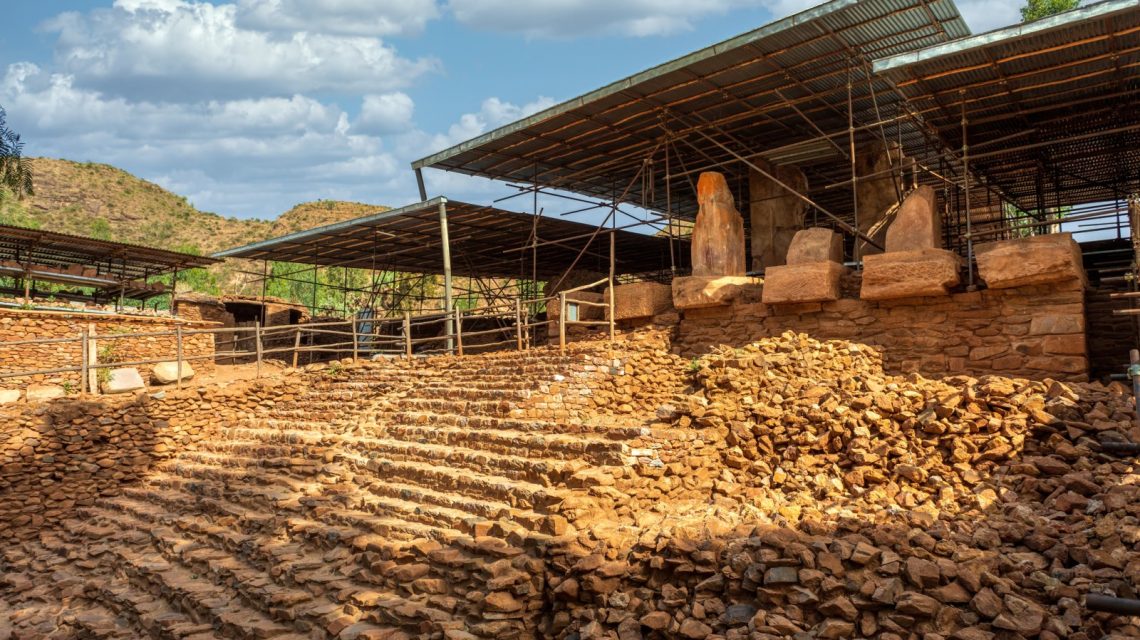
New findings about a palace in Ethiopia, dating back 2,800 years, suggest it may have reached dimensions similar to skyscrapers. This research, led by the German Archaeological Institute and Brandenburg University of Technology Cottbus-Senftenberg, focused on the Grat Be’al Gibri palace in the Ethiopian-Eritrean highlands.
Largest Known Palace Complex
The Grat Be’al Gibri palace, built around 800 B.C., is considered the largest palace complex of its era in South Arabia and East Africa. It covers approximately 60 by 60 meters, or over 196 feet. Unfortunately, a fire destroyed much of the palace in antiquity, leaving only parts of its ground floor and podium.
Construction Techniques and Materials
The palace utilized rubble masonry combined with clay mortar and reinforced by horizontal timber beams. Professor Davide Tanasi from the University of South Florida highlighted that this method was already established technology in Yeha and the broader region. A recent study employed a 3D model to analyze the wall sections’ load-bearing capacity using the finite element method.
Engineering Analysis and Historical Forms
The findings suggest this system had remarkable load-bearing capacity, indicating the architectural prowess exceeded what remains of the ground floor. The study connected ancient accounts of multi-story structures, providing the first engineering analysis to support such claims.
Tanasi emphasized the significance of these findings, offering a quantitative assessment of a recognized complex construction system. The study surmised the wall system could have supported at least 19 floors, marking the palace as potentially skyscraper-like.
“This would have meant that the Palace of Yeha could well have reached skyscraper proportions,” BTU reported.
Clarifications and Cautions
Historians clarify, however, that a wall’s capacity to carry 19 floors differs from the building standing 19 floors high. The reference pertains to the structural load factor in the engineering model. Konadu and Tanasi expressed caution when referring to this palace as a skyscraper in modern contexts.
Impact on Historical Narratives
This research challenges older narratives positioning Arabia as the origin of such construction techniques. Konadu emphasized the long-standing local traditions in monumental building evident in the region’s architecture, including palaces and townhouses.
Tanasi remarked that this study expands our understanding and indicates advanced engineering was not exclusive to regions like Egypt or Rome but also present in the Ethio-Sabaean world.
Advanced Engineering Methods
Martin Drieschner of BTU noted that modern techniques, like finite element methods, are applicable to ancient structures. This use of numerical simulation underscores the method’s versatility beyond traditional civil engineering.
 The Threat of Melting Glaciers: A Call to Action
  Climate-Resistant Rock Glaciers: Hidden Water Resources
  California Voters to Decide on $7.5 Billion State Research Fund
 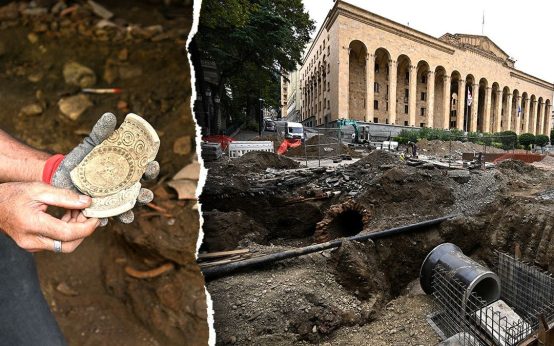 Ancient Pottery Unearthed During Roadworks in Tbilisi
  U.S. Space Academy Announcement
  The Need for New Strategies in Oregon’s Wildfire Management