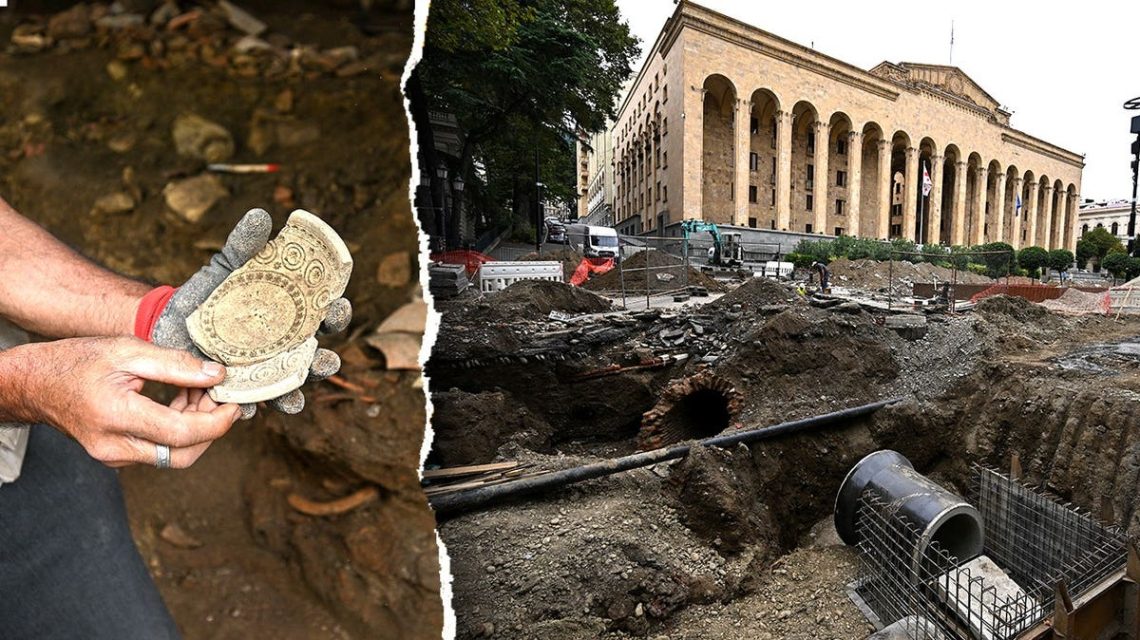
Workers renovating a busy city boulevard in Tbilisi, Georgia, made a surprising discovery: a cache of ancient pottery, dated to around 1,000 years ago. These artifacts were found approximately 20 feet beneath Rustaveli Avenue, Tbilisi’s main street.
“Tbilisi is very rich with archaeological material… so it’s very logical to find workshops of different periods,” said David Lordkipanidze, director of the Georgian National Museum.
Pictures showcase archaeologists examining intricately decorated pottery fragments, jugs, and various shards. The roadwork forms part of a larger initiative to enhance Rustaveli Avenue with pedestrian crossings and improved signage.
Labeled items suggest the pottery dates back to the 10th and 11th centuries, when Tbilisi fell under Arab rule. This period also marked the city’s role as a crucial hub along the Silk Road. Further analyses, including 3D scanning, aim to accurately pinpoint the artifacts’ age.
Tbilisi, founded in the fourth century, has a rich history, having been under the control of various powers like Mongols, Persians, Russians, and Arabs during the Middle Ages.
The discovery in Tbilisi aligns with global incidents where construction work reveals ancient shrines and burial sites.
In Italy, highway construction uncovered fifth-century B.C. sanctuary remains, prompting archaeological scrutiny. Similarly, Peruvian utility workers unearthed pre-Incan tombs dating from 1000 to 1470 A.D. while digging trenches for gas networks.
 Rabbi and Jewish Leaders Criticize Adam Brody for ‘Genocide’ Comment
  Flydubai’s Emergency Landing Highlights Cockpit Security
  Former Israeli PM Naftali Bennett Commends Passengers and Crew for In-Flight Heroism
  Diplomatic Complexities Unfold at U.S. National Archives Visit
  Russia’s Nuclear Threats Amid Tensions with the UK
  Future Cities: Ambitious Projects Aiming for Innovation and Sustainability