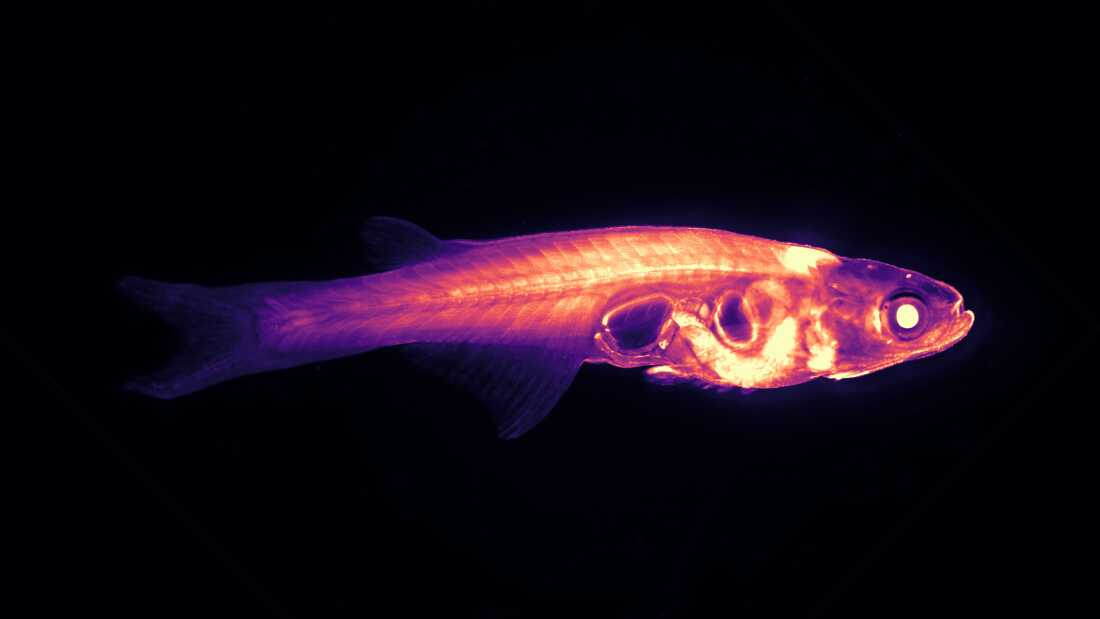
Researchers have found a unique way to explore the brain thanks to fluorescent proteins seen inside the transparent Danionella fish. These proteins allow scientists to observe processes within the fish’s brain and body. Researchers at a leading brain science center aim to uncover new insights into the connection between brain function and behavior by studying Danionella fish.
High Stakes for Brain Science
The Howard Hughes Medical Institute’s Janelia Research Campus, located near Washington, D.C., is investing considerable resources on this small, transparent fish. The institute has introduced a project using artificial intelligence combined with Danionella to understand how the brain controls complex behaviors such as social interaction.
Gerry Rubin, Janelia’s founding executive director and biology head, describes this initiative as a significant but worthwhile risk. The campus will expand the space for fish to 6,000 square feet, accommodating thousands of tanks. The number of scientists working with Danionella is expected to grow from 10 to over 100. This effort aims to capture the entire fish brain’s real-time functioning to glean insights transferable to other species, including humans.
Nelson Spruston, Janelia’s executive director, notes the evolutionary connection between humans and fish, asserting that our brains share numerous structural features.
Advantages of Danionella
Among lab animals, Danionella offers certain advantages over typical species like rodents. Most species’ brains are concealed by a skull and skin, but Danionella lacks the top portion of its skull and has transparent skin. Despite being less understood than other models like zebra fish, scientists increasingly embrace Danionella cerebrum, a species recognized only in 2021.
Matt Lovett-Barron from the University of California, San Diego, emphasizes the utility of a clear-headed, transparent-bodied animal for neuroscience research.
From Fruit Flies to Fish
Previously acclaimed for its achievements with fruit flies, including mapping all 54.5 million neural connections in their brains, Janelia now aims to tackle a new challenge—deciphering the brain-behavior question. This question examines how physical processes like neuron activity trigger phenomena such as memory and decision-making, moving beyond studying isolated brain regions.
Understanding the entirety of brain functionality necessitates observing all neurons firing simultaneously, something facilitated by transparent Danionella, Rubins remarks. However, this project involves 3 times more neurons than in previous fruit fly studies, prompting the need for artificial intelligence to handle the vast data generated.
Developing New Scientific Approaches
Creating tools to facilitate research on Danionella is part of Janelia’s grand plan. Replicating fruit fly brain mapping in Danionella, developing AI partnerships for swift discoveries, and altering current practices like immobilization during studies are core efforts.
Spruston reveals a broader aim to conduct these studies on freely swimming creatures, requiring significant engineering breakthroughs.
Such advancements promise eager anticipation among Danionella researchers. Lovett-Barron points out potential benefits for investigating social behaviors in virtual environments involving virtual social partners.
Easier tools and techniques to monitor neuronal activities would expedite research, highlighting the long-term aspect orchestrated by O’Shea. She’s optimistic about understanding even one complex behavior like schooling in Danionella over the next decade.
Recent progress includes observing simultaneous neuron activity in larval zebra fish, laying the groundwork for scaling up for adult Danionella fish, brimming with about 650,000 neurons. This is a significant step toward the extensive human brain, which houses roughly 86 billion neurons.
 Climate-Resistant Rock Glaciers: Hidden Water Resources
  California Voters to Decide on $7.5 Billion State Research Fund
  Ancient Pottery Unearthed During Roadworks in Tbilisi
  U.S. Space Academy Announcement
  The Need for New Strategies in Oregon’s Wildfire Management
  Plastic Pollution in the Great Lakes: A Growing Concern