On Saturday, the Red Cross reported the deaths of three volunteers in the Democratic Republic of Congo. These individuals died after seemingly contracting Ebola while on duty in March. This central African nation, along with Uganda, faces a severe Ebola outbreak. The World Health Organization (WHO) has classified the situation as an international public health emergency.
The International Federation of Red Cross and Red Crescent Societies confirmed that the deceased volunteers belonged to the DR Congo Red Cross in Ituri. This northeastern province acts as the outbreak’s center. They worked for the Mongbwalu branch in Djugu territory.
Alikana Udumusi Augustin, Sezabo Katanabo, and Ajiko Chandiru Viviane are believed to have contracted the Ebola virus while performing dead body management activities on March 27. These were part of a humanitarian mission not directly linked to Ebola,stated the IFRC.
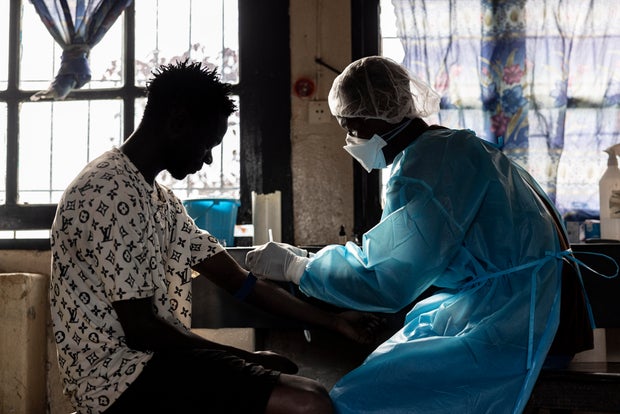
The community was unaware of the Ebola outbreak at the time of their intervention. These volunteers are among the outbreak’s first identified victims. A patient prepares for a blood test at the General Referral Hospital of Mongbwalu amid the Ebola response in the region as of May 20, 2026, according to a photograph by Michel Lunanga.
The IFRC reported one volunteer died on May 5, while the other two perished on May 15 and 16.
The Geneva-based IFRC honored the volunteers, stating, These volunteers lost their lives while serving their communities with courage and humanity. Their commitment reflects the extraordinary dedication shown every day by Red Cross volunteers working in complex and high-risk environments to support vulnerable people.
As the world’s largest humanitarian network, the IFRC, active in more than 191 countries with over 17 million volunteers, remains resolved to assist Ebola-affected communities. It is reinforcing efforts to address the outbreak.
On Saturday, the Africa Centres for Disease Control and Prevention expanded the list of high-risk countries. This list now includes Angola, Burundi, the Central African Republic, Ethiopia, Kenya, Rwanda, South Sudan, Tanzania, and Zambia.
In Uganda, authorities reported three new Ebola cases, raising the country’s total to five confirmed cases. The new cases included a Ugandan driver who transported the first confirmed case, a health worker exposed during treatment, and a Congolese woman entering Uganda with mild symptoms.
In DR Congo, there are 82 confirmed cases and seven deaths from Ebola. There are also nearly 750 suspected cases and 177 suspected deaths, as noted by the WHO.
Dr. Craig Spencer, public health professor at Brown University and former Ebola survivor, expressed concern over healthcare workers responding to the outbreak. Healthcare workers are the group that I’m really concerned about because they had very close contact with people when they’re most contagious, particularly around the time of folks’ death,
he noted.
Ebola spreads through direct contact with bodily fluids, leading to severe bleeding and organ failure. The outbreak involves the Bundibugyo virus strain, which has no approved vaccine or treatments.
The WHO recently raised the risk assessment level for Congo from high to very high. The regional risk remains high, while the global risk stays low.
 U.S. Monitors Russian Plague Scare
  Poland Prepares for Potential Conflict
  Guide to Choosing the Best Probiotic Powder for Gut Health
  Current Developments in the Iran Conflict and the Impact on Oil Markets
  Defeat Threatens Sánchez and His Leadership
  Tensions Surround Prince William and Prince Harry Amid Diana Anniversary Projects