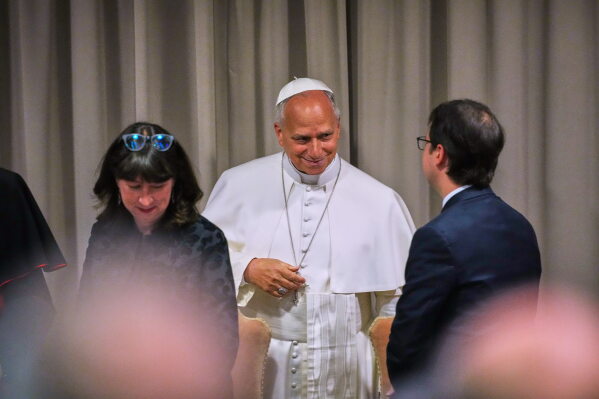
The Vatican has announced that Pope Leo XIV has initiated a study group on artificial intelligence. The group focuses on ethical concerns tied to AI deployment, prioritizing human dignity and peace. The decision underscores the church’s interest in how AI affects humanity, echoed by Leo’s latest encyclical, marking a significant development since Pope Leo XIII’s pivotal encyclical, “Rerum Novarum.” This document, pivotal at the onset of the Industrial Revolution, addressed workers’ rights and capitalist limits. Today, similar existential questions arise with AI.
The upcoming encyclical intends to frame the AI discussion within the church’s teachings on labor, justice, and peace. Meghan Sullivan, a philosophy professor at Notre Dame University, believes the church will play a critical role in ethical AI integration. Pope Leo has committed to sharing the church’s social principles on AI’s impact on dignity, justice, and work.
Soon, the encyclical’s release may create tension with U.S. policies under President Trump, who promotes rapid AI development for national strategies, rejecting global regulatory measures.
Trump’s recent visit to China, alongside tech leaders like Elon Musk and Nvidia’s CEO Jensen Huang, highlights the AI industry’s strategic importance. Huang secured U.S. approval to sell advanced AI chips to China, aligning with tech expansion goals.
Since the debut of ChatGPT, AI’s swift advancement prompts both amazement and concern over potential risks, from rogue AI to biased hiring systems. The UN has adopted new governance to address AI’s rapid growth, post unsuccessful attempts by several nations.
The Vatican seeks to lead ethical AI discussions, emphasizing that AI should augment, not replace, human judgment. Its guidelines cover sectors ranging from defense to healthcare. The church warns of AI’s environmental costs, specifically energy and water consumption.
Thomas Harmon, a theology professor, emphasizes the impact of the Catholic Church and its tradition in contemplating human nature, while addressing nearly 1.5 billion Catholics.
In 2020, the Vatican introduced the Rome Call for AI Ethics. Companies like Microsoft, IBM, and Cisco endorsed principles focusing on inclusiveness, accountability, and privacy. Pope Francis had proposed an international AI treaty to ensure technology aligns with human values like compassion and morality. He stressed to G7 leaders the necessity of human oversight on AI-used weapons.
Pope Leo XIV critiques AI’s influence on truth and reality in homilies and sermons. As an authoritative figure, the pope has reiterated the importance of truth within AI applications, questioning AI’s impact on perceiving reality and its role in scientific and healthcare advancements.
The pope is equally concerned about AI’s potential proliferation in global conflicts, such as those in Ukraine and the Middle East, where autonomous weapons change warfare dynamics, indicating a progression toward destruction.
This content is supported by Lilly Endowment Inc. through AP’s collaboration with The Conversation US, though AP is solely responsible for its content.
 Activists Push for Nationwide Ban on Child Marriage in the U.S.
  Investigation into Alleged Incident at Cornell University
  Rising Drone Threats Highlight Vulnerabilities in Moldova’s Airspace Defense
  Bolivia Faces Security Test Amid Unrest
  Incident on FlyDubai Flight Raises Security Concerns
  Journalist Gershkovich Discusses Wrongful Detention and Release in Russian Prisoner Swap