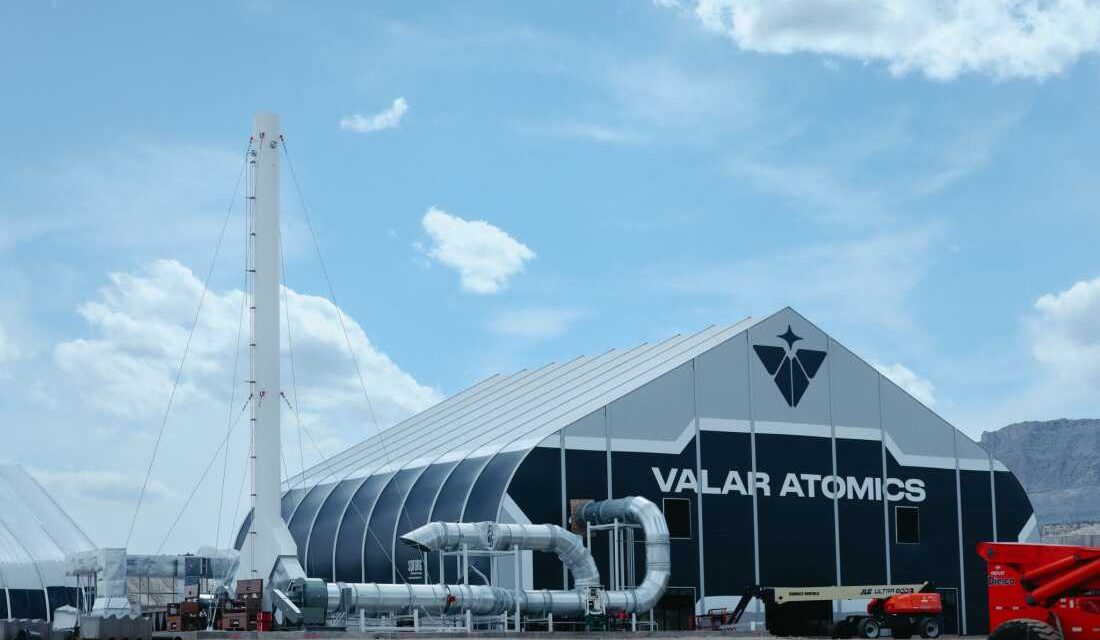
Valar Atomics emerged as one of the first companies to operationalize its new nuclear reactor in the Utah desert. The experimental reactor, housed in a tentlike structure, achieved critical status on June 18, indicating its activation in terms used in nuclear technology.
Over a year ago, President Trump set forth a strategic goal encouraging American companies to construct at least three experimental nuclear reactors by July 4, 2026, marking the 250th anniversary of American independence. This executive order led to the creation of the Department of Energy’s Reactor Pilot Program, aimed at streamlining the regulatory process for reactor development and testing.
This initiative has led to quick advancements in reactor technology, with two companies meeting the critical milestone. Antares Nuclear went critical on June 4, followed by Valar Atomics on June 18, both generating tens of kilowatts of heat from their newly operational reactor cores.
“We haven’t done anything this fast, basically ever,” Nick Touran from Ocean Atomics commented on the rapid progression in reactor development.
Aside from Valar and Antares, other companies prepare to meet the upcoming deadline. Touran, although not directly involved in the pilot program, monitors developments closely, believing this could reinvigorate the U.S. nuclear power sector.
While the program sparks enthusiasm among some, others express reservations, highlighting safety and regulatory challenges. Edwin Lyman of the Union of Concerned Scientists characterizes the initiative as public relations maneuvering. He points out that the drastic reduction in regulations reverses decades of advancements in nuclear safety.
Central to this initiative is the Department of Energy’s Idaho National Laboratory, where multiple companies, including Radiant, aim to build smaller, versatile reactors. Rita Baranwal from Radiant shared plans to test their reactor within a secure building known as the DOME, albeit not yet achieving critical status by the July 4 deadline.
Radiant plans to utilize innovative nuclear fuel in spherical forms resembling gobstoppers, enabling operations at higher temperatures with enhanced resistance to melting. This technology, along with other advancements, sets them on a path to produce around 50 reactors annually.
Accelerated development of these reactors comes with considerable implications. The Energy Department revamped its safety and security guidelines to expedite regulatory approvals, asserting that safety remains intact despite these changes. Public consultation on these amendments was notably absent, raising concerns among skeptics.
“If you bend all the rules, you can do things quickly,” Lyman warned, cautioning against loosening standards that ensure security and environmental oversight as small reactors become widespread.
 OpenAI’s Delay of GPT-6.1 Astra Driven by Security Concerns
  Bill Gates Warns Against Potential Risks of AI Technology
  Recent Technology Trends Shaping 2026
  Enterprise Transformation with Generative AI
  Data Centers and Community Divisions: The Growing Debate Across America
  From Hogs to Mushrooms: The Faaborg Family’s Transition to Sustainable Farming